Showing posts with label Writers and Writing. Show all posts

1.01.2012

“Jane’s Fame” by Claire Harman

Jane's Fame: How Jane Austen Conquered the World by Claire Harman Jane's Fame: How Jane Austen Conquered the World
Claire Harman
Henry Holt and Co.
2010
304 pp.

While I was tidying up the list of books I read in 2011 I noticed that I began the year with a short biography of Jane Austen, read the wonderful A Jane Austen Education in the summer, and finished the year with Jane’s Fame: How Jane Austen Conquered the World. Add to that a re-reading of Persuasion (my favourite) and much munching of popcorn in front of various film adaptations and the enjoyable Lost in Austen spinoff. This all happened without even trying, which just goes to show how ubiquitous Jane Austen has become. Jane’s Fame traces the development of Jane Austen’s popularity, which was by no means a sure thing in the beginning. She was nearly forgotten after her death in 1817, but a biography published by her nephew in 1869 revived interest in her, which prompted the reprinting of her books, and her renown steadily grew from there to today’s all-Austen-all-the-time proportions.

I found it interesting that for a long time the most ardent Janeites were male scholars. No doubt it only seems that way because they had the floor, but in any case her books were certainly not considered to be particularly for women until recently. She was also much-loved by soldiers in World War I, who read and discussed her books in the trenches to escape the hell they were going through. Austen was also prescribed to wounded and shell-shocked soldiers for comfort and solace in their convalescence or their last days.

Claire Harman points out that one of the reasons Austen is so easily appropriated by generation after generation of readers is that her books lack details of time and place that would make it seem dated or foreign to future readers. Apparently she did this quite deliberately and mentions it in her letters. Though some criticized her books for failing to mention the great events of the time, such as the French Revolution and Napoleonic wars, in retrospect she made the right choice if she wanted her works to be enduringly accessible. Two centuries later, references to contemporary issues and obsolete facts of life would only get in the way of the stories. Today’s writers might do well to question the conventional wisdom about describing the setting of a novel in vivid detail. People are people, whether they communicate by text message or penny post.

Jane’s Fame is quite a thorough examination of the reception of Austen’s books, and even describes the huge success of the recent film adaptations (including a discussion of the wet shirt), and mentions the most popular Austen blogs and web communities. Nothing is left out, as far as I can tell, though it is understandably UK-centric. If you want to know what people have thought about Jane Austen and her books over the last 200 years, this book will tell you. The tone is scholarly but with enough Austen-like wry humour to make it enjoyable.

After reading this book I realize that I have been remiss in not reading Austen’s unfinished novels, now called Sanditon and The Watsons, as well as the story Lady Susan. I even have a Penguin edition of them sitting on my bookshelf so I have no excuse. I believe that will be my first new book of 2012!

10.15.2010

2666: The Forest of Minor Works

“…I was a writer, I was a writer, but my indolent, voracious brain gnawed at my own entrails. Vulture of my Prometheus self or Prometheus of my vulture self, on day I understood that I might go so far as to publish excellent articles in magazines and newspapers, and even books that weren’t unworthy of the paper on which they were printed. But I also understood that I would never manage to create anything like a masterpiece. You may say that literature doesn’t consist solely of masterpieces, but rather is populated by so-called minor works. I believed that, too. Literature is a vast forest and the masterpieces are the lakes, the towering trees or strange trees, the lovely, eloquent flowers, the hidden caves, but a forest is also made up of ordinary trees, patches of grass, puddles, clinging vines, mushrooms, and the little wildflowers. I was wrong. There’s actually no such thing as a minor work. I mean: the author of the minor work isn’t Mr. X or Mr. Y. Mr. X and Mr. Y do exist, there’s no question about that, and they struggle and toil and publish in newspapers and magazines and sometimes they even come out with a book that isn’t unworthy of the paper it’s printed on, but those books or articles, of you pay close attention, are not written by them.

“Every minor work has a secret author and every secret author is, by definition, a writer of masterpieces. Who writes the minor work? A minor writer, or so it appears. The poor man’s wife can testify to that, she’s seen him sitting at the table, bent over the blank pages, restless in his chair, his pen racing over the paper. The evidence would seem to be incontrovertible. But what she’s seen is only the outside. The shell of literature. A semblance,” said the old man to Archimboldi and Archimboldi thought of Ansky. “The person who really writes the minor work is a secret writer who accepts only the dictates of a masterpiece.

“Our good craftsman writes. He’s absorbed in what takes shape well or badly on the page. His wife, though he doesn't know it, is watching him. It really is he who’s writing. But if his wife had X-ray vision she would see that instead of being present at an exercise of literary creation, she’s witnessing a session of hypnosis. There’s nothing inside the man who sits there writing. Nothing of himself, I mean. How much better off the poor man would be if he devoted himself to reading. Reading is pleasure and happiness to be alive or sadness to be alive and above all it’s knowledge and questions. Writing, meanwhile, is almost always empty. There’s nothing in the guts of the man who sits there writing. Nothing, I mean to say, that is wife, at a given moment, might recognize. He writes like someone taking dictation. His novel or book of poems, decent, adequate, arises not from an exercise of style or will, as the poor unfortunate believes, but as the result of an exercise of concealment. There must be many books, many lovely pines, to shield from hungry eyes the book that really matters, the wretched cave of our misfortune, the magic flower of winter!

“Excuse the metaphors. Sometimes, in my excitement, I wax romantic. But listen. Every work that isn't a masterpiece is, in a sense, a part of a vast camouflage. You’ve been a soldier, I imagine, and you know what I mean. Every book that isn’t a masterpiece is cannon fodder, a slogging foot soldier, a piece to be sacrificed, since in multiple ways it mimics the design of the masterpiece. When I came to this realization, I gave up writing. Still, my mind didn’t stop working. In fact, it worked better when I wasn’t writing. I asked myself: why does a masterpiece need to be hidden? what strange forces wreath it in secrecy and mystery?

“By now I knew that it was pointless to write. Or that it was worth it only if one was prepared to write a masterpiece. Most writers are deluded or playing….

“Play and delusion are the blindfold and spur of minor writers. Also: the promise of future happiness. A forest that grows at a vertiginous rate, a forest no one can fence in, not even the academies, in fact, the academies make sure it flourishes unhindered, as do boosters and universities (breeding grounds for the shameless) and government institutions and patrons and cultural associations and declaimers of poetry—all aid the forest to grow and hide what must be hidden, all aid the forest to reproduce what must be reproduced, since the process is inevitable, though no one ever sees what exactly is being reproduced, what is being tamely mirrored back.

“Plagiarism, you say? Yes, plagiarism, in the sense that all minor works, all works from the pen of a minor writer, can be nothing but plagiarism of some masterpiece. the small difference is that here we’re talking about sanctioned plagiarism. Plagiarism as camouflage as some wood and canvas scenery as a charade that leads us, like as not, into the void.

“Jesus is the masterpiece. The thieves are minor works. Why are they there? Not to frame the crucifixion, as some innocent souls believe, but to hide it.”

—Roberto Bolaño, 2666

3.30.2009

Thomas Merton in the Book Vault

[Merton] was under orders to keep writing. The abbot had given him the key to the book vault, a chamber full of rare books and manuscripts, to use as a workspace. He wore the giant key on a cord around his waist, a token of his secret life.

—Paul Elie, The Life You Save May Be Your Own: An American Pilgrimage

I’m really taken with this image of the writer imprisoned by his talent, even though he himself holds the key. Merton’s was a voluntary imprisonment, as he voluntarily entered the monastery and pledged his obedience to the Abbot who was now forcing him to write, but it was not as wonderful as it looks on the surface. Fame and overwork were detrimental to Merton’s contemplative life, which was what he entered the monastery for, so his was not a situation to be envied. Nevertheless I find the idea having exclusive access to a writing room filled with old books quite appealing in itself.

1.30.2009

Medieval Sisters Are Doing It For Themselves

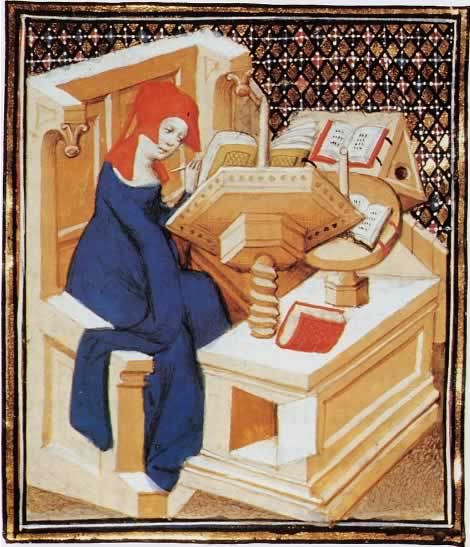
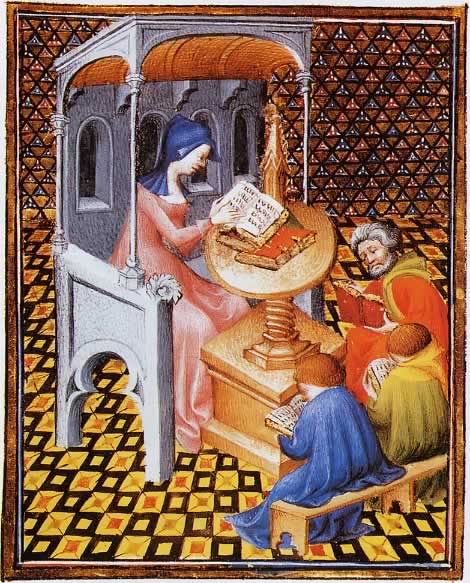
I found a great little book at the thrift store last week: The Medieval Woman: an illuminated Book of Days. It's a hardcover datebook packed with vibrant illuminations of women doing all sorts of work. This includes traditional occupations such as textile work (from cultivating silk worms to tailoring), farm work, cooking, nursing, and midwifery, to nontraditional work such as trade (often alongside their husbands), painting, sculpture, musical performance, and even masonry, smithing, mining, and castle defense. I've scanned a few of the more bookish women to present here.

Medieval Woman Christine de Pisan, Writing Collected Works of Christine de Pisan, MS. Harley 4431, f. 4 French, fifteenth century British Library, London

Medieval Woman Writer Giovanni Boccacio. Le livre des femmes nobles et renommées. MS. Fr. 598, f. 43r French, fifteenth century Bibliothèque Nationale, Paris

Medieval Woman Woman Teaching Giovanni Boccaccio. Le livre des femmes nobles et renommées. MS. Fr. 598, f. 71v French, fifteenth century Bibliothèque Nationale, Paris

I particularly enjoy the scholar with her multiple book stands. Perhaps if she were working today she'd have multiple monitors. I also must find out more about Christine de Pisan. According to the book she is the earliest known French female author. There is one illustration in the book of two fine ladies building a city wall from a work called "Cité des Dames" by Christine de Pisan. Could it be a fifteenth century feminist utopia? I must find out!

2.04.2008

What is Stephen Harper reading?

Last year the Canada Council for the Arts celebrated its 50th year of supporting Canadian artists, and as part of the celebration they invited 50 of those artists to Parliament Hill to be recognized by the House of Commons. Yann Martel, author of The Life of Pi, was one of those Canada Council artists, and describes the experience thus:

The Honourable Bev Oda, Minister for Canadian Heritage, whose seat on the government benches is as far away from the Prime Minister’s as is possible for a member of the cabinet, rose to her feet, acknowledged our presence and began to speak. We stood up, not for ourselves but for the Canada Council. Her speech was short. There was a flutter of applause. Then Minister Oda sat down, our business was over, MPs instantly turned to other things, and we were still standing. That was it. Fifty years of building Canada’s dazzling and varied culture, done with in less than five minutes.

We should have been prepared. How many Members of Parliament do you think showed up at a reception the previous day on Parliament Hill meant to be a grand occasion on which the representatives of Canada’s people would meet the representatives of Canada’s artists? By my count, twenty, twenty-five—out of 306—with only one cabinet minister, the one who absolutely had to be there, Bev Oda. There we fifty stood around, for two hours, waiting, each one of us a symbol for one year of the Canada Council’s fifty. I, for example, was 1991, the year I received a Canada Council B grant that allowed me to write my first novel. I was 27 years old and the money was manna from heaven. I made those $18,000 last a year and a half (and compared to the income tax I have paid since then, an exponential return on Canadian taxpayers’ investment, I assure you). By comparison, the equivalent celebration of a major cultural institution in, say, France would have been a classy, flashy, year-long, exhibition-filled affair with President Chirac trying to hog as much of the limelight as possible. No need to go into further details. We all know how the Europeans do culture. It’s sexy and important to them. The world visits Europe because it is so culturally resplendent. Instead, we stood around, drank our drinks, and then petered away in small groups.

So we should have been prepared for this perfunctory salute in the House of Commons. Nonetheless, I was surprised. Even embarrassed. Not for myself. I mean for all artists, from Jean-Louis Roux, great man of theatre, electrifying doyen of the fifty celebratory artists, to Tracee Smith, a young aboriginal hip-hop dancer and choreographer, recipient this year of her first Canada Council grant, to unknown emerging artists throughout this country. Do we count for nothing, you philistines, I felt like shouting down at the House. Don’t you know that Canadians love their books and songs and paintings? Do you really think we’re just parasites feeding off the honest, hard work of our fellow citizens? Truly I say to you, there are only two sets of tools with which the rich soil of life can be worked: the religious and the artistic. Everything else is illusion that crumbles before the onslaught of time. If you die having prayed to no god, any god, one expressed above an altar or one painted with a brush, then you risk wasting the soul you were given. Repent! Repent!

To help the government repent, Martel decided to go straight to the top and to use what he knows, literature. He has vowed to send Prime Minister Stephen Harper a book every two weeks, along with a letter explaining why he should read it, until Harper leaves office (which could be many years, as things stand now). Here is what he has sent so far:

The Death of Ivan Ilych, by Leo Tolstoy
Animal Farm, by George Orwell
The Murder of Roger Ackroyd, by Agatha Christie
By Grand Central Station I Sat Down and Wept, by Elizabeth Smart
The Bhagavad Gita
Bonjour Tristesse, by Françoise Sagan
Candide, by Voltaire
Short and Sweet: 101 very short poems, edited by Simon Armitage
Chronicle of a Death Foretold, by Gabriel García Márquez
Miss Julia, by August Strindberg
The Watsons, by Jane Austen
Maus, by Art Spiegelman
To Kill a Mockingbird, by Harper Lee
Le Petit Prince, by Antoine de Saint-Exupéry
Oranges Are Not the Only Fruit, by Jeanette Winterson
Letters to a Young Poet, by Rainer Maria Rilke
The Island Means Minago, by Milton Acorn
Metamorphosis, by Franz Kafka
The Brothers Lionheart, by Astrid Lindgren
Imagine A Day, by Sarah L. Thomson and Rob Gonsalves
The Mysteries of Harris Burdick, by Chris Van Allsburg
The Educated Imagination, by Northrop Frye
The Cellist of Sarajevo, by Steven Galloway
Meditations, by Marcus Aurellius

Martel's covering letters are conversational and personal, and seek to point out not just the books' artistic merits, but their broader, philosophical, political, or psychological merits, all part of the quest to demonstrate to our Prime Minister the incalculable value of art. To read the letters, visit What is Stephen Harper reading? Maybe we should all start sending art to our elected officials. What would you send?

via Rogueclassicism

4.27.2007

The Agony and Ecstasy of Writing

This goes out to all the bloggers who are brave enough to try writing...

via Book Chase

3.26.2007

Gabo Turns Eighty

Gabo80 Gabriel García Márquez was honoured at the International Spanish Language Congress in Cartagena, Colombia over the weekend in honour of his 80th birthday. Kings, Presidents, and thousands of adoring fans showered him with admiration for his work, particularly Cien Años de Soledad (100 Years of Solitude), which was called the most important novel in Spanish since Don Quixote. The Real Academia Española presented Gabo with a new annotated 40th anniversary edition of Cien Años. (The only other book they've published in this way is, you guessed it,  Don Quixote).

You can read his address here, that is, if you can read Spanish. Since this is also the 25th anniversary of his Nobel Prize, Anglophones may enjoy reading his address at that august occasion. There are also photos of the festivities in Cartagena, and may I say, I hope I am in that kind of shape at 80!

via Latin Americanist

UPDATE: I forgot to mention that Amazon has the Real Academia Española editions of Don Quijote de la Mancha and Cien Años de Soledad at insanely low prices. When was the last time you got a 1300 page hardcover critical edition for ten (US) bucks? Even with my shaky Spanish it's too good to pass up.

1.19.2007

Lattimore on Translation

For Mark 7.1–5 I have written:

"Then the Pharisees gathered to him, and some of the scribes who had come from Jerusalem, seeing that some of the disciples were eating their bread with profane, that is, unwashed, hands: for the Pharisees, and all the Jews, will not eat unless they have washed hand against first, thus keeping the tradition of their elders; and when they come from the marketplace they will not eat unless they have purified themselves, and there are many other observances that are traditional with them, the washing of cups and vessels both wooden and bronze: the Pharisees and the scribes asked him: Why do your disciples not walk according to the tradition of our elders, but eat their bread with profane hands?"

Let me try to put this into what is more like a contemporary idiom:

"The Pharisees, with some of the scribes, went out from Jerusalem to visit him. They noticed that some of his disciples ate without first washing their hands, which made their hands profane. The Pharisees and the Jews in general observe a tradition handed down from their ancestors not to eat without first washing their hands thoroughly. When they come in from the marketplace they will not eat until they have purified themselves. They have many other traditions, like washing their cups, whether these are made of wood or bronze. Because of all this the Pharisees and the scribes asked Jesus: Why do your disciples disobey our ancestral tradition by eating with profane hands?"

Now, other modern translators have modernized this passage much  more successfully than I have. My heart is not in this kind of rearrangement of the syntax. Still, all the essential meaning is there. But to me it reads much less like Mark than the version which stands in my translation.

—Richmond Lattimore, The Four Gospels and The Revelation

I'm with Dr. Lattimore. And the Pharisees. Wash your hands or you may be forced to commit the idolatry of worshipping the porcelain goddess!

8.12.2006

Anne Labastille: A Canoe of One's Own

When I first started writing, I discovered an interesting metabolic pattern. Mornings are my best time for writing. Time at the desk or on the sun deck is the equivalent of an executive's hours in an office composing letters, writing memos, researching, and editing. However, instead of coffee breaks and committee meetings, my work is broken by such distractions as meeting the mail boat, tramping to the outhouse, putting fresh wood in the stove, or admiring the hummingbirds. I am alone with time yet never really alone. On sunny, calm days I may even work in the bottom of my canoe, floating on the lake. My portable typewriter just fits on the seat like a stenographer's desk. And a yellow pad works anywhere. No word processors for me! I want no machinery or electricity between my brain, hand, pen, and paper.

—Anne Labastille, Woodswoman II: Beyond Black Bear Lake

7.30.2006

Woolf on Reading

A million thanks to Danielle (A Work in Progress) for bringing Virgina Woolf's essay, How Should One Read a Book?, to my attention. It is a welcome antidote to the pedantic and mechanistic How to Read a Book by Adler and Van Doren. Although her approach is generally the same, she expresses it much more beautifully and from the perspective of a fellow reader, rather than an omniscient teacher who may not be questioned.

Like Adler and Van Doren (and Susan Wise Bauer), she describes two phases of reading, the first devoted to understanding, the second to criticism. Unlike these other authors, Woolf feels it is a mistake to begin by categorizing books and forming expectations based on even the most general classification.

Do not dictate to your author; try to become him. Be his fellow-worker and accomplice. If you hang back, and reserve and criticise at first, you are preventing yourself from getting the fullest possible value from what you read. But if you open your mind as widely as possible, then signs and hints of almost imperceptible fineness, from the twist and turn of the first sentences, will bring you into the presence of a human being unlike any other. Steep yourself in this, acquaint yourself with this, and soon you will find that your author is giving you, or attempting to give you, something far more definite.

Step by step procedures for dissecting different types of book would obviously be anathema to this approach. Woolf continues:

The first process, to receive impressions with the utmost understanding, is only half the process of reading; it must be completed, if we are to get the whole pleasure from a book, by another. We must pass judgment upon these multitudinous impressions; we must make of these fleeting shapes one that is hard and lasting. But not directly. Wait for the dust of reading to settle; for the conflict and the questioning to die down; walk, talk, pull the dead petals from a rose, or fall asleep. Then suddenly without our willing it, for it is thus that Nature undertakes these transitions, the book will return, but differently. It will float to the top of the mind as a whole. And the book as a whole is different from the book received currently in separate phrases. Details now fit themselves into their places. We see the shape from start to finish; it is a barn, a pigsty, or a cathedral. Now then we can compare book with book as we compare building with building. But this act of comparison means that our attitude has changed; we are no longer the friends of the writer, but his judges; and just as we cannot be too sympathetic as friends, so as judges we cannot be too severe. Are they not criminals, books that have wasted our time and sympathy; are they not the most insidious enemies of society, corrupters, defilers, the writers of false books, faked books, books that fill the air with decay and disease? Let us then be severe in our judgments; let us compare each book with the greatest of its kind.

It's true that I generally have to 'let the dust settle' after reading a book before I can form any impression of it as a whole, and in fact those impressions do seem to materialize fully formed in my mind as if by magic. But mere impressions are not enough:

It would be foolish, then, to pretend that the second part of reading, to judge, to compare, is as simple as the first—to open the mind wide to the fast flocking of innumerable impressions. To continue reading without the book before you, to hold one shadow-shape against another, to have read widely enough and with enough understanding to make such comparisons alive and illuminating—that is difficult; it is still more difficult to press further and to say, “Not only is the book of this sort, but it is of this value; here it fails; here it succeeds; this is bad; that is good”. To carry out this part of a reader’s duty needs such imagination, insight, and learning that it is hard to conceive any one mind sufficiently endowed; impossible for the most self-confident to find more than the seeds of such powers in himself.

All is not lost, however, for we have some guides:

…in order to steady ourselves in this difficult attempt, it may be well to turn to the very rare writers who are able to enlighten us upon literature as an art. Coleridge and Dryden and Johnson, in their considered criticism, the poets and novelists themselves in their considered sayings, are often surprisingly revelant; they light up and solidify the vague ideas that have been tumbling in the misty depths of our minds.

Woolf seems to understand the desire (which is my desire) to penetrate the beautiful mysteries of the literary arts. She gives her advice so charmingly that I am inclined to follow it and seek out other authors who have written on "literature as an art." Would it be too much to ask for an anthology of such writings? [She googles madly...] Ah. Perhapsnot.

6.26.2006

Muriel Spark: "Curriculum Vitae"

Muriel Spark

Curriculum Vitae is Muriel Spark's attempt to answer what she calls the essential poet's question: Who am I? Like a true professional she researched her own life, digging up old documents and consulting friends and family to corroborate her own memories. The autobiography describes the first 39 years of her life, from her birth to the publication of her first book, The Comforters, in 1957. If there is an answer in Curriculum Vitae to the question of who she was, it is simply that she was a writer.

Muriel Spark was born in Edinburgh in 1918 to an English mother and Scottish father, and although her family was poor, her formative years were rich with experience—perfect for a future writer. Spark's parents included her in their vibrant social life, and she encountered a great variety of interesting and memorable people before starting her formal education. I suspect she picked up part of her penchant for observing people from her parents who would talk about their acquaintances in front of their daughter, often making fun of them and giving them nicknames.

The main beneficiary of Scottish philanthropy over several centuries was education, so Spark was able to go to a good school at little or no cost to her parents.

Education was held in awe, and the Scottish idea was that nobody should be denied this privilege.

At Gillespie's Girls' School she was taught by many excellent teachers, including the "exhilarating and impressive" Miss Christina Kay who was the model for Miss Brodie. Miss Kay lived a rich and adventurous life and shared it with her girls, stimulating Muriel's imagination and thirst for experience of her own.

What filled our minds with wonder and make Christina Kay so memorable was the personal drama and poetry within which everything in her classroom happened.

From a young age Spark showed an aptitude for poetry and literature, and was encouraged and supported in this at home and at school.

Miss Kay predicted my future as a writer in the most emphatic terms. I felt I had hardly much choice in the matter.

She read all the poetry and fiction she could get her hands on, and sought feedback on her poems and stories from friends and teachers. By the time she left school she was already an award-winning and published poet. Despite her obvious talent and intelligence, she did not pursue a university degree, partly due to a lack of money, and partly because she preferred to study on her own. She did take some writing and secretarial courses that enabled her to enter the working world and gain more of the life experience she was looking for.

At the age of 18 she met and married Sydney Spark and moved to Rhodesia (now Zimbabwe) where he was posted as a teacher. The marriage was "disastrous." She calls her husband "mentally ill," but what she describes, in very detached language, is a violent, abusive man. Spark never describes what he did to her or anyone else, nor does she say how she felt about it. She does say she feared for her life, which propelled her to obtain a divorce.

Spark longed to leave Africa, partly because of her domestic situation, and partly because she could not tolerate the hideous racism of the white colonists. "Life in the colony was eating my heart away." By this time the war had started and civilian transport was restricted, but with a little trickery she did secure a passage home for herself. She had to leave her son behind because children could not be transported in to the UK; indeed many were being shipped out for safekeeping. Friends and relatives questioned whether she wouldn't be safer in Africa, but she wanted to "experience" the war. In fact she chose to settle in London rather than Edinburgh in order to witness the bombing.

All women under 45 without family obligations were required to join the war effort. Spark's employment agent turned out to be an avid reader, and as they conversed about literature and poetry the agent soon realized Spark had a superior intellect. As a result she was posted to intelligence work, helping to create and distribute anti-Nazi propaganda via fake German radio stations. Spark began to feel a "definite desire" that gaining experience was no longer enough, but that she wanted to "give experience" to the reader with her writing. It was a vague feeling, however, and she didn't feel ready to try it yet.

After the war she worked in publishing, eventually becoming the editor of Poetry Review. Her attempts to raise the quality of the journal and welcome more modern poets was met with fierce and underhanded resistance and she was eventually forced out. After that she became a "hoarder" of all her records, papers, letters, etc. so that she could submit "documentary evidence" the next time she was attacked. This apparently continued for the rest of her life, and now that she has passed I imagine her archives will be of great interest to Spark scholars.

She also had another unsuccessful relationship with a possessive and vindictive man. She cobbled a living together by working for magazines and writing literary biography and criticism, but it was barely enough to keep body and soul together. A combination of post-war rationing, self-neglect, and Dexedrine (an appetite suppressant) led to malnourishment and she eventually had to leave London to convalesce. There are hints that alcohol was also a problem, but no more than hints. It was her friends that kept her afloat through all her troubles, and she remembers them with great fondness.

By the mid-50's she started making a name for herself in the literary world and was commissioned to write her first novel, an unusual thing in that day. The timing was right because she was already shifting her work towards story-telling.

I was now moving, myself, from lyric poetry to narrative verse. This was the start of my move in literature towards the short story and then the novel.

The book ends with the success of her first novel, The Comforters, which is based on the word hallucinations she had while taking Dexedrine, and also on the Book of Job. She writes of that book:

I didn't feel like 'a novelist' and before I could square it with my literary conscience to write a novel, I had to work out the novel-writing process peculiar to myself, and moreover, perform this act within the very novel I proposed to write.

As a Catholic convert myself I was looking for what she would say about her own conversion experience. I find it difficult to explain why I became a Catholic and it seems to be no different for Spark.

The simple explanation is that I felt the Roman Catholic faith corresponded to what I have always felt and known and believed. … The more difficult explanation would involve the step by step building up of a conviction. … Indeed, the existential quality of a religious experience cannot be simply summed up in general terms.

Some of those steps undoubtedly took place with Father Frank O'Malley, who counselled her during her illness, and during her convalescence at two Carmelite monasteries. Unfortunately for the curious, she keeps the details of those experiences to herself. Indeed she keeps a lot to herself, relating the facts of her experiences without much emotion or personal comment. Some crucial moments are described only through her friends' comments. She says next to nothing about her son, and as I mentioned earlier, very little about her marriage. Perhaps this reflects her Anglo-Scottish background. She writes that "It was certainly an attitude typical of Edinburgh to deny feelings for the sake of principle," and the English are not known for emotionality.

One has to read between the lines to infer where her feelings were involved. Loyal friends are clearly one thing she feels passionate about, particularly, I imagine, since her romantic relationships were so disappointing. (A friend called her "a bad picker" of men.) The book was also written in part to "put the record straight" after a former friend and writing partner wrote unauthorized accounts of her that were filled with inaccuracies. She does the research into the facts of her life that he did not, and she refutes his work through her narrative and directly in her account of her (non-romantic) relationship with him. A word to the wise: take any works about Spark by Derek Sanford (and works based on his works) with a grain of salt. She describes his "disregard for the truth" as "very uncharitable towards students and scholars," but I believe she herself felt betrayed and deeply hurt. This book is her public response to that betrayal.

In the last chapter she writes:

Since I wrote my first novel I have passed the years occupied with ever more work, many travels, and adventures. Friends, famous and obscure, abound in my life-story. That will be the subject of another volume.

Sadly for us she did not write that volume before her death this year. Let's hope her next biographer will be as scrupulous as she was in writing Curriculum Vitae. Muriel Spark, rest in peace.

6.25.2006

Muriel Spark: Priorities

Soon after arriving in London I registered at the Kensington Public Library and took out some books.
…The morning after, I went to the local Employment Bureau in Ladbroke Grove to see about a job.

—Muriel Spark, Curriculum Vitae: Autobiography

A reminder to the Slaves of Golconda: your posts on The Prime of Miss Jean Brodie (and your second Spark book, if applicable) are due Friday, June 30, after which we will repair to MetaxuCafé.com for discussion.

5.03.2006

Muriel Spark on Writing

I have always found writing the most pleasant form of expression. I know that I have a talent for giving pleasure with my writing. It has become my constant profession, and through the written word I have realized my life and livelihood. I have drawn the greatest possible happiness from the pursuit, especially of creative work.

I write by hand as I have always done, and enjoy opening an empty notebook waiting to be filled in.

—Muriel Spark (1918–2006)


12.31.2005

Decommissioning Gabo

Tying up more loose ends...

Some of you may have noticed the sidebar with resources for the Slaves of Golconda. Since we are moving on to Wilde now I wanted to collect those resources here for future reference.

The book: Chronicle of a Death Foretold by Gabriel García Márquez

The background: Literary Masters: Gabriel García Márquez
A compact but comprehensive guide to Gabo's life and works. Too bad there isn't one like this on Oscar Wilde.

The discussion: MetaxuCafé Forum

The online resource: Macondo
An extensive (and beautiful) website about Gabriel García Márquez.

From the man himself: Living to Tell the Tale (Vivir Para Contarla)
The first volume of Gabo's three-volulme autobiography.

A bit about Colombia: on Wikipedia


12.12.2005

Stranger Than Fiction

From Gabriel García Márquez' Nobel Prize lecture:

Antonio Pigafetta, a Florentine navigator who went with Magellan on the first voyage around the world, wrote, upon his passage through our southern lands of America, a strictly accurate account that nonetheless resembles a venture into fantasy. In it he recorded that he has seen hogs with navels on their haunches, clawless birds whose hens laid eggs on the backs of their mates, and others still, resembling tongueless pelicans, with beaks like spoons. He wrote of having seen a misbegotten creature with the head and ears of a mule, a camel's body, the legs of a deer and the whinny of a horse. He described how the first native encountered in Patagonia was confronted with a mirror, whereupon that impassioned giant lost his senses to the terror of his own image.

One thing I've learned while reading about GGM is that everything he writes is true. He claims that every single element in his novels and stories comes directly from life, especially life on the Caribbean coast of Colombia. He is as much a journalist as a novelist, and has observed and collected all sorts of strange and unusual anecdotes, in much the same way as Thomas Hardy did. His juxtapositions and exaggerations make his stories seem unbelievable, but ultimately they are based on strange-but-true events. He would probably even deny that these events were strange, but that they are simply part of the fabric of ordinary life in Colombia. The difficulty for non-Latino readers is that what is ordinary in Latin America would be extraordinary anywhere else.

The book that the Slaves of Golconda are about to read, Chronicle of a Death Foretold, is no exception to this. It is based on the true story of a childhood friend, Cayetano Gentile, who was murdered by the brothers of a schoolteacher who married a woman who turned out not to be a virgin and named Gentile as her seducer. Even the method of death and Gentile's last words are reproduced exactly in the book. I look forward to finding out if Gabo can make fiction even stranger than truth.

Visit Macondo for more on Gabo's life and works.

And for musical accompaniment, check out this CD by Rubén Blades inspired by the short stories of Gabriel García Márquez.


The Scoop on Gabo

…I consider journalism to be a literary genre. Intellectuals would not agree, but I believe it is. Without being fiction, it is a form, and instrument, for expressing reality

The timing may be different but the experience is the same in literature and journalism. In fiction, if you feel you get a scoop, a scoop about life that fits into your writing, it's the same emotion as a journalist when he gets to the heart of a story. These moments occur when you least expect them and they bring extraordinary happiness. Just as a journalist knows when he's got the story, a writer has a similar revelation. Of course, he still has to illustrate and enrich it, but he knows he's got it. It's almost an instinct. The journalist knows if he has news or not. The writer knows if it's literature or not, if it's poetry or not. After that, the writing is very much the same. Both use many of the same techniques.

…my misfortune is that people don't believe my journalism. They think I make it all up. But I promise you, I invent nothing either in journalism or fiction. In fiction, you manipulate reality because that's what fiction is for. In journalism, I can pick the subjects that suit my character because I no longer have the demands of a job.

—Gabriel García Márquez in an interview (source)


12.05.2005

García Márquez and Colombia's History

An understanding of the history of Colombia is necessary to an understanding of the fiction of García Márquez. As Regina Janes notes, he himself "once remarked that the reader of Cien años de soledad who was not familiar with the history of his country, Colombia, might appreciate the novel as a good novel, but much of what happens in it would make no sense to him.

Liberals were represented by the color red and Conservatives by the color blue; when the new mayor arrives in Macondo in One Hundred Years of Solitude and demands that all the houses be painted blue, the reader immediately knows his political orientation. Hundreds of thousands of people have died in Colombia over the difference in color, red or blue.

—Joan Mellen, Literary Masters: Gabriel García Márquez

Colombia on Wikipedia


12.04.2005

Faulkner, Hemingway, and García Márquez

I don't know who said that novelists read the novels of others only to figure out how they are written. I believe it's true. We aren't satisfied with the secrets exposed on the surface of the page: we turn the book around to find the seams. In a way that's impossible to explain, we break the book down to its essential parts and then put it back together after we understand the mysteries of its personal clockwork. The effort is disheartening in Faulkner's books, because he doesn't seem to have an organic system of writing, but instead walks blindly through his biblical universe, like a herd of goats loosed in a shop full of crystal. Managing to dismantle a page of his, one has the impression of springs and screws left over, that it's impossible to put back together in its original state. Hemingway, by contrast, with less inspiration, with less passion and less craziness but with a splendid severity, left the screws fully exposed, as they are on freight cars. Maybe for that reason Faulkner is a writer who has had much to do with my soul, but Hemingway is the one who had the most to do with my craft—not simply for his books, but for his astounding knowledge of the aspect of craftsmanship in the science of writing.

—Gabriel García Márquez, 1981 (source)


García Marquez' Writing Routine

His routine for writing has been the same for years. He awakens early, listens to the news, may read from six a.m. until eight, and then write from eight until one. Later this became from nine until two-thirty.…

… Lunch was between half past two and three, in the Spanish style. When he awoke from his siesta at four, he read and listened to music. He always listens to music, he says, "except when I'm writing because I attend to it more than to what I'm writing."

While he was working on Love in the Time of Cholera, and they lived by the sea in Cartagena, Mercedes [his wife] packed a lunch and went to the beach and waited for him there with friends. She did not inform him who would be present on a given say, so he never knew whom to expect, an experience he enjoyed. After lunch he had a siesta and then went out into the streets "to look for places where my characters would go, to talk to people and pick up language and atmosphere. So the next morning I would have fresh material I had brought from the streets."

—Joan Mellen, Literary Masters: Gabriel García Márquez


García Márquez: Women and Men

Often García Márquez has contrasted women and men. "Men waver," he has said, "but women survive. Thanks to women, history is able to continue its normal course." It seems, he has added, "as if men are the protagonists of history, but if they are, it is because someone is giving them support from behind and that someone is a woman. My women are more in touch with reality." Men, he concludes, are impatient, untrustworthy, and in fact, are "weaklings."

—Joan Mellen, Literary Masters: Gabriel García Márquez

I think Señor García and I are going to get along.