How about all of them?

Vanessa Mancini: Bathing in Knowledge.
via @BookPatrol

The British Library is trying to raise £9M to acquire what is thought to be Europe’s oldest intact book, the Anglo-Saxon St. Cuthbert Gospel. The late 7th century book still has its original red leather cover, and contains the Gospel of John. The binding is beautifully decorated and the calligraphy is as clear and beautiful as it was when it was written 1300 years ago. You can get a look at it in the video below, and contribute to the acquisition fund at the British Library website.
via @Melwyk


This charming edifice is The House of Books Has No Windows by Janet Cardiff and George Bures Miller. To me it looks like where I might have to live if I don’t stop buying so many books! Read more and see a video of how it was constructed at Flavorwire. (Warning: Books were harmed in the making of this artwork!)
via Win!
This reminds me of my TBR pile…

via tumblr (if anyone knows the artist, let me know!)
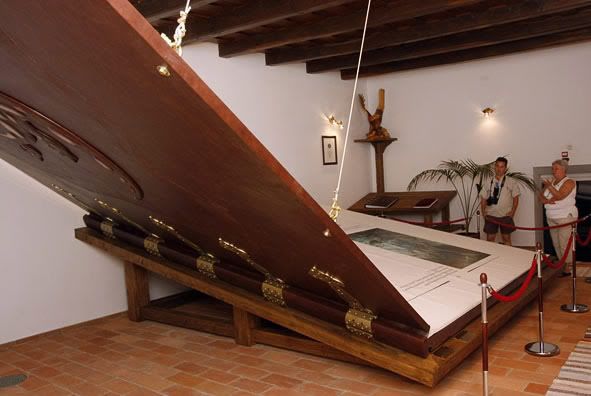
How’s that for a big book? This megatome currently holds the Guinness World Record for the largest book in the world, at 4.18m by 3.77m, and weighing 1,420 kg. That’s more than my car weighs. Our Fragile Natural Heritage was built by Hungarian inventor Bela Varga with family and friends, and was completed on March 21, 2010. Its 346 pages describe natural wonders in Hungary and around the world, and is intended to raise ecological awareness. The World’s Largest Book blog has videos and descriptions of the making of the book. To install the book they had to remove the roof over the exhibition room and lower the book in with a crane. There is also a smaller version of the book, which is about the size of an atlas. I love that the cover is decorated with a fire salamander, the mascot of Aggtelek National Park, where the book is located.
Speaking of atlases, the world’s largest atlas also went on display in the spring of 2010 at the British Library. The Klencke Atlas dates from 1660, and is a svelte .95m by 1.75 m and contains 37 maps. I should say that it was the world’s largest atlas at the time; in October 2010 it was eclipsed by Earth, published by Gordon Cheers in Australia. This 2m by 3m atlas can be yours for a mere $100,000. It was created partly as a counterpoint to today’s emphasis on digital and mobile technologies. When the Kindles and iPads have long since released their toxins into the groundwater, books like these will still be here.
Just to even things out I thought I’d also post a little something on miniature books. Flickr has a Miniature Books pool that is worth checking out, and if you’d like to make your own miniature book, you can also find full instructions on Flickr. No crane required!
Folded book art by Isaac Salazar, featured on the cover of W.W. Norton’s fall/winter catalog.

via W.W. Norton
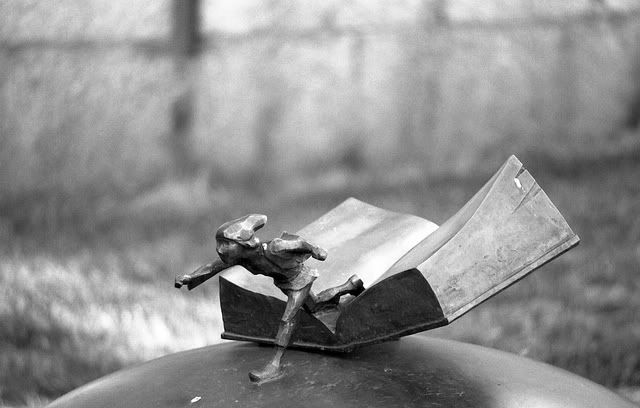
I couldn't find any information about this sculpture, other than that it is located in Karlskrona, Sweden. I’d love to know more, but that won’t make it any more charming to look at! The great photo is by misteraitch.
Update:
Thanks to the mighty Google I have discovered that this is a sculpture of Nils Holgersson from The Wonderful Adventures of Nils by Selma Lagerlöf. Here is an explanation from (of all places) The Hindu Businessman:
Written originally as a geography book about Sweden by this Nobel prize-winner (the first woman to get the literature prize, in 1909), the book’s central character, Nils, takes a journey across Sweden on the back of a migrating wild goose.
The city of Karlskrona recently immortalised Nils with a sculpture by Ralf Borselius showing Nils leaping out of the book. Writers in Sweden are not just read, what they write is remembered.
There is more on the sculpture (in Swedish) at Ralf Borselius’s website. If you’d like to know more about Nils’ adventures you can read or download the book at Project Gutenberg.
One of the drawbacks of online book shopping is that you can’t flip through a book to view its contents. That has improved somewhat with things like Amazon’s “Look Inside” feature, but even that is limited depending on how much the publisher is willing to share. The Book Design Studio at the Academy of Fine Arts in Warsaw has taken things one step further by showing flash movies of someone actually flipping through their books. It’s a clever idea and makes viewing books online a much more human experience. I don’t imagine it could be done on a large scale but it’s a clever idea and fun to watch. Here’s a little snippet to give you an idea of what it looks like:

See more at www.buszmeni.pl.
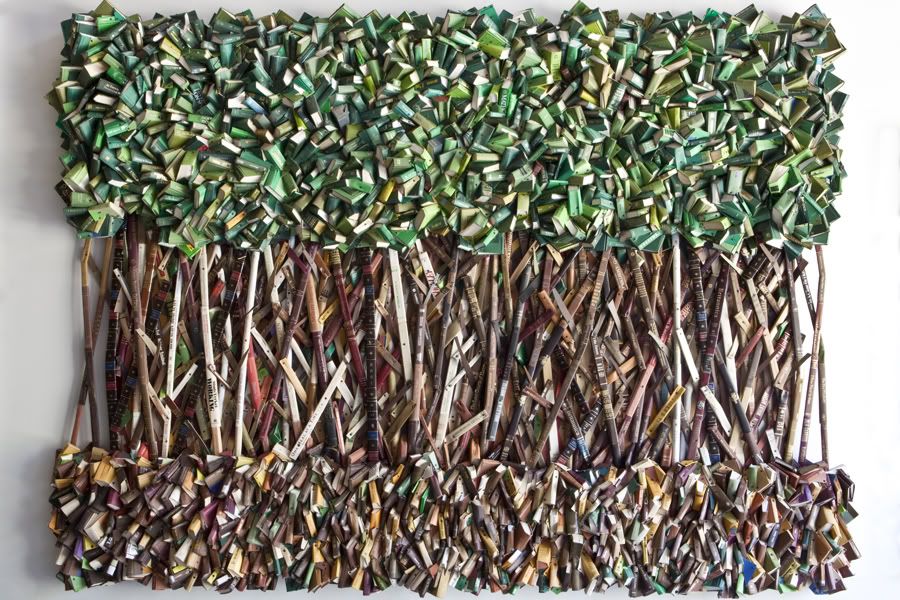
Once upon a time there was a forest. Its trees were turned into books. And some of those books became a handcrafted echo of that forest.
I stumbled across Federico Uribe in a horrible article about private libraries built for show. While the wealthy “recycle” books to puff up their image, Uribe uses discarded books to create art. In his 2010 installation, “Once Upon A Time,” he takes the recycling full circle by making trees out of books.
As an ecologist I love that he has trees representing a diversity of global ecosystems, and has populated his book forest with a variety of animals—birds, butterflies, squirrels, frogs, and spiders. Below is just a little taste of the exhibition. I highly recommend viewing the slide show and virtual tour for much more.



Here’s a piece of furniture that leaves no doubt about its purpose:

“Pile of Books” by Josefin Hellström-Olsson.
Do you think an e-reader is the only way to carry a library of books around with you? Bookbinder Todd Pattison has thought of another way:

Found and altered early 19th-century leather binding with fore-edge clasps. The bookshelves of the altered binding hold seventy-two blank leather- and paper-covered books which open and range in height from 1” to 1.5”.
Read more at the Guild of Bookworkers.
 Script and Scribble: The Rise and Fall of Handwriting
Kitty Burns Florey
Melville House
2008-11-01
225 pp.
9781933633671
I’ve been wanting to read Script and Scribble since reading Stefanie’s review of the book at So Many Books. Although I was very interested in handwriting in my teen years and developed my own distinct script, the quality of my handwriting has deteriorated in proportion to my use of the computer for communication. I do still write in a journal by hand, but in that case illegibility is a virtue in that it shields my innermost thoughts from prying eyes (and sometimes even my own!). I have been dissatisfied with the state of my handwriting for some time, and so I was glad to hear of a book dealing with the issue.
Lest I give the impression that the book is some dry instruction manual, let me say that Script and Scribble is so much fun that I devoured it in a day and a half. Its unabashed curmudgeonliness is delivered with such abundant wit that even a die-hard keyboarding purist would enjoy it. The book traipses through the history of handwriting from antiquity to the latest pedagogical trends, with a sprinkling of anecdotes from the author’s own graphological joys and sorrows.
I must admit I did skip the chapter on “graphology” (handwriting analysis), a subject so ludicrous it doesn’t even merit the effort of mockery. Otherwise the book was thoroughly entertaining. I was (temporarily) wooed by the graceful beauty of the florid (to us) Spencerian script, which was
…based on natural forms. To Spencer, the stones washed smooth by the lake became the ovals that are the foundation of his letters; arching tree branches and smooth-flowing streams led him to his graceful connecting lines. Remembering the joys of nature—the wild flowers, the smooth pebbles, the beams of sunlight, the flight of birds across a sky traced with wispy clouds—he mingled round and angular, light and dark, trailing vines and curling stems, slender upstrokes and shaded downstrokes, swooping capitals and judicious flourishes.
But I soon came to my senses when I considered the practicality of such handwriting in my life. It’s difficult to write (though by no means the most difficult hand available), and for those not used to it, difficult to read, which makes it a poor medium for communication. When I glanced back over the examples of past writing and calligraphy styles, I came to the same conclusion as the author does in the last chapter: Renaissance Italic stands out as the most legible, beautiful, and practical hand we have come up with yet. Indeed there is a movement (which has its epicentre in Oregon) to teach children (and adults) a single, semi-cursive Italic-based writing hand to replace both “ball and stick” printing and the loopy Palmer-esque cursive that is sprung on children just as they are getting the hang of printing.
We can only hope this is the beginning of the end of Puritanical (literally—Puritans disliked calligraphy) domination of handwriting. I wonder if the pointed arches of Italic reminded the Puritans too much of “Papist” cathedrals? In any case, the roundhand (a.k.a. copperplate) writing they invented replaced the earthiness of a broad nib with the ethereal swooping of a pointed pen, and it obviously caught on among a growing literate population. I don’t imagine they would have approved of the excessive flourishes their style of writing gave rise to, but without it we might not have the humble ballpoint pen, which might have been more to their liking.
While the author does not hold any illusions about the status of handwriting in this digital age (i.e. it’s on life-support, with the family divided on whether to pull the plug), she does point out that there are areas where handwriting is still essential. Our competence may still be judged through hand-written job applications, notes of love, thanks, or condolence are only acceptable when written by hand, and in the case of medical records and prescriptions, good handwriting can save lives. There is also the fact that a full quarter of the children in the USA do not have access to a computer at home, and so handwriting is still an essential skill for students. If this is the case, then a quick, simple, good-looking Italic-based writing style might fulfill all of these needs, as well as solve more mundane problems like deciphering the shopping list or post-it note.
Alas, the book the Florey recommends for learning the new cursive Italic, Write Now, is out of print [Edit: is now available here], but there are plenty of websites and even YouTube videos showing how it’s done. But for me the most exciting thing about rethinking handwriting is the opportunity to come up with one’s own style. Technology may have handwriting on the ropes, but it also makes the entire history of handwriting available to us. We can take what we like from history and adapt it to our needs. Perhaps in the end technology will help us improve our handwriting and make it more open, accessible, streamlined, and customized—like technology itself.
A true source of human happiness lies in taking a genuine interest in all the details of daily life and elevating them by art.
–William Morris
Postscript: One of the many amusing sidenotes in the book includes this gem from the writers’ guidelines for Verbatim magazine:
Under no circumstances will a handwritten MS be read. Instead, it will be roundly ridiculed, unless it is written using the Palmer method, in which case it will be stared at in amazement.
I haven’t been a big fan of Penguin classics, mainly because the books, unlike their contents, deteriorate so quickly. They are books to be read once and then left to yellow and dissolve on the shelf. But Penguin is making up for it with their new beautifully designed clothbound classics.

The covers are the work of Penguin’s senior cover designer, Coralie Bickford-Smith. In this interview at Design*Sponge, she talks about her influences, including the Arts and Crafts movement, and how she tailored each design to the book and to the equipment and materials used to produce them. I haven’t seen one myself but I would hope they paid equal attention to the quality of the interiors. Using Amazon’s “Look Inside” feature I see that they are printed on Forest Stewardship Council-approved paper, which is a good sign, but doesn’t go as far as the Modern Library hardcovers, which are printed on recycled and acid-free paper. Interestingly, they also come with all the usual editorial extras of Penguin Classics, such as introduction, chronology, and notes. I think this is unusual in hardcover classics, except for one-off translations.
I don’t know if I will get any myself. I already have copies of my favourites and don’t really have room for much else, but I love the cover of their Odyssey so much I might just get that one. I already have two editions of it, but it’s good to have multiple translations of ancient classics. Alas, that particular volume doesn’t seem to be available yet, and I can’t find out which translation it is, though I would guess Fagles, which I don’t have. I’ll just have to wait.
If you’d like to ogle more of these books, see this Flickr photo gallery.

UPDATE: After reading some of the reader comments about these books here and here, I am now doubtful about the quality of these books. One reader says that the foil decoration comes off quite easily when the book is transported in a bag, and another reports that the paper is poor and the binding is glued rather than stitched. If that’s true then these books are not for me. I’d rather have a plain Modern Library hardcover that is beautifully printed on recycled, acid-free cream paper with a proper stitched binding. That is a book that will last, a book that is a pleasure to read, a book that is worthy of its contents.
Watch as John Carrera of Quercus Press transforms engravings from 19th century Webster’s dictionaries into a handmade work of bookish art.
The handmade editions are expensive, naturally, but a trade edition is available from Chronicle Books for $35. Chronicle Books is also giving away one of the leather-bound editions—enter the contest here before November 15th. See sample pages and more about the project at Quercus Press.
via phantasmagorical


