Showing posts with label Illuminated Manuscripts. Show all posts

2.11.2012

British Library seeks to acquire Europe’s oldest book

The British Library is trying to raise £9M to acquire what is thought to be Europe’s oldest intact book, the Anglo-Saxon St. Cuthbert Gospel. The late 7th century book still has its original red leather cover, and contains the Gospel of John. The binding is beautifully decorated and the calligraphy is as clear and beautiful as it was when it was written 1300 years ago. You can get a look at it in the video below, and contribute to the acquisition fund at the British Library website.

via @Melwyk

2.13.2011

Codex Aureus

The ever-fascinating BibliOdyssey has posted a simply gorgeous 9th century manuscript Gospel, the Codex Aureus of St. Emmeram. The book has many spectacular full-page illuminations, but what really attracts me is the beautiful uncial writing of the text pages.

Codex Aureus p. 44

See more at BibliOdyssey, which has links to the full online version and background information.

1.30.2009

Medieval Sisters Are Doing It For Themselves

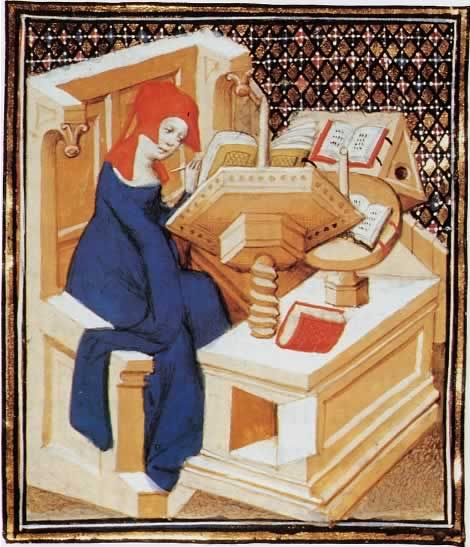
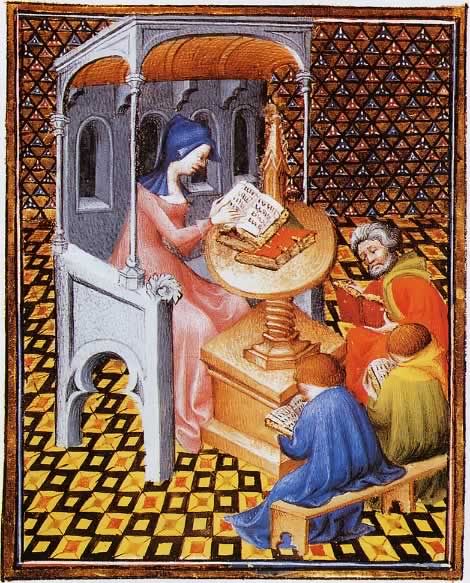
I found a great little book at the thrift store last week: The Medieval Woman: an illuminated Book of Days. It's a hardcover datebook packed with vibrant illuminations of women doing all sorts of work. This includes traditional occupations such as textile work (from cultivating silk worms to tailoring), farm work, cooking, nursing, and midwifery, to nontraditional work such as trade (often alongside their husbands), painting, sculpture, musical performance, and even masonry, smithing, mining, and castle defense. I've scanned a few of the more bookish women to present here.

Medieval Woman Christine de Pisan, Writing Collected Works of Christine de Pisan, MS. Harley 4431, f. 4 French, fifteenth century British Library, London

Medieval Woman Writer Giovanni Boccacio. Le livre des femmes nobles et renommées. MS. Fr. 598, f. 43r French, fifteenth century Bibliothèque Nationale, Paris

Medieval Woman Woman Teaching Giovanni Boccaccio. Le livre des femmes nobles et renommées. MS. Fr. 598, f. 71v French, fifteenth century Bibliothèque Nationale, Paris

I particularly enjoy the scholar with her multiple book stands. Perhaps if she were working today she'd have multiple monitors. I also must find out more about Christine de Pisan. According to the book she is the earliest known French female author. There is one illustration in the book of two fine ladies building a city wall from a work called "Cité des Dames" by Christine de Pisan. Could it be a fifteenth century feminist utopia? I must find out!

10.29.2007

What's Wrong With This Picture?

Photo Marc WathieuThis is a Kuka industrial robot that has been programmed to "write" Martin Luther's translation of the Bible on huge scrolls of paper as part of an art exhibit (click image for more photos). When I first saw this image on Book Patrol I was horrified. I find it profoundly disturbing to see a machine taking the place of a biblical scribe. This robot can have no relationship to the text being reproduced, and no relationship with the people who will be reading it (not that anyone will be reading those unwieldy scrolls). To have such a deeply human book "written" by a completely unfeeling thing just seems wrong to me. It should be no surprise that the resulting text looks perfect, and dead.

Contrast this with the Saint John's Bible, which is being written entirely by hand, or more precisely, by a group of hands. Every book is different, depending on the scribe, and every letter is unique, with different flourishes depending on its location in the word and the line. The text is alive, written by people for people, overseen and supported spiritually and materially by a strong community of faith.

Such a human endeavour is naturally open to mistakes. If they are minor, or caught right away, the surface layers of parchment can be scraped away and the correct text inserted. Large omissions that are not noticed until the page is proofread require more creative solutions. I've seen a few of these in the 5 volumes of the Saint John's Bible that have been completed so far, but here is a particularly charming one from the Wisdom Books.

Saint John's Bible, Wisdom 7

No robot, if it could make a mistake, would be capable of such humour and imagination in fixing it. I'll take creative human imperfection over lifeless robot perfection any day.

9.18.2007

Book-related Stamps

I've been meaning to post this for ages...

Bibliothèque humaniste de Sélestat

See more book-related stamps at the always interesting Literary Stamps. For more on the historic Bibliothèque Humaniste de Selestat, in Alsace, see the Selestat website or Les amis du bibliothèque humaniste [both in French].

3.01.2007

The Bible Business

Yes, I'm afraid it's another Bible post. What can I say, it's Lent. I found this interesting article via Book Patrol about the business of publishing Bibles. Here's an excerpt:

The familiar observation that the Bible is the best-selling book of all time obscures a more startling fact: the Bible is the best-selling book of the year, every year. Calculating how many Bibles are sold in the United States is a virtually impossible task, but a conservative estimate is that in 2005 Americans purchased some twenty-five million Bibles—twice as many as the most recent Harry Potter book. The amount spent annually on Bibles has been put at more than half a billion dollars.

In some ways, this should not be surprising. According to the Barna Group, an evangelical polling firm, forty-seven per cent of Americans read the Bible every week. But other research has found that ninety-one per cent of American households own at least one Bible—the average household owns four—which means that Bible publishers manage to sell twenty-five million copies a year of a book that almost everybody already has.

—Daniel Radosh, The Good Book Business [The New Yorker]

Someone should tell James Cameron that he might make more money going the Mel Gibson route! But I digress...

I've certainly been a good Bible customer, with six NRSVs (the seventh is on the way), a complete parallel Bible (four translations), an NRSV parallel Gospels, and a bilingual (Spanish-English) NIV, not to mention two concordances and a whopping big commentary. This is really backwards to how things used to be in monasteries in the middle ages. According to The Book, commentaries by "Church Fathers" such as Jerome and Augustine far outnumbered Bibles in old monastic libraries. Monks and nuns heard readings from Scripture several times a day in chapel and during meals, but it was the commentaries that they studied in detail. Over time the two texts came together in what are called glossed Bibles (see below), with excerpts from the great commentaries written on the same page with the biblical text. This tradition continues today with annotated ("study") Bibles, except that now the comments are written by scholars drawing on two thousand years of thought and research. It's a wonder that a book so old can keep getting better and better.

Mid-12th century glossed Bible

2.24.2007

Saint John's Bible: Prophets

Speaking of the NRSV, the latest gorgeous volume of the Saint John's Bible was released earlier this month. Prophets is the fourth of seven volumes to be published, coming after Pentateuch, Psalms, and Gospels and Acts.  The illuminations are darker than in the previous volumes, with what look to me like references to the Shoah (Holocaust), but these are balanced by frequently recurring rainbows, which recall God's covenant with the Earth (Genesis 9:13).

If you are particularly well-heeled, you can now sign up to buy one of the limited edition, full-size, high quality facsimiles of the original manuscripts. Only 360 copies of the "Heritage Edition" of the Saint John's Bible will be produced. I believe Canada's Museum of Civilization has ordered a copy, which makes me happy. Oh, the price? A mere $115,000 US. It's worth every penny I'm sure.

Saint John's Bible: Prophets

In other NRSV news, the third, augmented edition of the New Oxford Annotated Bible is being released next week. I didn't even know there had been a second edition so I am quite pleased about this. I've been reading my now ancient first edition NOAB and am amazed by what a thorough job both the NRSV translators and the Oxford editors have done at explaining these ancient texts in a concise and scholarly manner. If the third edition is even better then I can't wait to get my hands on a copy.

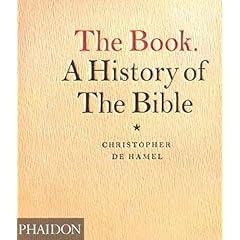
The Book: A History of the Bible by Christopher de HamelI've also been enjoying The Book: A History of the Bible by illuminated manuscript scholar Christopher de Hamel. The Book is about the history of the Bible as a book, or collection of books, and answers many questions (and puts to rest many suspicions) about how it has developed over time in various traditions and languages. De Hamel's book is published by Phaidon which means that it is drop-dead gorgeous, beautifully printed on heavy paper with colour illustrations on nearly every page. I think it's going to be one of those books I wish would never end.

8.06.2006

Five Books for the Price of One!

The Saint John's Bible: PentateuchFans of the the Saint John's Bible will be delighted to know that the Pentateuch is now available for purchase, either directly from St. John's or at your favourite bookstore (ISBN 0814690521). Go here to page through the book online.

Needless to say, my copy is already on it's way. :)


5.23.2006

"Salzinnes Antiphonal" to be Performed in Halifax

I couldn't resist a story that involved two of my favourite things, liturgical chant and illuminated manuscipts. (Three favourite things if you count Canada.) Chant from the 1554 Salzinnes Antiphonal will be performed at the Scotia Festival of Music in Halifax next year. The book was commissioned by Julienne de Glymes, prioress and cantrix of the now defunct Cistercian Abbey of Salzinnes in Namur, Belgium. It was brought over by a Halifax archbishop in the 19th century and lost in an attic for a time before being rediscovered in the 1970's and donated to St. Mary's University.

The book is now being restored and the music transcribed for performance by an Australian choir next summer. What is interesting about the illuminations is that it depicts nuns from different orders, and I gather from the news stories that many or all of them are identified.

Go to CBC Maritimes for pictures of the book and a good audio report that ends with some lovely Gregorian chant. CBC Arts has a story on the project, and there is also a press release from St. Mary's.

UPDATE: More pictures have been posted at the St. Mary's Archives website. (Thanks Hansel!)

Salzinnes Antiphonal

via Mirabilis and Rare Book News


4.25.2006

"Illuminating the Word: The Making of the Saint John's Bible" by Christopher Calderhead

Illuminating the Word: The Making of the Saint John's Bible by Christopher CalderheadMy bedtime book for the last couple of weeks has been Illuminating the Word: The Making of the Saint John's Bible, written by artist and Anglican/Episcopal priest Christopher Calderhead. This lavishly illustrated, well-written, and well-ordered book recounts the birth of the Saint John's Bible, the first bible of its kind to be produced in 500 years. "Birth" is an appropriate metaphor because the seven volumes of the Saint John's Bible will be living books, functioning members of the religious community that commissioned them. These enduring works of art and faith will travel, touch people's lives, and acquire a history of their own that will likely continue for centuries after the people who created them have passed on.

The book begins with the community of Saint John's Abbey in Collegeville, Minnesota. Saint John's has a strong tradition of preserving illuminated manuscripts in its Hill Museum and Manuscript Library. Through past projects they had made a connection with world famous calligrapher Donald Jackson of Wales, and when he suggested they commission him to write a new manuscript bible (or Gospels, the stories differ), they (eventually) agreed to undertake this massive project.

Donald Jackson was in charge of the production of the bible, but Saint John's "Committee on Illumination and Text" was in charge of the content. Wanting to make this a bible for our times, not a throwback to the past, the committee decided on using the New Revised Standard Version of the bible text, which is considered the most accurate and up-to-date (with respect to scholarship) translation now available. They also determined which illuminations were to be painted and provided detailed theological briefs to guide Jackson's team in designing the illuminations.

The book then moves to the scriptorium in Wales, where Jackson and his team of artists, artisans, and scribes worked to design the bible. It was not a given that they would use traditional materials. At one point Jackson considered using mylar for the pages. "It takes writing beautifully," he says. But in the end Jackson chose traditional methods and material, not because they were traditional, but because they were the best for this project.

The two-foot-high pages are of vellum (calfskin), difficult to find in such a large size and difficult to prepare, but it gives extremely crisp edges to the letters and with care will last for centuries. All of the writing is done with quills, which were also hard to find in the right size because birds are slaughtered so young now. The scribes used antique Chinese ink that Jackson was only able to secure enough of by accident, and many of the other tools and materials used in the making of the Saint John's Bible were 50 to 100 years old, brought out of calligraphers' hoards for this special purpose.

Because there was no model to follow, and for copyright reasons, every word of the bible had to be laid out in advance. This was done with the aid of computer, but even this process was labour intensive because each line had to be justified by hand. The computer allowed Jackson to play with the page size, column height and width, line weight, and other factors without wasting time and vellum, both of which were in short supply. The scribes followed the printed layouts exactly when writing, leaving spaces for the illuminations as prescribed.

Illuminating the Word describes in detail some of the technical challenges involved in writing and illuminating with the chosen materials. Sometimes scribes had to work without heat to prevent the vellum from over-drying. The various methods of laying down gold are described in detail. Also, Calderhead delicately recounts the difficulties Donald Jackson had in translating the very verbal theological briefs into the visual medium. The birth of this great bible certainly had its share of labour pains. What Calderhead couldn't describe, because it hadn't happened yet at the time of writing, was the final binding of the bible volumes between oak boards. I would love to hear that story too.

The book concludes with a look at some of the illuminations in Gospels and Acts and at the book of Psalms (both of which are now available in scaled down hardcovers). The Committee on Illumination and Text will also be editing its theological briefs for the illuminations into a sort of study guide to be used with the Saint John's Bible (can't wait for that!!).

I'm sure this is not the last book that will be written about the Saint John's Bible. Saint John's, Donald Jackson and his team, and all the many benefactors who have made this project possible are leaving behind an enduring, living legacy, and I am very glad to be a witness to it. I'll leave the last word to Christopher Calderhead:

When the Bible is finished, bound and installed at the Abbey, the story will not be over. Like the great manuscripts of the past, the Saint John's Bible is meant to speak to generations to come, igniting the imagination, encouraging a rich engagement with the Scriptures and inviting people to explore a living tradition of art, spirituality and theology through the written and illuminated word.

Saint John's Bible: Mark: 6-7 Loaves and Fishes

4.05.2006

More Saint Isidore

Here is an image of Isidore from the Aberdeen Bestiary. He is writing "Isidoris, de natura hominis," that is, "Isidore, Concerning the Nature of Man." What follows is a chapter on human anatomy and biology, which you can read in parallel translation at the Aberdeen Bestiary site.

Saint Isidore of Seville from the Aberdeen Bestiary

In my cybertravels I also discovered Medieval Latin Online, an illustrated online resource for a now defunct course at the U of Oklahoma. MLO is hosted by Laura Gibbs of the U of O, whose website (mythfolklore.net) is full of all sorts of good things. Do check it out.

MLO links to another amazing resource, Bibliotheca Augustana, which presents classic texts in every major European language plus Hebrew and Yiddish. It also has an image gallery (Museum virtuale) and audio files (Odeion virtuale). Saint Isidore would be proud.

3.16.2006

Torah Bible Coran: Livres de Parole

The Bibliotèque Nationale de France is presenting an extraordinary exhibition on the history of the holy books of Judaism, Christianity, and Islam. Torah Bible Coran: Livres de parole explores the parallels between and development of the holy texts of the three monotheistic religions that originated in the "fertile crescent" of the Middle East. There is even a section addressing the touchy subject of the depiction of holy beings in these three traditions.

If you don't read French, Google does a fairly good translation. (Download the Google toolbar and you only need to right click to translate a web page.) If you want to go directly to the images, click on "feuilletoirs." A review (in English) of the exhibition can be found here.

This one's for Talmida:

Biblioteque Nationale de France: Torah Bible Coran: Livres de Parole

Via Rare Book News

2.02.2006

The Medieval Bookshelf

Now that you've all put in your applications at the Rare Book School at UCLA, what are you planning to do on the weekends (other than stock up on vitamin D)? You might get extra credit by checking out The Getty's current exhibit of non-religious illuminated manuscripts, The Medieval Bookshelf: From Romance to Astronomy.

As a liberal arts wannabe I especially love the image from The Consolation of Philosophy of Lady Philosophy (or Philosôphia - first declension!) presenting the seven liberal arts (grammar, rhetoric, logic, music, geometry, mathematics, and astronomy) to the philosopher Boethius.

Via the lovely and talented Moyen Âge

Philosophy Presenting the Seven Liberal Arts to Boethius (detail)

1.02.2006

Making Art: Medieval Manuscripts

Making Art: Medieval Manuscripts

The Fitzwilliam Museum at the University of Cambridge is presenting a very nice interactive animation on how medieval illuminated manuscripts were made. They also have two online exhibits, the Cambridge Illuminations, and the Macclesfield Psalter. See also this article and video (excellent quality) on the Macclesfield Psalter.

via Rare Book News

5.28.2005

The Bookworm Collection

My latest distraction project is to create a gallery of visual links to online exhibitions of illuminated manuscripts and bookbinding. There are simply too many of these exhibitions to fit in a sidebar, therefore I present The Bookworm Collection.

This collection is still in its infancy and will (one hopes) grow quickly as I find more and more sources (suggestions are welcome). There doesn't seem to be any comprehensive listings of these online exhibitions (perhaps they are cropping up too fast) but if I find one I will post that in the sidebar under (what else?) Illuminated Manuscripts.

I hope you will enjoy this visual guidebook to beautiful books online!

I'm also thinking of starting a gallery of beautiful public and private libraries. If anyone knows what library that is on the cover ofA Splendour of Letters, please let me know!


5.26.2005

Scattered Leaves

The University of Saskatchewan is attempting to digitally reunite 50 medieval manuscripts that were dismembered by a 20th century collector. A certain Otto Egge from Cleveland took one page from each book, put them in boxes, and sold the boxes as exemplars of medieval calligraphy and illumination. Now the U of S is bringing together the owners of most of these boxes in a project to digitize the pages and virtually reconstruct the books.

News story

Remaking the Book (project website)

Scattered Leaves (virtual exhibition)

Scattered Leaves: Italian Psalter
Is this stunningly beautiful or what?

via Rare Book News


4.27.2005

St. John's Bible: Three Down, Four To Go

I hope you're not tired of hearing about the St. John's Bible yet because it won't be finished until 2007! The first volume to be reproduced and published, Gospels and Acts, is a work of art. I can't imagine what it's like to see the real thing, full size, with shining gold leaf (but I intend to find out). Here is a nice article from the Duluth News Tribune celebrating the completion of three of the seven volumes:

Usually the black-robed monks chant their evening prayers alone, their voices echoing off the concrete walls of the Abbey Church. But they were recently joined by guests not seen in monasteries since the Middle Ages -- a group of scribes and artists who are creating a hand-lettered and illuminated Bible.

At a cue from the abbot, the visitors came forward for a blessing on their work. A few of them wept, struck with the magnitude of their project.

St. John's University in Collegeville commissioned a calligrapher in Wales to head up this unlikely effort seven years ago. Now at the halfway point, the first three volumes of the St. John's Bible are on display through July 3 at the Minneapolis Institute of Arts. For the first time, most of the dozen scribes and illuminators working on the project recently gathered in Minnesota.

Continue reading article...

via Rare Book News


3.11.2005

More old books online

Girdle BookHand Bookbinding: Plain and Simple to Grand and Glorious
Special Collections in the Princeton University Library


Gutenberg Bible: Paper versus VellumTreasures in Full: High-quality digital editions, free to your desktop
British Library


Horae et Psalterium: Murder of Thomas a BecketMedieval and Renaissance Illuminated Manuscripts from Western Europe
New York Public Library Digital Gallery


AllviaMirabilis.ca


2.03.2005

Pass the Smelling Salts

I'm having the vapours. I can barely contain my excitement. The dogs, who had been unsure, are now 100% convinced that I'm touched. What has sent me into these transports? The publication of the first volume of the Saint John's Bible.

[pause for breath]

Genesis: Creation"The what?", you ask? Why, it's only the first bible manuscript to be commissioned in 500 years! In 1995 the monks of St. Johns Abbey, Minnesota, and world-renowned calligrapher Donald Jackson, decided it was high time to revive the tradition of bible manuscripts. The first words (the prologue of John's Gospel, of course) were laid down in 2000 and Jackson's team of calligraphers are still at it.

This project is a wonderful marriage of the modern and the traditional. The materials are all hand-crafted—the vellum pages, the bindings, the quill pens, even the inks. But make no mistake, this is no attempt to recreate the past. The calligraphy and artwork, though drawing on tradition, is new and contemporary, and every page was laid out on computer. Also they have chosen to use a contemporary Bible translation, the New Revised Standard Version, which some consider to be the best translation of the bible to date.

In the Middle Ages, monasteries helped preserve knowledge and culture for the sake of the greater community. By commissioning a handwritten Bible, Saint John's revives a tradition and affirms its commitment to the study of scripture, to the book arts and to educational, artistic and spiritual pursuits.

When complete the Saint John's Bible will comprise seven volumes, each two feet tall, and although it will live at the Hill Museum and Manuscript Library at St. John's University, it will also go on tour to educate and inspire. Prints of the illuminations are available for purchase, and a variety of volume reproductions—from the trade version I am apoplectic about to high-end, full-size facsimiles—will be produced.

At the dawn of the 21st century, Saint John's Abbey and University seek to ignite the spiritual imagination of believers throughout the world by commissioning a work of art that illuminates the Word of God for a new millennium.

I've been waiting for this for a long time—and it looks like I'll be waiting a little longer. The first volume, Gospels and Acts, is set to be released in April, and I'll be looking at May flowers by the time it graces my mail box. The same goes for the companion book, Illuminating the Word: The Making of the Saint John's Bible. So I guess the first lesson this book will be teaching me is patience.

Gospels and Acts: The Saint John's Bible


1.29.2005

Leaves of Gold

Leaves of Gold

Leaves of Gold: Treasures of Manuscript Illumination from Philadelphia Collections

From the Introduction:

Illuminated manuscripts are hand-produced books that include drawn, painted, and gilded decoration on pages made of vellum, a specially prepared and polished animal skin. The simplest manuscripts are adorned with calligraphic penwork dividing one paragraph of text from another. More lavish examples are embellished with historiated initials, enlarged and colorful letters that contain tiny representations of figures or biblical scenes.

…

Historically, illuminated manuscripts were produced by monks in monasteries. Beginning in the thirteenth century, an increasing
number were created by professional artisans working in commercial centers across Europe.

Leaves of Gold is organised into five sections that highlight several major types of medieval books: Bibles, Psalters, Books of Hours, Liturgical Manuscripts, and Literary Texts. This website shows two images from each book in the exhibition, the exhibited opening and an additional page from the book.

Leaves of Gold: The Annunciation