Showing posts with label Classics — Ancient. Show all posts

2.11.2012

British Library seeks to acquire Europe’s oldest book

The British Library is trying to raise £9M to acquire what is thought to be Europe’s oldest intact book, the Anglo-Saxon St. Cuthbert Gospel. The late 7th century book still has its original red leather cover, and contains the Gospel of John. The binding is beautifully decorated and the calligraphy is as clear and beautiful as it was when it was written 1300 years ago. You can get a look at it in the video below, and contribute to the acquisition fund at the British Library website.

via @Melwyk

1.05.2011

Martial: Books and Hooks

Quod tibi Decembri mense, quo uolant mappae
gracilesque ligulae cereique chartaeque
et acuta senibus testa cum Damascenis,
praeter libellos uernulas nihil misi,
fortasse auarus uidear aut inhumanus.
Odi dolosas munerum et malas artes;
imitantur hamos dona: namque quis nescit
auidum uorata decipi scarum musca?
Quotiens amico diuiti nihil donat,
o Quintiane, liberalis est pauper.

Because in December's month, when napkins fly
about, and slender spoons, and wax tapers, and paper,
and pointed jars of dried damsons, I have sent you
nothing but my home-bred little books, perhaps I
may seem stingy or impolite. I abhor the crafty and
cursed trickery of presents; gifts are like hooks;
for who does not know that the greedy sea-bream is
deceived by the fly he has gorged  Every time he
gives nothing to a rich friend, O Quintianus, a poor
man is generous.

—Marcus Valerius Martialis (Martial), Epigrams V:xviii (from A Christmas Celebration)

11.29.2010

Odyssey Readalong: Books 19–24

The Odyssey Readalong

Now that noble Odysseus has punished the suitors, let them
make their oaths of faith and friendship, and let him be king
always; and let us make them forget the death of their brothers
and sons, and let them be friends with each other, as in the time past,
and let them have prosperity and peace in abundance.

The masterful story-telling continued in the last section of the Odyssey. As with the previous 6 books I was kept on the edge of my seat the whole time. Step by step Odysseus’ plan to get revenge on the suitors comes together and is carried out successfully, though not without the necessary dramatic hiccups. All of Odysseus’ testing has sorted the goats from the sheep, so to speak, and they fall right into Odysseus’ trap, despite warnings and opportunities to save themselves. Once the doors are closed their fate is sealed and not one suitor or traitor is left standing. There is a certain amount of gore but not as much as I was expecting, and it was all cleaned up in short order (by the treacherous maidservants who were executed immediately thereafter!). I found it interesting that Odysseus cleansed his house with “fire and brimstone,” which he called “the cure of evils.” We usually think of fire and brimstone as part of the punishments of Hell, but here they are used to banish evil rather than punish it.

The final crisis is bookended nicely by encounters between Odysseus and Penelope. In their first meeting he keeps his disguise to test her, and she explains how she is caught between wanting to wait for her husband and seeing her son’s inheritance wasted away by the feasting suitors. She finally resolves to put the suitors to a trial of strength and skill, and marry the one who wins. This epic has been full of trials, with both gods and mortals testing each others’ identities and faith. Penelope tests the stranger, Odysseus in disguise, asking him about his origins and to prove that he has seen Odysseus. In the penultimate book when Odysseus finally reveals himself to her, she tests him again, fearing some kind of deception. Clearly she is a woman after his own suspicious heart, and it is no wonder she is called “circumspect” throughout the epic. Their final reunion is quite touching as they both have such great admiration and love for each other.

The character of Penelope is interesting to me because so often she is doubted and maligned, even by her own son, but over the course of the epic she is shown to be not only virtuous but also shrewd in keeping the suitors off as long as she did. Finally she displays motherly selflessness in resolving to marry one of the suitors, hateful though the prospect is to her, in order to preserve the property of her less-than-supportive son. She gets her just reward in the return of her beloved hero, the greatest of men.

Had Odysseus not returned it’s hard to say whether her plan would have succeeded. During the archery trial, the suitors admit they are afraid not of losing the chance to marry Penelope but of being seen as inferior to Odysseus, whose bow they could not string. Before being killed one of the suitors accuses another of not being interested in Penelope herself but of plotting to kill Telemachos so he could take Odysseus’ place as king. In essence, Penelope was wanted as a trophy wife, as though marrying her would automatically make the lucky suitor as great as Odysseus. It seems unlikely that Penelope could have done anything to save her son, but luckily she had Odysseus and the gods to uphold justice for her and her family.

One little touch I found interesting was how during the climactic scene of slaughter, the food that the suitors had been feasting on was scattered on the floor along with their bodies. This was repeated several times, and I think it points to the illicitness of their feasting at Odysseus’ expense. Feasting and hospitality were evidently very important to the ancient Greeks, and abusing hospitality must have been seen as a great offense, great enough to get the gods involved in setting things to rights.

The epic ends with the suitors in Hades telling their whole story to Agamemnon, Achilleus, and the other heroes there. There is an obvious connection to the underworld adventure from book 11, and it gave me the same sense of it being shoehorned in after the fact. There doesn’t seem to be much purpose to it. Perhaps it was a way to blend in a competing poem on the same story from the underworld perspective. The very last section of book 24 returns to the above-ground action but terminates rather abruptly when Athene shows her power and terrifies both Odysseus’ company and the avenging Ithakans into dropping their arms and pledging peace. There is nothing about Odysseus making the required sacrifices to placate Poseidon and the other gods, so I wonder if the original ending of the poem was lost. Not that it is out of character for the gods to swoop in and direct matters—Athene did quite a bit of that during the battle with the suitors. There is also a sense of finality in the way Laertes expresses his joy at seeing is son and grandson showing their valour, and, with Athene’s help, kills the father of the worst of the suitors. Three generations have defended their honour and the gods put an end to it there. Perhaps that is a fitting end to this revenge fantasy. Though the gods seem capricious at times, it does seem that their main concern is to uphold the right and see justice done. The quote above is what Zeus told Athene would be the “proper” end of events, and that is exactly what she brought about.

I’m sure I haven’t even begun to understand this great epic, but at least I have begun my journey with it. I will read it again, hopefully a number of times, as well as the Iliad and the other texts that go with them. I must thank Trish for initiating this readalong, and I definitely recommend The Odyssey to everyone. It is not as difficult as one might fear from an ancient work of literature, and it is certainly entertaining, with everything from swashbuckling action to tender romance. If you haven’t already, give it a try!


Previous posts: Books 1–6; Books 7–12; Books 13–18.

For more Odyssey Readalong posts, visit Love, Laughter, and a Touch of Insanity.

The Odyssey of Homer, Richmond Lattimore trans.

11.22.2010

Odyssey Readalong: Books 13–18

The Odyssey Readalong

Of all creatures that breathe and walk on the earth there is nothing
more helpless than a man is, of all that the earth fosters;
for he thinks that he will never suffer misfortune in future
days, while the gods grant him courage and his knees have spring
in them. But when the blessed gods bring sad days upon him,
against his will he must suffer it with enduring spirit.

I’m surprised that Odysseus has the time to turn philosophical with all that has been going on in the previous few days. The Phaiakians dump him on a deserted beach near home and he spends some time, in disguise, with his loyal and hospitable swineherd who brings him up to speed on local developments. When the swineherd asks him who he is and how he got there he has to do some quick thinking and comes up with quite an elaborate tale of woe that doesn’t quite convince his interlocutor but he gets away with it. Meanwhile, Athene gets Telemachos to come around and he finally sees his father again. Much weeping ensues, naturally. Eventually they get down to plotting the downfall of the suitors and head off, separately, for their palace. Odysseus travels as a beggar and suffers much abuse, but you can be sure he will even the score presently. Penelope gets wind of his impending return so now the whole family is more or less on the same page and are drawing the suitors into their trap. Penelope scolds the suitors for not bringing her gifts, and the bling starts pouring in from all directions, much to Odysseus’ delight. Whatever costs the suitors is fine by him. All three of them get in some pretty good speeches chastising the suitors for their uncouth behaviour and warning them of what will happen when the master of the house gets home. Naturally they scoff, but they can’t say they weren’t warned. Only one of them, Amphinomos, calls for some restraint, but I have the feeling that won’t help him much in the end. If he’s in the house he’s on the list.

I was glad to be done with all the monsters and I have to say that this section of The Odyssey had me in suspense much more than the last. With the monsters you pretty well knew it was going to end badly, but now we are in an unknown situation and it’s hard to say how it will play out. Odysseus and Telemachos have laid out some plans but how it will go down in the end is apparently in the hands of the gods. No doubt Athene will be there every step of the way as Odysseus and Telemachos go snicker-snack through the suitors.

The saddest moment had to be when Odysseus’ poor old neglected dog who he raised from a puppy recognizes him but doesn’t have the strength to greet him. After 20 years of waiting for his master he finally dies right there on a dung heap—how sad!

One thing I liked about this section was all the humble little details that provide a refreshing contrast to the more epic and magical aspects of the tale. There aren’t many of them but they really attracted my attention. For example, Telemachos woke up Peisistratos “stirring him with a nudge of his heel,” after which he “made haste to slip the shimmering tunic over his skin.” I liked how it is said of the chariot horses that “All day long they shook the yoke they wore on their shoulders.” At one point Athene “nodded to him with her brows,” and later Penelope “rubbed her cheeks with both her hands.” These are not important remarks but the rarity of such descriptions makes them stand out to me.

Another thing that stands out in this section is the augury. During the sea voyage it was the gods who warned Odysseus of future perils, but now it is the birds who portend what is to come. Luckily there always seems to be someone by who can interpret the signs. They have pretty much the same message for Odysseus, Telemachos, and Penelope: woe to the suitors!

One of the major themes here, as with the travels (among humans) of Odysseus and Telemachos, is hospitality. In this case it is hospitality towards beggars, and almost everyone fails in this regard except for Eumaios the swineherd. Odysseus chides Eurymachos, the most prominent and dastardly of the suitors, for being so stingy that he won’t even share food that isn’t his. One of Odysseus’ own serving girls, who happens to be Eurymachos’ girlfriend, is rude to him as well and gets some sharp words in return. Even the most famous local beggar lords it over Odysseus, and gets a broken jaw for his trouble. Just about everyone is getting on to Odysseus’ naughty list, and I have the feeling that the last 6 books are going to get pretty messy.


Other posts: Books 1–6; Books 7–12; Books 19–24.

Read more Odyssey Readalong posts at Love, Laughter, and a Touch of Insanity.

11.15.2010

Odyssey Readalong: Books 7–12

The Odyssey Readalong

That was the most pitiful scene that these eyes have looked on in my sufferings as I explored the routes over the water.

This part of the Odyssey is thick with gods and monsters, and I am starting to see why Odysseus can’t stop crying. Nowadays we’d say he has post-traumatic stress disorder, and with good reason. First he loses a large number of men in a foolish battle with the Kikonians, then he sees several of his friends eaten by Polyphemos the cyclops, and giants sink all of the ships but his. As if that’s not enough grief, the “evil monster” Skylla eats a few more of his friends (see quote above), and finally the rest are finished off at sea by Zeus’ thunderbolt. Oh, there was also the little matter of being surrounded by the hordes of the dead in Hades. Even the best of us would need some counselling after all that.

Of course it’s not all bad, what with beautiful goddesses throwing themselves at him and plenty of feasting. In the palace of Alkinoös he is entertained by the blind bard Demodokos, who I gather is thought to be a portrait of Homer himself. Many complimentary things are said about the singers of stories by the way.

For with all people upon the earth singers are entitled
to be cherished and to their share of respect, since the Muse has taught them
her own way, and since she loves all the company of singers.

Of course we cannot say who really composed that or any part of this epic. I haven’t made a close study of it but it seems that this section of the story has a different style than the first five or six books. There is more adventure, less psychology, and more mystery about the gods. Several times Odysseus says that a god did such and such but does not specify which. Perhaps that is just a manner of speaking but in the earlier books the gods (mostly Athene) are named when they act. And where is Athene? She does not seem to be a part of this story at all. I get the impression that the story of Odysseus’ perilous voyage originated separately from the more human story of Penelope and the suitors, and the two were grafted together, without a great deal of editing. The episode in Hades also seems like an add-on, and it’s hardly necessary since Circe gives much more detailed advice on the voyage home than Teiresias of Thebes did. However Teiresias does warn Odysseus about potential troubles back home, so perhaps the episode is essential for knitting the two tales together.

I must say I’m looking forward to more of the Penelope-Telemachos story and getting on with Odysseus’ homecoming. I don’t think Odysseus can take much more from gods and monsters!


Other posts: Books 1–6; Books 13–18; Books 19–24.

Find links to other Odyssey Readalong posts at Love, Laughter, and Insanity.

Ulysses and the Sirens by John William Waterhouse

This is my (somewhat frightening) desktop background at the moment. Click to see larger version.

John Williams Waterhouse: Ulysses and the Sirens

11.07.2010

Odyssey Readalong: Books 1–6

The Odyssey Readalong

I could not tell you all the number nor could I name them,
all that make up the exploits of enduring Odysseus…

This my first time reading The Odyssey, and right away I was impressed with how polished it is. This is as finely-crafted story-telling as I’ve ever read, and that’s without being able to read the Greek and appreciate the poetry. The way characters are introduced and scenarios set up is so fluid and yet so well-structured. Never is one left at a loose end, though there is the occasional contradiction, such as how the Achaians made it home when the gods were out to destroy them. Still, the main story moves along as smoothly as the wine-dark sea . . . when Poseidon is busy elsewhere!

The story starts with the scandalous suitors of Penelope, who sponge off Odysseus’ household and pressure his grieving wife to marry one of them without going through proper channels (i.e. by presenting gifts to her father). They want to get her for free, and are quite happy to feast at her husband’s expense until they break her down. They say she encourages them but I suspect that is a self-justifying lie of the “she was asking for it” variety. At the very least she has the loyalty and decency to wait until she has definite news of Odysseus’ fate. It’s to get that news that their son Telemachos sails off, and whenever he tells the story of the suitors, gods and mortals alike are angered and make dire predictions about what will happen when Odysseus gets back. He finally finds out where Odysseus fetched up, and the scene shifts to the island where the nymph Kalypso has Odysseus captive as her own personal boy toy. I had to laugh when the gods asked for him back and she pouts saying it was the gods who shipwrecked him in the first place and she’s the one who rescued him. Finders keepers! But Odysseus is homesick and has some justice to dispense back home (though he doesn’t know it yet), so he must be on his way. Unfortunately he is out of the frying pan and into the fire because the next woman he encounters, Nausikaa of the Phaiakians, takes a fancy to him and I don’t think she will let him out of her clutches too easily either.

But when he had bathed all, and anointed himself with olive oil,
and put on the clothing this unwedded girl had given him,
then Athene, daughter of Zeus, made him seem taller
for the eye to behold, and thicker, and on his head she arranged
the curling locks that hung down like hyacinthine petals.
And as when a master craftsman overlays gold on silver,
and he is one who was taught by Hephaistos and Pallas Athene
in art complete, and grace is on every work he finishes,
so Athene gilded with grace his head and his shoulders,
and he went a little aside and sat by himself on the seashore,
radiant in grace and good looks; and the girl admired him.

Can you blame her? Apart from his physical charms, Odysseus is known for his thoughtfulness, cunning, and patience. He is often described as god-like and praised for his use of reason. At various points were are let into his thought process as he considers various options and chooses the best one. Though Homer far precedes the great Greek philosophers that we know of, it seems that even in his time logic and reason were highly valued and ranked as god-like qualities. Nausikaa may have admired Odysseus’ looks on the beach, but she also notices how thoughtful he is. Brains and beauty, a lethal combination! Trouble is sure to ensue…


Other posts: Books 7–12; Books 13–18; Books 19–24.

Check out more Odyssey Readalong posts at Love, Laughter, and Insanity.


The Odyssey of Homer, Richmond Lattimore trans.

10.27.2010

Odyssey Readalong

The Odyssey Readalong

A Novel Challenge recently posted a notice about an Odyssey readalong taking place in the month of November. Despite the fact that my current reading challenges are in critical condition, and that I haven’t read the Iliad yet, this challenge is too tasty to pass up. The Odyssey Readalong is being hosted by Trish at Love, Laughter, and a Touch of Insanity, and has so far attracted 14 hardy souls to join Odysseus in his journey through Siren-infested waters and Cyclops-ridden lands. I like that it’s a small group—with some of the larger challenges it’s simply impossible to visit all the posts and it’s too easy to just stick to familiar blogs. This will be more life-raft than cruise ship, so we should be able to get to know each other by month’s end. The reading pace seems reasonable, and it will be a nice way to get in one last serious reading binge before the Christmas craziness sets in.

I still haven’t decided which edition to read. Trish has tantalizingly suggested trying an audio version. I have two audio options at the library, Fagles and Rouse.  From what I’ve read elsewhere, I suspect the Fagles version might be too casual for my liking, though it certainly gets lots of rave reviews. I understand that the Rouse is prosified and easy to follow, but I think I’d rather have it in verse. In print I have Lattimore and my lovely little Loeb Classical Library edition (Murray and Dimock). I should probably go with the Lattimore since the Loeb translation is intended more as an aid to reading the original Greek (which is on the verso pages) than an aesthetic rendering in English.

There’s still time to head down to your favourite bookstore or library and grab a copy for yourself before the challenge starts on Monday. Who’s in?

9.17.2010

Virgil’s Facebook

Click image for full-size classical hilarity.

Virgil's Facebook

via Roman History Books and More

4.07.2009

St. John's College Seminar on Agamemnon

This video is much better in the original Greek.

Check out the related videos for other SJC Great Books hilarity.

sort of via A Great Idea at the Time

11.10.2008

The Green Bible

The Green Bible Bible publishing is big business these days. One way publishers have kept up sales has been by putting out specialty Bibles to suit every imaginable demographic and interest group, from men, women, teens, and children, to sports fans, hunters, and even surfers (yes, it's waterproof). Most of these are geared towards American Evangelicals, but there is one new specialty Bible that should be of interest to a much broader group of people: Harper Collins' new Green Bible.

Concern for and kinship with nature has a long history in mainstream Christianity (as the collection of quotes in the Green Bible attests), but it took the energy of American Evangelicals to make the environment a public Christian issue and thus to make this book possible. This is not a book specifically for Evangelicals, however. It comes from a mainstream publisher, and it uses an up-to-date, scholarly translation of the Bible, the New Revised Standard Version. It also features essays from a variety of faith perspectives: Jewish, Catholic, Orthodox, mainline Protestant and Evangelical. These writings range from personal stories of growing environmental awareness to sophisticated statements on the Christian's duty to safeguard what ultimately does not belong to us.

The Green Bible's main feature is that all verses relating to nature and the environment (there are more than a thousand) are printed in green. This is an idea borrowed from "red letter Bibles," in which words spoken by Jesus are printed in red. There is also a special concordance of environmental topics at the back, and a "Green Bible Trail Guide" which traces six environmental themes through the Bible with references and study questions. As I mentioned before, there is also a section of quotations from both Christian and Jewish sources arranged chronologically from the first century to the present day. A resource guide, with suggestions for action and website addresses, and a general concordance complete the volume.

It should be mentioned that the book itself is "green," printed on Forestry Stewardship Council-certified paper with vegetable ink, and made in the U.S. rather than somewhere without pollution controls. Like the other recent Harper Bibles I've seen, this book is beautifully produced, but it has the same flaw as the others: bleed-through. The paper is so thin you can see through it easily, which is especially a problem in the green-letter sections, since the green ink is a little lighter than the black. The paper is also quite glossy, which causes glare, depending on your lighting, and that makes reading it more difficult still. It really is such a shame that Harper insists on using inappropriate paper for its Bibles because otherwise they are beautiful books. If the Green Bible is used primarily as a reference these shortcomings should present no problem, but I do hope Harper Collins will "see the light" and start printing Bibles that as readable as they are beautiful and relevant.

Overall I'd have to say I am very impressed with the Green Bible. When I first heard about it I feared it might just be a gimmick, an attempt to capitalize on the green bandwagon. Now I see that it is a serious effort and could be a very effective tool in advancing the environmental agenda among English-speaking Christians. Gripes about paper aside, Harper Collins has done a very good thing here, and not a moment too soon.

The Green Bible (official website)

Disclosure: My copy came courtesy of Harper Collins.

10.05.2008

Bible Marathon Gets Underway

A very special book reading is now taking place at the Basilica di Santa Croce in Gerusalemme, in Rome. For seven days and six nights, the entire Bible will be read out, 24 hours a day, by over 1,200 volunteers in a variety of languages (though Italian will predominate). Bibbia Giorno e Notte (Bible Day and Night) is being broadcast live by RAI to mark the beginning of Synod of Bishops on the Word of God. The setting is absolutely breathtaking (tune in to see), and the reading is made more beautiful with musical performances by an astounding variety of musicians and singers from all over the world. People of all faiths were invited to participate, and the organizers received more than 180,000 offers. Clearly there is an appetite for this sort of event. It all started with a similar pilgrimage through the Bible in Limoges, France, and has since spread to other cities in France and Italy. I wonder how long before it makes its way to this side of the pond?

UPDATE: Er, looks like we crashed the server. The Bible is the best-selling book every year, and apparently it is pretty hot on the interwebs too. Oops.

UPDATE II: The webcast is back online, though it is a bit sketchy at times. If they do this again I hope they get more bandwidth.

Bibbia Giorno e Notte

10.03.2008

Literary Critics, Then and Now

The modern literary critic characteristically inhabits a university. He studies printed books, and writes others of his own, passing on the fruits of his labours, as he hopes, to a wider audience of intelligent readers than he commands among his own pupils. If he is a popular reviewer, he may have a very large readership indeed. Such a figure, however familiar to us today, was more or less unknown before, say, 1900, and finds no counterpart whatever in the ancient world. Higher education did not then concern itself with literature for its own sake, but with philosophy and rhetoric. If there were any professional critics, they contributed nothing to the distinguished critical literature whose peaks are arranged in the present volume. That was largely a side-product of the work of poets, philosophers, and historians who saw that literature was a crucial part of a world they wished to describe, reflect, and even reform.

—D.A. Russell and Michael Winterbottom, Classical Literary Criticism


7.03.2008

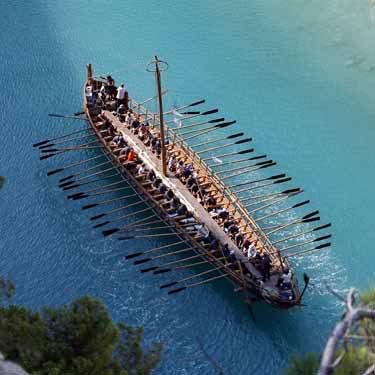
The Argo Sails Again

Argo

On June 16 a replica of the mythical ship Argo left Volos in Greece. The original intent was to re-enact Jason and Argonaut's voyage to the kingdom of Colchis (now in Georgia) to retrieve the Golden Fleece, but Turkey refused to guarantee safe passage of the Greek vessel through its waters, so the ship is bound for Venice. It's too bad that politics had to interfere with this educational enterprise. The ship is powered by representatives from the 27 EU countries (perhaps they should have invited Turkey...) and is scheduled to arrive in Venice on August 12th. The BBC has a video showing some of the construction and preparation of the vessel; AFP and ANA have the story.

Here's an excerpt from the Argonautica of Apollonius of Rhodes:

Now when gleaming dawn with bright eyes beheld the lofty peaks of Pelion, and the calm headlands were being drenched as the sea was ruffled by the winds, then Tiphys awoke from sleep; and at once he roused his comrades to go on board and make ready the oars. And a strange cry did the harbour of Pagasae utter, yea and Pelian Argo herself, urging them to set forth. For in her a beam divine had been laid which Athena had brought from an oak of Dodona and fitted in the middle of the stem. (II. 519 ff.)

The original Argo could speak, sort of a prehistorical version of OnStar. Those Greeks thought of everything.

Argo

4.13.2008

BBC Radio gets Juvenal

The subject of this week's Greek and Latin Voices on BBC Radio 3 is the Roman satirist, Juvenal. Though his name is not too familiar, some of his sayings are: "bread and circuses"; "rare bird"; "who will watch the watchers?"; "sound mind in a sound body" (mens sana in corpore sano). I think he would have laughed heartily at the blogosphere:

Since there are so many poets wasting paper and everyone’s time anyway – why not write? (Book I, Satire I, It is Hard Not to Write Satire, line 19)

Here are the programs for this week:

Monday: Maria Wyke sets Juvenal in a literary context and considers how Dr Johnson reworked Satire 3 into his poem, London.

Tuesday: Contemporary writer and satirist Alistair Beaton explains his admiration for Juvenal and how many of the morally questionable ideas of 2nd century Rome are still relevant to 21st century Britain.

Wednesday: Dr Fred Jones of Liverpool University examines Juvenal's literary techniques and discovers a collage of genres taken from both Roman and Greek literature.

Thursday: Dr Susanna Braund looks at recent re-interpretations of Juvenal's Satires and sets Roman satire into a wider context of Roman anxiety about masculinity.

The 15-minute talks will be archived for a week at The Essay.

4.07.2008

The History of Herodotus on BBC Radio 3

The subject of this week's Greek and Latin Voices on BBC Radio 3 is the Father of History, Herodotus.

Monday: Prof Christopher Pelling explores the work of the great Greek historian Herodotus, whose The Histories, the story of the Greco-Persian war in the 5th century BC, was considered the first work of history in western literature.

Tuesday: Author Tom Holland recalls his schoolboy passion for Herodotus' shaggy dog stories, complete with naked queens, dolphins and cannibals, and how, through Herodotus' account of the wars between Greece and Persia in the 5th century BC, he was given his first taste of tragedy.

Wednesday: Prof Emily Greenwood considers the enduring popularity of Herodotus' work and his importance in travel writing, journalism, anthropology, science, and the art of storytelling. In the light of Herodotus' tales of cryptic gifts of animals and arrows, goat-footed men, and bald-headed tribes, she also explores what this 5th-century BC historian can tell us about cultural diversity today.

Thursday: Prof Paul Cartledge looks - through the writings of Herodotus - at the famous battle of Thermopylae, where the West met the East, as 300 Spartans faced the might of the Persian army at a pass known as the 'Hot Gates', and the West won and remained free - just. Prof Cartledge looks at why the Persians lost, why this was such a crucial battle for both sides, and why the 300 Spartans, as they waited for the Persians to attack, spent their time combing their long hair.

The 15-minute talks will be archived for a week at The Essay.

3.02.2008

Greek and Latin Voices Return

After a few weeks off the Greek and Latin Voices series resumes on BBC Radio 3. This week features Euripedes:

Monday: Prof Christopher Pelling examines the life and work of Euripides, whose surviving tragedies fascinate theatre audiences today as much as in 5th century BC Athens.

Tuesday: Distinguished neuroscientist Prof Susan Greenfield explores her lifelong passion for Euripides' play The Bacchae, which she says still offers fresh insights into the workings of the human mind.

Wednesday: Classics professor Simon Goldhill explores how the work of Euripides is open to so many and such different interpretations, and also considers why in recent years his plays are the most frequently staged of all the Greek tragedies.

Thursday: Fiona Macintosh, Senior Research Fellow at the Archive for the Performance of Greek Drama at Oxford, explores the enduring popularity of Euripides through the centuries right up to the present day.

Listen at The Essay.

2.01.2008

Odyssey: Mini

This made me laugh, but then I'm easily amused...

via rogueclassicism

12.15.2007

Reminder: Greek and Latin Voices on BBC Radio 3

Don't miss your last chance to listen to Homer Week on BBC 3's new series, Greek and Latin Voices. The programs are only available online for a week, so make time this weekend to listen to the four 15-minute glimpses into the world of Homer. Monday's show looked at Homer's very human heros, and on Tuesday was presented a perspective on what Homer's work says about poets, perhaps including Homer himself. I particularly enjoyed Wednesday's episode, in which Oliver Taplin takes a literary view and looks at some of Homer's themes and devices. In the last program, poet Michael Longley brings Homer into the modern age through his own poetry. If you do listen to Monday's program, stay online to hear the great music that makes up the rest of the podcast.

Next week they turn to Latin literature and Horace. To see what else is coming up, see the Greek and Latin Voices schedule.

11.25.2007

Crash Course in Classics on BBC Radio 3

BBC Radio 3 will soon be starting a new series of short programmes on the Greek and Roman classics:

Greek And Latin Voices, a new series within BBC Radio 3's The Essay, offers an accessible modern guide to some of the foundation texts of Western culture. Each week, the series focuses on the works of one of the major figures of Greek or Roman literature, philosophy, history and politics, including wide-ranging essays from contemporary novelists and poets, politicians and philosophers, as well as leading classical academics.

The 12-week series will be broadcast in six two-week sections. Each fortnight includes one week with a Greek focus and one week with a Latin focus; those featured over the series include Horace, Augustine, Tacitus, Thucydides, Euripides and Lucien.

The series is anchored by two classical authorities: Chris Pelling (Greek specialist and Regius Professor of Greek at Oxford) and Maria Wyke (Latin). Chris and Maria introduce the first essay in each sequence, offering listeners an opening insight into the life, times and work of the writer in focus. (more...)

The series starts with "Homer week" on December 10, and can be heard at The Essay.

via ARLT