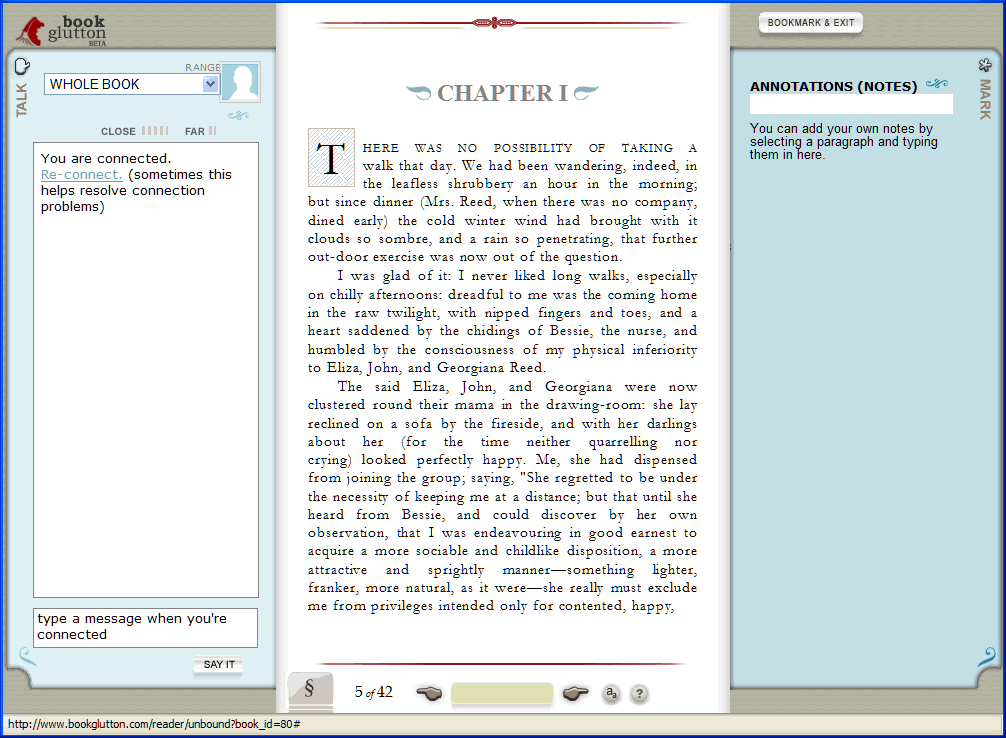
I really have to thank Stefanie for mentioning Paul Saenger’s book, Spaces Between Words: The Origins of Silent Reading. I have always been interested in the origins of language and writing, and reading a little bit of this book on Google Books has supplied many amazing insights into the development of writing and language. We tend to think of the invention of writing, some 5,000 years ago, as the invention of the tool we use to communicate with each other today. In reality it was something quite different.
At first, alphabets lacked vowels, and so words were written out separately, with spaces between them, to make decoding them easier. However, after vowels were invented, it became much easier to decipher words and sentences, and the spaces were eventually abandoned. This sounds incredible to us, since we know how much faster it is to read with spaces, but there is an explanation, or at least a theory.
For one thing, unless you have been trained to read by sight, spaces do not speed up reading. Give text without spaces to an adult and their reading speed slows to a crawl. Give the same text to a young child and their reading speed is pretty much the same because they haven’t progressed beyond the point of reading by sounding out syllables. Adding spaces does not speed up their reading because they haven’t learned to recognize whole words by their shape. Moreover, according to Saenger, if you give a child text without spaces they will automatically read it aloud. This is exactly how the ancients “read.” Today we might call it recitation instead. One ancient text that points to this quite explicitly is the Quran. It’s first word is “Read,” which is interpreted to mean “Recite,” and indeed the book was first transmitted orally and only later written down.
I think the underlying answer to the question of why we stopped using spaces is that writing was developed more as a mnemonic device for oral recitation than as a way to record thought. Saenger doesn’t say this explicitly, but this is how it seems to me. Ancient texts, especially poetry, are full of complex internal rhythm and rhyme that only make sense aloud. This is the natural outgrowth of oral culture. Books were read much as we used to play cassette tapes: from beginning to end. Separating text into sections or paragraphs and numbering pages were not at all common practices, especially among the Romans. “Reference reading,” that is consulting a book for specific information, was unknown. Writing may seem “digital” to us, but it was “analog” to them—an integral oral performance rather than a collection of individual bits of information.
Ancient languages were inflected, meaning that the function of words was determined by their prefixes and suffixes, not word order. Words could theoretically be placed in any position, and they were often jumbled (in our view) for effect. Typically, the whole sentence had to be read and held in working memory before the relations between the words and the meaning of the sentence could be understood. As it turns out, according to modern experiments, we can retain many more words in our memory if we hear them. It is simply much easier and faster to read inflected language aloud, and as pointed out above, if you are reading phonetically, adding spaces doesn’t make it any easier or faster.
So, how is it that we came to our senses and adopted the style of language we use today? I haven’t gotten to all the details in Saenger’s book yet, but it seems that the breakdown in the system of inflection started in late antiquity. The “vulgar” Latin that Jerome used in his monumental translation of the Bible known as the “Vulgate” was already starting to drop inflection in favour of word order. This was considered degenerate by scholars, who were probably concerned with preserving their high erudition, but in the end, utility trumped artistry. Throughout the middle ages, inflection gave way to word order, and thanks to the monks and scribes of Britain and Ireland, spaces between words were reintroduced.
Now language was written according to the logic of cause and effect—subject-verb-object— not according to the music of rhythm and rhyme. Word order allowed people to decode the syntactical meanings of words on the fly, and so it was no longer necessary to say them aloud to keep them in memory. Finally, spaces between words allowed us to start reading even more quickly by recognizing the shapes of words, and we haven’t looked back since.
The adoption of word spacing and word order was, I think, as revolutionary as the invention of writing itself. They not only made reading possible for the masses, they also (along with punctuation) made the writing and reading of more complex thinking possible, and so scholarship blossomed. The Renaissance was probably only a matter of time after that. Yes, we have lost the music of the high poetic language of the ancient orators and poets, but mass literacy and intellectual progress were obviously worth more to our ancestors. The people have spoken!
To test some of this for yourself, try the exercise on this page from Rice University. The site has other interesting information on the development of language as well.