Can’t. Wait.

via @heroinebook and Brontë Blog

Alas there hasn't been much notable movie watching lately at the Classical Bookworm home theatre (to use the term extremely loosely). A couple of weeks ago I did see a very good film about Polish pianist Wladislaw Szpilman. The Pianist is set in Warsaw around the time of World War II and chronicles his familys experiences as Jews under Nazi rule and his struggle to survive during the occupation, bombing, and levelling of Warsaw. It is not an adventure story nor a sentimental hero's tale; it is an extremely well-played character study and real human story. It's a beautifully made film.
Did anyone else watch the new "Masterpiece Classic" version of Wuthering Heights? I confess that I still have not read the book, though I have the general idea. I can't say whether the production was true to the book, but I thought Tom Hardy (any relation?) did a fantastic job of playing Heathcliff as a man beaten down by life and slave to an powerful and eternal passion for Cathy Earnshaw. He looked the part, and the slightest flicker of his eyes spoke volumes. I must see what else he has done because he is an extraordinary actor. You could see the tenderness underneath the violence. His primal scream when he learned of Cathy's death was astounding. I've never seen anything like it. It's worth watching just to see that.
So, seen any good movies lately?

I have a suspicion that people who love good books also tend to love good movies, so I thought it might be fun to start talking about the stories we watch. I know some of you subscribe to Netflix (in Canada it's Zip), but movies don't seem to appear on book blogs very often. Perhaps you all have secret movie blogs on the side...?
It may not surprise you to hear that my movie tastes tend towards the obscure. It's not often that I watch a film without subtitles, or at least an accent. Whatever puts most people to sleep will probably fascinate me. The last movie I went to a theatre to see was a nearly 3-hour, nearly silent documentary about a monastery in France. The parts that weren't silent had subtitles, of course. I loved every minute of it.
This weekend I saw a delightful low-budget film from Germany, Enlightenment Guaranteed. It's about two brothers having mid-life crises who run off to a Zen monastery in Japan and, well, find enlightenment. It's shot in video, not film, but if you can ignore that it's really a very fun and zen-like movie. I can't remember who recommended it, but if it was you, thanks!
I was also recently blown away by Heaven, with Giovanni Ribisi and Cate Blanchett. It was the last film co-written by the late Krzysztof Kieslowsi, of Trois Couleurs fame, a favourite director of mine. It's a gripping story of unexpected love, tragedy, and loyalty. It is visually arresting also—I think it does Kieslowski justice.
So, seen any good movies lately? My Zip list is full to overflowing but I'm always interested in hearing about other good films.
I'm talking about the new adaptation of Mansfield Park, which was aired last night on PBS. Anyone else see it? It is now being pleasantly skewered over at Austen Blog. And what's with "Masterpiece" without the "Theatre"???
Following the fine (?) tradition of Gladiator, Troy, and Alexander, Hollywood will now be bringing us the story of the battle of Thermopylae, a suicide mission in which three hundred Spartans held the Persian army off long enough for the rest of the Greeks to get off their duffs and defend their homeland. According to The Guardian, the new movie, 300, is based on a graphic novel (red flag #1) which features monsters and warriors with superpowers (red flag #2) written by a man who didn't "realise that the hero wasn't necessarily the guy who won" (flaming radioactive red flag #3). Mark my words: no good can come of this.
via ARLT
How could I resist Imani's expressive "OooOOoo"? The book is yours, Cinnimani, if you'll just e-mail me an address I can send it to. (Sorry Wil, your Soldier of Fortune collection will have to march on alone.)
So, what did everyone think of part two of J.E.? Am I just getting to be an old fuddy duddy or was there far too much kissing? I really thought Toby Stephens was going to swallow Ruth Wilson. I nearly gagged when he spoke the line about wishing for a potion to make him more handsome. What were they thinking?!?
They certainly packed a lot of action into two hours but for some reason it wasn't very compelling. Perhaps there was just not enough time to develop the characters; it takes a special actor to walk on, say a few lines, and give the impression of being a complete human being. The scenes with the dying Mrs. Reed were decent (thanks to Tara Fitzgerald), and St. John wasn't bad, but the rest did not impress. Was it not absurd for them to film the supposedly dark, dank Ferndean Manor on a bright, sunny day? Or am I just being as grouchy as Mr. Rochester?
As for the book, I am nearly half way through and enjoying every single syllable!
I had an enjoyable evening watching two new productions based on great novels, Jane Eyre and The Robber Bride. Actually, I'm not sure "enjoyable" is the right word for my experience of watching part one of the latest adaptation of Jane Eyre. I should have known something was wrong when the opening scene depicted young Jane wandering among dunes in a great sandy desert. The scene shifted to her reading a book with pictures of steamy, exotic places. Whaaa? So much for Bewick's History of British Birds and the lonely, storm-tossed northern seabirds.
Things didn't improve much after that. The gothic imagery, music, and even Rochester's brooding seem forced and cliché. I'm still not sure about Ruth Wilson as Jane, but Toby Stephens' muscle-bound, swaggering Rochester, though not as bad as some, is definitely a miss for me. The worst part, though, is the re-writing of the dialogue. The screenwriter actually has Rochester, and then Jane, use the word "youngish," three times in rapid succession. Youngish?!Oy vey. In the same scene he mentions the duel with Céline Varens' cavalier: "I shot him—in the shoulder or some insignificant place." How dull! Compare that with the original: "Next morning I had the pleasure of encountering him; left a bullet in one of his poor etiolated arms, feeble as the wing of a chicken in the pip..." I don't understand the point of adapting a book and then not using the author's words, especially when they are so superior.
But pay no attention to me. I seem to be the only person on two continents who dislikes this production so thoroughly. BrontëBlog has collectedover ascore ofglowingreviews from critics on this side of the pond. I will watch the conclusion of this production but as an antidote I am re-reading Jane Eyre, which I thought to do this year anyway. So far it is as wonderful as ever.
The Robber Bride was much better done, I thought. It starred some of my favourite actresses, Mary-Louise Parker, Wendy Crewson, and Amanda Root (who was Anne Elliot in Persuasion), and the whole cast was excellent. I noticed they cast an aboriginal actor as a police officer, which was refreshing because nationality was completely irrelevant to her part. I can't say much more about the movie since it's been a while since I read the book, but I definitely recommend watching it if you get the chance.
Here is something for everyone:
The new BBC adaptation of Jane Eyre will be airing soon on PBS. I'm not sure I believe Toby Stephens as Rochester, but we'll see. Ciaran Hinds [swoon] set the bar pretty high for that part. I'm glad Tara Fitzgerald is in it, she's great.
Want to spruce up your public library? Check out Change on the Cheap for ideas on how to make your library more functional, inviting, and (it irks me to say this) relevant (as if books could ever be irrelevant!). [via H20boro lib blog]
Want someone to read you a story? Check out GreatBooksAudio.com where Walter Gerald Burek is reading through The Heart of Darkness and also reads a poem every week. Beautiful site, beautiful voice.
In case you missed the link when it was buried in my library rant, do check out Jon Swift's dyn-O-mite post, "Who Needs Books?" Here is a little taste:
If book huggers think reading is so important, they should watch the movie Fahrenheit 451. In that film (which I'm sure is better than the book, which I have not actually read) people live in a future Utopian society where the government keeps the people safe from terrorism and everyone can afford big-screen televisions. The hero of the film is a librarian who has his hands full freeing up shelf space. By the end of the film they arrive at a solution that makes everyone happy. Bookworms memorize the books they like and recite them to someone who cares. I think if people did that today, it would free up even more shelf space for things like video games, which actually promote the skills kids will need to fight the wars of the 21st century.
Book huggers. Love it!
Yes, that's right, I was the last person on the planet who hadn't seen Brokeback Mountain, but now I've seen it and want to cry forever. Sigh. Good message, though. Don't let fear of what may happen, even fear of what is likely to happen, stop you from living the life that is in you. No one wins when we pretend to be something we're not.

UPDATE: I must have this: Brokeback Mountain: Story to Screenplay.
The backless dress has much to answer for!
—Lady Lydia Eliott, from The House of Eliott (Series 1 Episode 2)
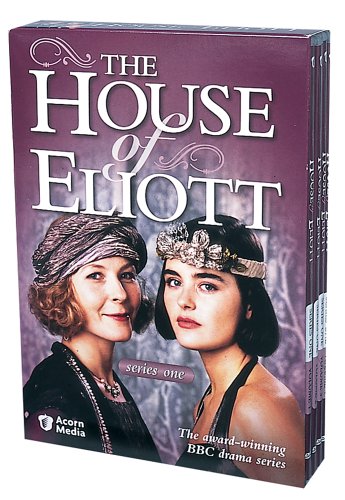
I have to thank Danielle for reminding me about this wonderful series. I saw it a number of years ago and am no less captivated by it now than I was then. It's the story of two genteel sisters who are left nearly penniless when their father dies and must support themselves with their dressmaking skills. It is set in 1920's London, a time of great social change, especially for women. Mrs. Pankhurst and Marie Stopes are mentioned, along with coalminer's strikes and unemployment. No less controversial are the fashions of the day, and the Eliott sisters are in the vanguard when they eventually open their own fashion house. Anyone with the slightest interest in clothes would be well entertained by the award-winning costumes alone, but the writing and acting are excellent as well. Shakespearean actress Barbara Jefford, who plays the arrogant Aunt Lydia, is particularly brilliant and reminds us what good acting is suppposed to be like. Sadly, my library doesn't carry the second and third seasons, but they do have the companion book by Jean Marsh (of Upstairs Downstairs fame), co-creator of the series. I can't get the theme song out of my head now, but the funny thing is that I don't mind! Now if only I knew how to do the Charleston...
It's movie night at Bookworm, and coincidentally it's a Slaves of Golconda double feature. First, The Prime of Miss Jean Brodie with the magnificent Maggie Smith. It's a shame they could only give her one Oscar for her performance. It was spectacular, especially her big fight with Miss Mackay. Wow. I actually applauded at the end of that scene.
The film is based on a play that is a somewhat simplified but generally accurate adaptation of the book. The main departure from the book is when the girls' concocted love letter between Miss Brodie and Mr. Lowther is discovered and precipitates the showdown with Miss Mackay. The characters (especially Mr. Lloyd) take over some of the exposition and also do some interpretation, just to make it perfectly clear what is wrong with Miss Brodie. There is no attempt to emulate Spark's style of writing— the film is conventional— it is the characters and the acting that make it great.
On a girly note, I have to say I enjoyed the costumes too. Smith looked downright sexy in her close-fitting jackets and pencil skirts. Only a woman with her impeccable posture could breathe in some of those outfits!
The second movie I caught by coincidence on TV. It was The Island of Doctor Moreau. I won't go into any details since the Slaves of Golconda are going to read the book together. I'll just say that it's f--ing freaky and philosophically fascinating. I had to laugh at the parental guidance warnings. Forget the violence, the thing is fr-eaky!!! I plan to read the book on nice sunny mornings with a cat in my lap. Oh wait, bad idea. Maybe a plant. Yes, a plant would be much better.
When Danielle at A Work in Progress mentioned that Monster... I mean, Masterpiece Theatre would be airing the BBC production of Dickens' Bleak House, I thought, "That's nice, but it doesn't fit in with my grand reading plan; I haven't even started the Epic of Gilgamesh yet!"  However, this evening I found myself with my Latin homework done and no further ambitions for the day so I tuned in. Let me tell you, it was riveting. What a marvellous cast, including the devilishly handsome, "when he good, he's very good; when he's bad, he's better," Mr. Charles Dance. (Is it just me or is it getting warm in here?)
I haven't read the book so I can't critique it as an adaptation, but as a stand-alone drama it is top quality, just as we expect from the BBC. If you missed the first episode and haven't read the book, do read the synopsis before attempting episode two. Already, after one instalment, schemes, suspicions, and entanglements abound. With another 13 hours to go I can only imagine how juicy things will get. I might just have to interrupt my orderly reading program and give Dickens a try.
COLONEL: My God, where do you get all the books?
MARCO: Oh, I, uh... I got a guy picks 'em out for me. At random. ... He's in, uh, San Francisco. A little bookstore out there and, uh, he ships 'em to me wherever I happen to be stationed.
COLONEL: You've read them all?
MARCO: Yeah. They also make great insulation against an enemy attack. But the truth of the matter is that I'm just interested, you know, in, uh, principles of modern banking and history of piracy, paintings of Orozco, modern French theatre, the jurisprudential factors of Mafia administration, diseases of horses and novels of Joyce Cary and ethnic choices of the Arabs -- things like that.
Marco realizes he's rambling. The Colonel looks at him, concerned. A long pause.
COLONEL: Ben?
MARCO: Sir?
—The Manchurian Candidate (from the screenplay)
The Colonel then orders Major Marco to take some sick leave so he can be crazy without bothering the department. Great movie (the original; I haven't seen the recent version). Not one to watch before going to sleep, though. I don't think I'll be playing solitaire for a while.
One of my recent site hits came from a search for "films based on novels" and it reminded me of a business idea I once had. Actually, "business fantasy" is more apt since I have no intention of establishing such a business—but I wish someone would. The business would rent (and sell) movies based on literature and sell the corresponding books right next to the videos. The idea is that if people like the movie they'll want to read the book and vice versa. Most of my videos and DVDs have counterparts on my bookshelves, so I think there's a market for this sort of thing. And with so many popular films being based on books I think this venture could be an economic success. Tolkein and Rowling alone could probably keep the place afloat for a decade.
I don't know why the online retailers don't link between different formats of the same story. Video and book databases appear to be strangers to each other. You can see "similar" books with some clicking on amazon.ca, but the results are poor. Suggested books to go with Jane Austen's Persuasion (the film) include Harry Potter and Eats, Shoots and Leaves, with no print edition of Persuasion (or any Austen books) to be found. Starting from the book side of things, there is no way to get directly to the film versions. Things are even worse at Chapters/Indigo, with no option whatsoever to browse books related to a film or films related to a book. [Aside: There is a DVD edition of Persuasion that includes the book, so apparently some publishers are thinking cross-format even if the retailers aren't.] Things are much better at amazon.com, with good linkage between books and movies in both directions, but alas (?) I don't live in the U.S.
Until some enterprising retailer steals my idea and makes a fortune, there is always the library. From the comfort of my own home I can browse the catalogue, reserve the movie versions of the books I love, or the books that inspired the movies I love, and the only thing I have to take out of my wallet is my library card. I'd say that's a pretty good deal.
 I just re-watched one of my favourite films based on one of my favourite novels, Maurice, produced by Merchant-Ivory (who turn out my kind of eye candy), from the book of the same name by E.M. Forster. I've read the book and watched the film countless times over the last 15 years or so, but I got so much more out of it this time. I saw themes and motifs and "character development" that I had not been consciously aware of before. It's almost as if I'm encountering the story for the first time.
 I saw the contrast between Maurice's somewhat brutish but ultimately salvific physicality, and Clive's powerless intellectualism. I saw how they found, lost, and influenced each other, and how they both were affected by and dealt with the prospect of losing their position in society, both becoming physically ill, and then one choosing the liberty of the outlaw and the other choosing comfortable imprisonment. I noticed for the first time that in the final scene, where Clive looks out into the night whither Maurice has escaped with his lover, that the window mullions resemble prison bars, an apt image for the life that Clive has chosen.
I also noticed, as I have noticed in C.S. Lewis and Tolkein as well, that the indoors, city life, privilege, and society are seen as fostering ill health and dishonesty, whereas the outdoors, the "greenwood" as Forster puts it, nurtures health, liberty, honesty, and courage. Forster biographer Nicola Beauman puts it this way:
For the novel is not merely a plea for homosexuals to be allowed to have the same happiness in personal relations as heterosexuals; it is also a heartfelt expression of [E.M. Forester's] belief … that country life is pure, unselfish and full of integrity and that town life is the opposite.
—
This is not the first time that I have been surprised by my perspicacity; my powers of observation have been growing for some time now. Where my new perceptions are coming from, I don't know. I suppose it is partly due to life experience and increased exposure to literature, but I suspect the main contributor is my ongoing study of biblical interpretation, which is after all really just a matter of finding the meaning in narrative and images, in stories. It's a real joy to be more aware of what's going on "behind the scenes" of both favourite and new-to-me books and movies, like having one of my senses restored by some miracle surgery. If this continues I will be a happy bookworm indeed.
—
And if you haven't read or seen Maurice, do pick up a copy. Not only is it a good book and film, it is an important one for it is a story of forbidden love that, unlike most good stories of forbidden love, has a happy ending. As Forster put it, "A happy ending was imperative. I shouldn't have bothered to write otherwise." Society rejects the lovers in this story, but they equally reject society, so what looks like exile and deprivation to us is freedom and comfort to them. The book is dedicated "to a Happier Year," and though the year he was referring to has not yet arrived, we are certainly much closer to it than when this book was written (1914) or even published (1971). I hope there will come a time when a happy ending to a book such as this will not be revolutionary.
Post Script: From Forster's "Terminal note" in Maurice:
I dedicated it 'To a Happier Year' and not altogether vainly. Happiness is its keynote—which by the way has had an unexpected result: it has made the book more difficult to publish. … If it ended unhappily, with a lad dangling from a noose or with a suicide pact, all would be well, for there is no pornography or seduction of minors. But the lovers get away unpunished and consequently recommend crime. Mr. Borenius [the vicar] is too incompetent to catch them, and the only penalty society exacts is an exile they gladly embrace.