1935 saw the start of a new quarterly, The Amateur Musician, edited and published by a Miss Elizabeth Voss. When I wrote an article on The Recorder or English Flute for the third issue I did not know that I should become co-editor by No. 8, and marry my co-editor before No. 15, but that is how it happened!
–Edgar Hunt, The Recorder and its Music

Showing posts with label Art – Music – Dance. Show all posts
Showing posts with label Art – Music – Dance. Show all posts
11.12.2011
Editor and Editrix, a love story

12.09.2010
Make Love Not War, Classical Style
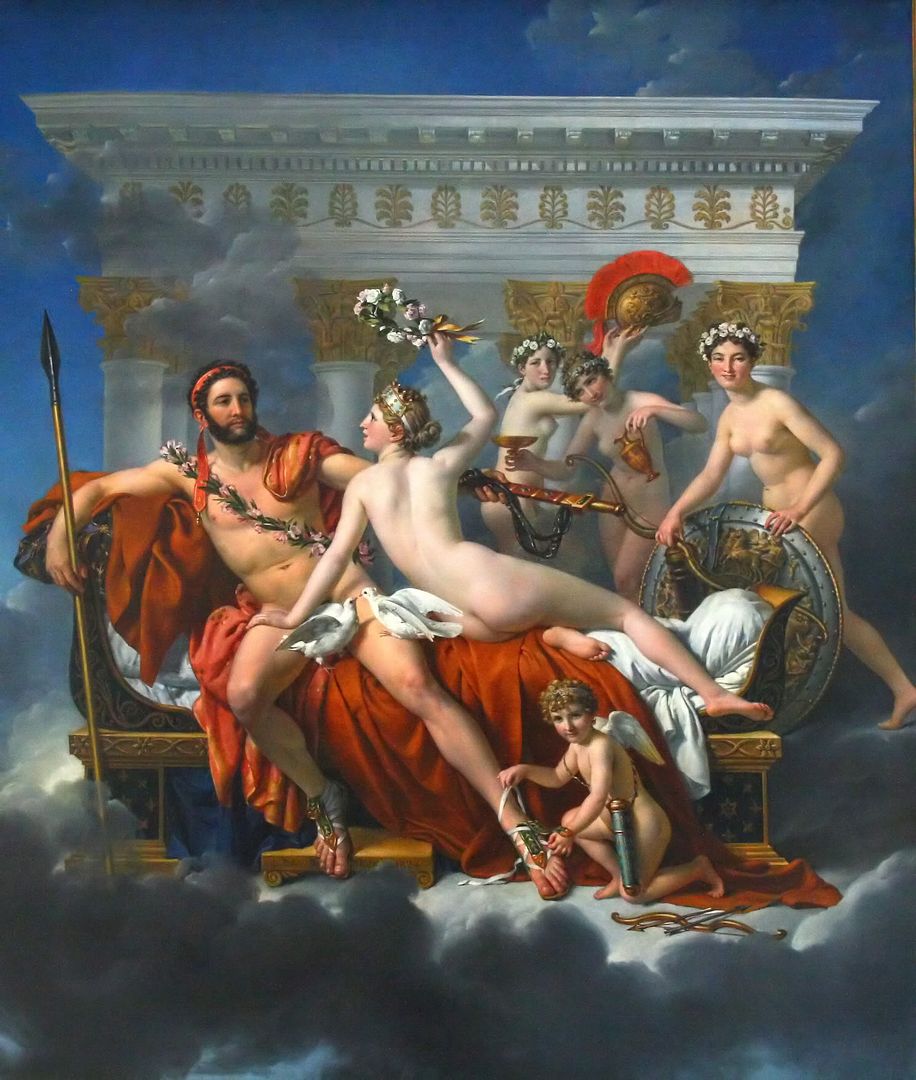
I just got my glorious copy of The Classical Tradition (which I will blog about later), and on the cover is one of the most hilarious paintings I’ve ever seen. It is Jacques-Louis David’s neoclassical romp, Mars being disarmed by Venus. Here we see the Goddess of Love working her feminine wiles to take Mars’ mind off of his petty wars. As you can see, it seems to be working. He is starting to get that far-off look in his eye, and though he is leaning away from her he doesn’t seem to mind her hand on his thigh. Venus’ accomplices include Cupid, who is helping Mars off with his sandals, and the three Graces, Aglaea (Splendour), Euphrosyne (Mirth), and Thalia (Good Cheer), who are confiscating Mars’ armaments and plying him with wine. Even the God of War can’t resist such a multi-pronged attack, and it looks like it will be a total rout.
[click image to enlarge]
11.15.2010
Ulysses and the Sirens by John William Waterhouse
This is my (somewhat frightening) desktop background at the moment. Click to see larger version.

10.13.2010
Pablo Neruda: Atacama
Atacama
Insufferable voice, disseminated
salt, substituted
ash, black bouquet
on whose extreme dewdrop the blind moon
rises, through grieving galleries of copper.
What matter, what hollow swan
plunges its naked agony into the sand
and hardens its slow liquid light?
What hard thunderbolt shatters its emerald
amid the indomitable stones until
the lost salt congeals?
Land, land
above the sea, above the air, above the gallop
of the horsewoman full of coral:
heaping granary where wheat
sleeps in the bells’ tremulous root:
O mother of the ocean!, maker
of blind jasper and golden silica:
upon your pure skin of bread, far from the forest,
nothing but your secret lines,
nothing but mankind’s days and nights,
but beside the thistle’s thirst, where
there’s a submerged and forgotten paper, a stone
marks the deep cradles of sword and cup,
indicates the calcium’s sleeping feet.—Pablo Neruda (Jack Schmitt trans.)

Mano del Desierto / Hand of the Desert by Mario Irarrázabal.
1.12.2010
Four Hands, Two Hearts, One Guitar
I can’t get over how cute this is, so I just had to post it. This is Cecilia Siqueira and Fernando Lima, “Duo Siqueira Lima,” from Brazil, playing their very cozy arrangement of Tico-Tico no Fubá by Zequinha de Abreu. Enjoy!
1.02.2010
2001: A Musical Odyssey
Bowman was aware of some changes in his behaviour patterns. It would have been absurd to expect anything else in the circumstances. He could no longer tolerate silence—except when he was sleeping or talking over the circuit to Earth, he kept the ship's sound system running at almost painful loudness. At first, needing the companionship of the human voice, he had listened to classical plays, especially the works of Shaw, Ibsen and Shakespeare, or poetry readings from Discovery's enormous library of recorded sounds. The problems they dealt with, however, seemed so remote or so easily resolved with a little common sense, that after a while he lost patience with them.
So he switched to opera, usually in Italian or German, so that he was not distracted even by the minimal intellectual content that most operas contained. This phase lasted for two weeks before he realized that the sound of all these superbly trained voices was only exacerbating his loneliness. But what finally ended this cycle was Verdi's Requiem Mass, which he had never heard performed on Earth. The “Dies Irae,” roaring with ominous appropriateness through the empty ship left him completely shattered, and when the trumpets of Doomsday echoed from the Heavens, he could endure no more.
Thereafter he played only instrumental music. He started with the Romantic composers, but shed them one by one as their emotional outpourings became too oppressive. Sibelius, Tchaikovsky, Berlioz, lasted a few weeks; Beethoven, rather longer. He finally found peace, as so many others had done, in the abstract architecture of Bach, occasionally ornamented with Mozart. And so Discovery drove on towards Saturn, as often as not pulsating with the cool music of the harpsichord, the frozen thoughts of a brain that had been dust for twice a hundred years.
—2001: A Space Odyssey by Arthur C. Clarke
I knew where this was heading before he got there. Bach always and everywhere.
12.27.2009
Galileo’s Instruments
“It was the summer of 1609 when on one of my trips to Venice, some startling news reached my ears. A spectacle maker in Holland had presented to Count Maurice of Nassau a glass, manufactured in such a way as to make distant objects appear very near, so that a man at the distance of two miles could be clearly seen. This seemed to me so marvellous an invention that I began to think about it. What if I could make such a device—only more powerful? It appeared to me to have a foundation in the science of perspective. Once again I turned to my lute for inspiration as I contemplated such an instrument.”
—Galileo Galilei, Sidereus Nuncius (via Galileo and His Lute)
Here is some lute music composed by Galileo's brother, Michelangelo Galilei:
9.21.2009
Treasures and Two British Museums
It was with great excitement that I finally made it to the British Museum exhibit at the Royal British Columbia Museum. Treasures: The World’s Cultures from the British Museum is a diverse collection of objects from every continent representing numerous cultures from prehistory to the present day. It’s been here since May but I cleverly managed to put off going until the last fortnight of the exhibition. I’ve made two trips now and thought I would share the bookish highlights. (As always, click images to find larger versions.)
Starting in the Egypt room there was a funerary papyrus sheet from The Book of the Dead. It would have been entombed with the mummy and contained incantations to assist the deceased in the afterlife. You have to admire a culture that provided the dead with reading material!
 The highlight for me was definitely the cuneiform tablets. I’m sure I saw scads of them when my parents took me to the BM as a child, but I have forgotten them. After reading up on Mesopotamia last year I was really looking forward to seeing some again. The first tablet dedicates a new temple to Nininsina. The writing is large, even, and very legible (assuming one can read Old Babylonian).
Next was a compact tablet which turned out to be a letter from king of Egypt to the king of Babylon, kindly requesting tribute (“send more gold!”).
Contrast those with the somewhat larger, crowded, but precise tablet from the magnificent library of Ashurbanipal at Nineveh. This one is a medical text, part of a treatise on treating coughs (very topical in light of the H1N1 flu that is already sweeping the Island). The British Museum describes the writing as “very close but clear and neat Assyrian character,” and indeed the cuts look as sharp as if they were made yesterday, not 2500–3000 years ago. The image below is roughly life size, so it gives you an idea of how small and detailed the writing is.

That was the sum total of the literature displayed, apart from some pages from illuminated Islamic texts, which I can’t find pictures for (perhaps because they depict living beings which is controversial in Islam). Literature was also represented in stone by two magnificent classical busts of Euripides and Marcus Aurelius. That was it, though. Not a single scroll or book from the last 2500 years. Perhaps they are all at the British Library? Here’s hoping they start a road show too!
I also wanted to post a couple of the drawings from the exhibit. There was a mini-gallery of drawings and prints from the European Renaissance and Enlightenment, and two of them really stood out to me. The first is a chalk drawing of Saint Francis by Peter Paul Rubens (1577–1640). I think the composition is very effective and I’m impressed by the confidence of the strokes. It’s hard to spot any restatements—every line is where it is supposed to be.

Another chalk drawing that caught my eye is of a woman drying her foot, by Auguste Renoir (1841–1919). You can see that Renoir repositioned her left hand and perhaps her right foot, but otherwise it is a masterful drawing. I think the natural subject makes it especially beautiful. In a way it is a foil to the Rubens—one forms an angular triangle facing upwards, towards higher things, the other forms a softened triangle facing downwards, engaged in a humble task. They don’t have much in common but I love them both.

7.25.2009
How to Get Great Delts
Become a conductor.

Inma Shara leading the Vatican concert celebrating the 60th anniversary of the Universal Declaration of Human Rights.
7.19.2009
Listen to the Music of the Spheres
Today on Sunday Afternoon in Concert Bill Richardson featured music from Tafelmusik’s special concert programme in honour of the International Year of Astronomy. The Galileo Project: Music of the Spheres features music inspired by the stars and planets from the time of Galileo (who was himself musical). I blogged about it with envy around the time of the concert’s debut, and so I was completely delighted to learn that it is being streamed at CBC Concerts on Demand. What a perfect accompaniment to the Astronomy Reading Challenge!

If you’d like to save a copy of the concert, at least until the CD comes out, try using the Freecorder toolbar. Try different settings if it doesn’t work at first. Vista users might have more luck with the newer Ask & Record toolbar.
3.27.2009
Dreadful and Dreary: B.C.'s Inside Passage
Dread was in fashion in the 1790s, when the word “awful” still had a precise meaning, and images of the vertiginous crag, the dark forest, the storm at sea were calculated to induce a delicious sensation of vicarious terror. It happened that the Pacific Northwest was discovered by whites at the same moment as the idea of the Romantic Sublime was gaining sway. The lonely and forbidding geography of the place perfectly fitted the reigning preconceptions of how a Romantic landscape ought to look. It conveniently combined, within a single view, the essential iconic features of the Swiss Alps, the German forest, and the English Lake District.
There was a single, unfashionable, dissenting voice—that of George Vancouver, known to his men (though never to his face) as Captain Van. At thirty-four, Vancouver was far behind his time…. His posthumously published Voyage gives a candid, heartfelt portrait of the Pacific Northwest as seen through the eyes of a young fogy who was out of touch with the intellectual currents of his own age.
Captain Van took a great shine to Puget Sound and its immediate surroundings. Among the low hills and forest clearings, he was able to imagine himself in a New Albion of close-shaven lawns, artful vistas, rolling fields, and country houses….
But his pleasure in this newfound land soon curdled into repugnance as the expedition sailed north and west into the narrow, mountain-walled channels of the Inside Passage. While his juniors, along with the expedition naturalist, Archibald Menzies, thrilled to dramatic sublimity of their surroundings, Vancouver recoiled from what he saw. The snowcapped peaks were “sterile,” the cliffs of dripping rock and vertical forest were “barren,” “dull” “gloomy,” “dreary,” “comfortless.” Of the much-admired waterfalls, he complained that their incessant noise made it impossible for him to hear any birdsong.
—Jonathan Raban, Introduction to The Pacific Northwest Landscape: A Painted History (Kitty Harmon, Ed.)
Young fogy indeed! Considering how many people come here to retire, and how they love to whack down the forest to put in a lawn that looks like every other lawn that ever was, I think Captain Van would fit in perfectly now. He probably never imagined that some day people would pay good money to travel the Inside Passage and gawk at his “barren” and “dreary” landscape.
3.12.2009
Anselm Kiefer: Sternenfall

This book is a detail from Anselm Kiefer’s 2007 giant installation, Sternenfall (Falling Stars). The cover of this book is supposed to depict part of the milky way, which as you can see is near the constellation of Libra and the Zuben Elgenubi (southern claw of Scorpius). Here is what Kiefer says about his books (which I’ve featured here before):
The books I make account for sixty per cent of my work. They are all unique; they are not published books in the usual sense. I have always been attracted by books because they are a manifestation of time. The time it takes to write a book, and the time it takes to read one, page by page. Paintings are the property of time. You enter a room, you see a painting, and everything is there straight away. You can stand in front of it for longer, to try and understand it better, but you don't have to follow it over any length of time. This is the difference between a picture and a book. The books I make are somewhere between the two: they are books you can move around, and they stand half open. They are books that you can look at like paintings. They are works halfway between apparition and time.
There’s more on Sternenfall at Monumenta, and a dossier is available at the French Ministry of Culture.
via wood s lot
2.22.2009
Natalie Dessay Presents the Diva Workout
If you get a chance to watch the Met’s production of La Fille du Regiment with Natalie Dessay and Juan Diego Flórez, do. It’s a hoot! It has touching moments too, but here is a compilation of some of Natalie Dessay’s vocal and physical acrobatics from that opera.
1.14.2009
Google Art
Google has added an intriguing new layer to Google Earth: The Prado Museum. The Guardian reports that fourteen of the Prado's most famous paintings have been added to Google Earth at an astounding resolution of 14,000 megapixels. This means being able to see detail you can't see with the naked eye. It's certainly not the same as being there, but if you can't be there it's a pretty good substitute.
At present there no plans to expand the Google Earth collection from the Prado or any other museums, but knowing Google this is probably only the beginning. And maybe sculptures will be next!
Does anyone know which famous Spanish painting this noble creature comes from?

via Moderato
Music of the Spheres, or, Why I wish I was in Banff
 Last Friday Tafelmusik helped inaugurate the International Year of Astronomy with a special concert in Banff, Alberta. The Galileo Project: Music of the Spheres is a special program of baroque music from the time of Galileo and inspired by the stars and planets.
Our programme begins and ends with reflections on the ancient concept of the “Music of the Spheres,” thought to have been created by a heavenly ensemble of planets and stars making music together as they move through space. The concert’s opening speech from The Merchant of Venice contains Lorenzo’s beautiful expression of this idea: “There’s not the smallest orb which thou behold’st but in his motion like an angel sings, still quiring to the young-eyed cherubins.”
The subject was treated extensively in Harmonices Mundi (The Harmony of the Worlds, 1619) by Johannes Kepler, who used the formulas from his laws of planetary motion to derive musical intervals and short melodies associated with each planet. We perform these short tunes on their own, and then weave them into the chorale tune “Wie Schön Leuchtet die Morgenstern,” (How Brightly Shines the Morning Star).
Astronomy and Music were closely connected at the time, and astronomers and musicians were sometimes the same people:
Uranus was discovered in 1781 by oboist, organist, composer and amateur astronomer, Sir William Herschel who, like Handel, had moved to England from Hanover. Herschel also built the largest and finest telescopes of his day, catalogued nebulae and discovered infrared radiation with the help of his musician sister Caroline, the discoverer of several comets.
Even Galileo Galilei, whose first astronomical observations we are celebrating this year, was an accomplished lutenist, and his father was a composer who studied the physics of the vibration of his lute strings.
The programme notes for the concert mention the 1719 Dresden Festival of the Planets:
George Frideric Handel made more of a sensation when he travelled from his adopted country of England to his homeland of Germany in order to play at a glittering royal wedding celebration in Dresden in September of 1719. It was a month-long “Festival of the Planets” with numerous operas, balls, outdoor events and special concerts in honour of each of the known planets: Mercury, Venus, Earth, Mars, Jupiter and Saturn....
There are detailed archives of the musical events at the 1719 Festival of the Planets, and we know that not only Handel but also Georg Philipp Telemann, who was living in Frankfurt at the time, joined the renowned musicians employed by Augustus the Strong in Dresden. These included double-bass player Jan Dismas Zelenka and Silvius Leopold Weiss, Europe’s most famous lutenist.
Can you imagine? Unfortunately I can't travel back in time to see Handel or across the country to see Tafelmusik, but I can listen to Bach's ode to Venus, Wie schön leuchtet der Morgenstern (How brightly shines the morning star, BWV 1!):
12.01.2008
Bookworms Crash Online Heritage Library
When Stefanie at So Many Books first posted about Europeana, the European Union's new online heritage library, I virtually ran rather than walked over to the website. Unfortunately, so did every other bookworm, history buff, art lover and cultural aficionado in the Western hemisphere, and we crashed the servers. I mean hard. They were getting up to 15 million hits per hour. Who says people aren't interested in culture and heritage any more? The site is still down but they plan to be back in a couple of weeks. You can get a full update at the New York Times.
via So Many Books
11.27.2008
Another Stolen Painting Returned
A day after posting about a documentary on the Nazi theft of art during World War II, there is news that another stolen painting is being returned to its rightful owners. The Centre Pompidou has given Matisse's Le Mur Rose to a UK charity that supports emergency medical services in Israel, as per the bequest of the deceased inheritor of the painting. This return is particularly meaningful because the Nazi official who took it was in charge of supplying the death camps with poison gas. Now the painting will be auctioned to fund services that will save lives. How appropriate.

11.26.2008
The Rape of Europa
PBS recently aired a riveting documentary called The Rape of Europa, about the theft of artworks by the Nazis during World War II. I knew before that the Nazis had stolen art from the countries they conquered, but I didn't realize it was on such a massive scale. It is estimated that 20% of all Western art was taken away by the Nazis during the war. That's more than the collections of the Louvre, the British Museum, and the Metropolitan Museum combined. Most of it was soon recovered by the Allies, but there are still 100,000 pieces known to be missing. The real number of stolen artworks may be even greater but those who might claim them were also taken away and never heard from again.
It started with the Anschluss, and the looting of art galleries owned by Jews in Vienna. "Looting" isn't exactly the right word, though. These were carefully planned and organized bureaucratic operations. They had shopping lists, and they maintained an air of legitimacy by declaring that property without owners could be confiscated by the government. Of course we all know what happened to the owners.
Poland was hit particularly hard because, as a Slavic nation, it was slated for complete annihilation. Warsaw was systematically levelled, but not before half a million books and works of art were taken away, many of which have not been returned. When the Nazis reached Paris they found the Louvre empty, and they didn't want to antagonize the French by searching for the state art collection, so they concentrated again on Jewish art galleries, and sent boxcar after boxcar full of precious artworks back to Germany.
The scale of the plunder in Russia, another Slavic land, is mind boggling. Although the Russians made heroic attempts to evacuate the Hermitage and other museums, they lacked time, and over a million works of art were taken. To add insult to injury, historic sites were destroyed during the German retreat, including Tolstoy's home, the Pushkin estate, and the Tchaikovsky museum. The Russians later retaliated by taking German artworks, which they still retain as a sort of compensation for the loss of life and heritage caused by a war they didn't start.
The purpose of all this plunder was mainly to fulfill Hitler's grandiose vision of creating the greatest art museum in the world. He wanted to turn his home town of Linz into a world arts center, with theatres, libraries, numerous art galleries, and, of course, his mausoleum. Only "pure" art would be allowed; no "degenerate" modern art, or art by Jews, Slavs, or other "inferior" peoples. It wasn't just Hitler, though. All of the Nazi elite were involved and built up their own vast personal collections as well.
One of the heroes of this tale is French art historian Rose Valland. She was the curator of the Jeu de Paume museum, which became the holding point for artworks being taken to Germany. Unbeknownst to the Nazi officials in charge of transporting the artworks, Valland understood German, and so she heard where the works had come from and where they were going. Every night she wrote down, from memory, everything she had heard. She passed information to the French Resistance so they could avoid blowing up any trains that were carrying art. After the war her records were instrumental in recovering stolen artworks, and she received many honours from her nation and even received a medal from West Germany.

If you missed The Rape of Europa, there are quite a lot of related resources online and in print. You can view the film's trailer at the main website. The filmmakers have also created an educational website which presents a great deal of information and multimedia content on the major themes of the film. The companion book, Rescuing Da Vinci, has its own website, and there is also a website that looks specifically at the role of the Monuments Men, American servicemen whose job it was to protect and repatriate art and architecture during and after the war. The book that inspired the film was The Rape of Europa: The Fate of Europe's Treasures in the Third Reich and the Second World War, by Lynn Nicholas.
9.20.2008
Digging in the Dark
I learned about the modern dance company, Capacitor, through Between Earth and Sky. The author of that book helped the group develop a dance based on the tropical rainforest. It seems that has not been Capacitor's only foray into the realm of science. Those of you participating in the Planet Earth Reading Challenge might be interested in Digging in the Dark, a dance piece based on the geology of our planet. Here are some highlights:
Would you believe they've also created an astronomical dance? Alas there is no video of it available. It would have been nice to see since the International Year of Astronomy is just around the corner.
8.21.2008
On Reading (in Bed)
Thanks to Book Patrol for mentioning the upcoming re-issue of André Kertész' classic photography collection, On Reading. A selection of these wonderful photos of people reading in all sorts of locations is available here. The one below is one of my favourites. Where would the sick be without books?

Subscribe to:
Posts (Atom)