He opened a book he had borrowed from Posulov and stared with distrust at the even lines of print:
“They all promised to cling to one another, to help one another at all times, to rescue one another from danger, to sacrifice their lives for one another if necessary and to avenge the death of any of their number.”
Kozhemyakin drew the lamp nearer without taking his eyes off the book.
“So sacred was this vow that a father would take vengeance on his own son to fulfil the demands of the blood-contract made with the brotherhood.”
He closed the book for a second, then re-opened it cautiously at the first page, put his elbows on the table and began to read. He read as long as his eyes could see, and when at last he raised his head he discovered that the room was light and the trees in the orchard had thrown off the heavy robes of night.
Surprised, he got up and walked about the room, smiling to himself and shaking his weary head.
So that’s what books are for, he thought. So that you don’t notice the passage of time.
Snatches of what he had read floated through his mind like clouds, changing colour and shape, merging, separating, vanishing. He made no effort to hold on to them, so astonished was he by the magic force that could make him forget himself so utterly.
A little later he undressed, lay down and feel fast asleep.
Next morning, as he was washing himself in the kitchen, he said to Shakir:
“Tell anyone who asks for me that I’m not at home.”
“Even Nikon?”
Kozhemyakin considered.
“Yes, even Nikon. Anyone at all. I shall be very busy.”
After breakfast he seated himself by the window and opened the book again.
Reading came to be essential to him It was as if he had been going down a long pathway through open fields and had been stared at from all sides by hostile eyes which seemed to be demanding something of him; he longed to hide from them but there was nowhere to hide; and now he had found a sequestered niche from which he could not get so much as a glimpse of the irritating life around him, a niche in which he could live without noticing the dull monotonous passage of time. He read slowly, going again and again over the lines that pleased him most, and whenever he approached the end of a book he would anxiously finger the diminishing pages that remained….
“…I want some more history,” he said to Posulov.
“There is no more history.”
“What do you mean?” asked the startled and incredulous Kozhemyakin.
“I haven’t got any more books on history.”
“Then get some. When you go to Vorgorod for goods I’ll give you some money to buy books. Serious ones. Ask somebody what to buy.”
So accustomed had he become to reading that he could not get through the day without it, and if he had no new book he would re-read old ones. Amazed by the strength of his passion he said to himself:
Fancy that! I used to look down on people who had a passion for cards and other things, but look at me now….
When Posulov returned and brought him a big box of new books he was overjoyed. He instantly cut the pages of all of them and arranged them in two high stacks on the floor beside his desk; from them he selected Solovyov’s History, put it on his desk, opened it at the first page and walked up and down in front of it for some time, postponing the pleasure of beginning.
Soon he was again reading all day long; reading until his eyes ached, jealously guarding his solitude, going nowhere, taking no interest in anything, hardly bothering to glance at the hands of the clock that noted the passage of time on the yellow fly-spotted face.
—Maxim Gorky, The Life of Matvei Kozhemyakin

12.12.2011
The Life of Matvei Kozhemyakin: The Passage of Time

The Life of Matvei Kozhemyakin: Sweet Tranquility
Peace emanated from the pines, standing straight as candles, their trunks decked with the gold and amber of hardened resin, their boughs shedding the blessing of sweet shade upon the earth, their crowns blazing like emerald flames in the sunlight. Through the billowing green foliage gleamed the gold of the chapel domes, the silver of the river and the yellow of the sand. Apple- and pear-trees, lavishly hung with fruit, stepped in solemn procession down the hill-side, and everything was wrapped in the sweet tranquility of a beautiful dream.
—Maxim Gorky, The Life of Matvei Kozhemyakin
This is one of many beautiful descriptions of the scenery in The Life of Matvei Kozhemyakin. It’s a sad story, but Gorky’s appreciation of nature and the seasons inserts some much-needed beauty into the book.
The Life of Matvei Kozhemyakin: Books
She talked a lot and willingly, and the most important thing he gathered from it all (and this raised him considerably in his own eyes) was that everything she said came from books; all her knowledge had been acquired by reading.
“As soon as you’re well you must get me books,” he insisted.
“Yes, indeed. I’m glad you want to read.”
“So am I.”
Mentally he added: Soon I’ll get to know as much as you do.
It was pleasant to realize that her superiority to him came only from books.
She kept saying over and over again that people must be taught, that then they would be come better and live like human beings. She told him about people who devoted their whole lives to trying to make others upright and to cultivate in them a respect for knowledge. And for this they were thrown into jail and exiled to Siberia.
—Maxim Gorky, The Life of Matvei Kozhemyakin
12.01.2011
The Life of Matvei Kozhemyakin: First Lesson
“What is learning?”
The quietness with which the question was put made the boy’s heart contract with a foretaste of mystery, and be edged nearer to his teacher trustfully.
“Learning,” said the deacon, stroking his pupil’s hair, “is the means by which we acquaint our minds with events in the past, with life in the present, and with human dreams for the future. Learning, then, binds one man to another; in other words, it is a link connecting him with the world as a whole. Now let’s see what that means.
“What are words? Words are the body of the human mind, just as these bodies, yours and mine, are the vesture of the soul, no more and no less. Further: take a book, any book; it is written by a man who lived, let’s say, a hundred years ago and left for our edification all the treasure the man’s soul accumulated in the course of a lifetime. And so we might say: books contain the souls of people who lived before our day or are still living; a book is, as it were, a man’s account to the world at large of his deeds; it is the life record of a human soul. Is that clear?”
—Maxim Gorky, The Life of Matvei Kozhemyakin
1.06.2011
Brideshead Revisited: The Chapel
‘You see, there’s nothing to see. A few pretty things I’d like to show you one day—but not now. But there’s the chapel. You must see that. It’s a monument of art nouveau.’
The last architect to work at Brideshead had added a colonnade and flanking pavilions. One of these was the chapel. We entered it by the public porch (another door led direct to the house); Sebastian dipped his fingers in the water stoup, crossed himself, and genuflected; I copied him. ‘Why do you do that?’ he asked crossly.
‘Just good manners.’
‘Well, you needn’t on my account. You wanted to do sightseeing; how about this?’
The whole interior had been gutted, elaborately refurnished and redecorated in the arts-and-crafts style of the last decade of the nineteenth century. Angels in printed cotton smocks, rambler-roses, flower-spangled meadows, frisking lambs, texts in Celtic script, saints in armour, covered the walls in an intricate patter of clear, bright colours. There was a triptych of pale oak, carved so as to give it the peculiar property of seeming to have been moulded in Plasticine. The sanctuary lamp and all the metal furniture were of bronze, hand-beaten to the patina of a pock-marked skin; the altar steps had a carpet of grass-green, strewn with white and gold daisies.
‘Golly,’ I said.
—Evelyn Waugh, Brideshead Revisited
Brideshead Castle was based upon Madresfield Court in Worcestershire, where Waugh spent time as a youth. The chapel was originally built in 1865 by the 6th Earl of Beauchamp (a member of the Oxford Movement), and later decorated in the Arts and Crafts style as a wedding present to the 7th Earl (a major patron of the Arts and Crafts movement) from his wife. It’s a good thing she didn’t find out that he was gay until much later, otherwise we might not have such an architectural beauty to admire. The chapel is considered by many to be the fullest and finest expression of the Arts and Crafts movement.
Click to enlarge. 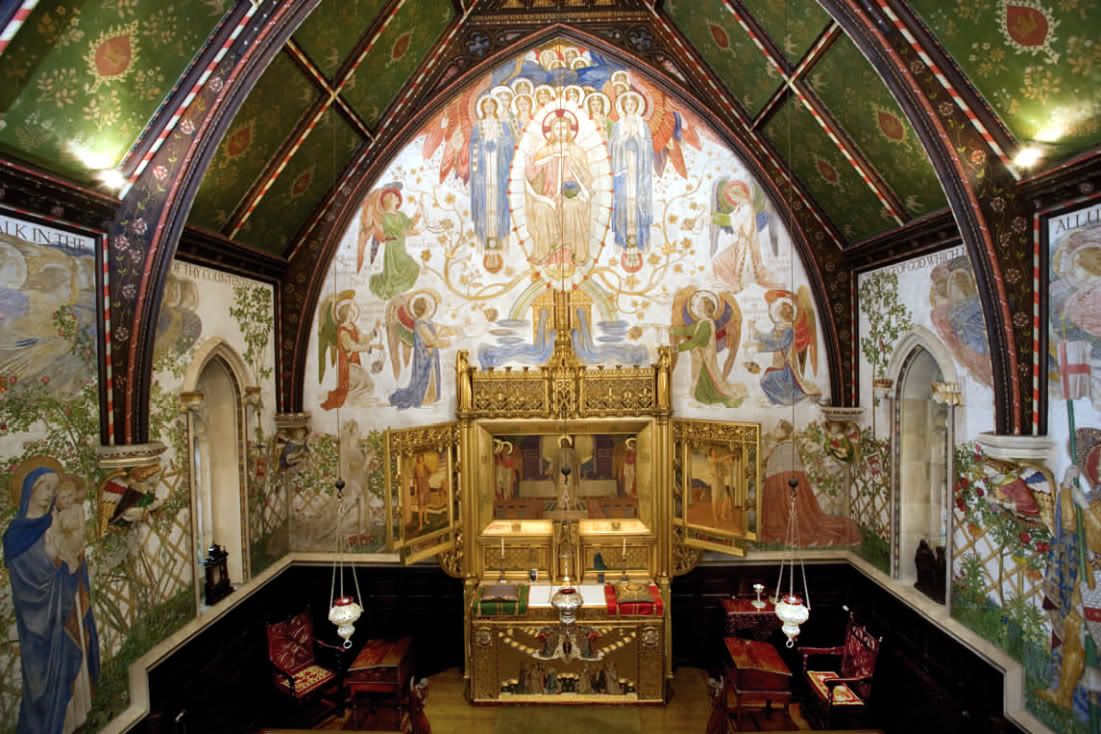

The house also has a magnificent Arts and Crafts library, full of books that the family actually read. Unfortunately, the family is rather private and so there are few good images of the interior online, and none of the library that I can find. Here is a tantalizing description:
Working later from their Cotswold base in Chipping Camden, the master carvers Alec Miller and Will Hart created scenes on four doors and two large bookcase ends which amount to Ashbee’s most successful scheme of interior decoration. The Tree of Knowledge and the Tree of Life form the centre of a series of images – the monkish scholar, the musician, the reaper, the doctor–which allude to the many different paths to learning and wisdom. Yet there is wit too: amidst the root of the Tree of Knowledge the hunched figure of the book thief rubs shoulders with the lowest forms of animal life, the toad, the rat and the weasel.
You can read more about the library and house in this pdf guide book. There is also a book on Madresfield containing more pictures and a history of the house and family, which goes back almost 1,00o years. Madresfield has another literary claim to fame: A past legal battle over inheritance in the family is said to be the inspiration for Charles Dickens’ Bleak House.
6.11.2009
Anne of Green Gables: Orphans and Kangaroos
“Matthew went to Bright River. We’re getting a little boy from an orphan asylum in Nova Scotia and he’s coming on the train to-night.”
If Marilla had said that Matthew had gone to Bright River to meet a kangaroo from Australia Mrs. Rachel could not have been more astonished. She was actually stricken dumb for five seconds.
—Lucy Maud Montgomery, Anne of Green Gables
I’m not sure how I managed to grow up in this country without reading Anne of Green Gables. It is undoubtedly our best-loved children’s classic (though Wikipedia says it was written for a general audience). Of course I’ve seen the wonderful CBC production with Megan Follows, but I hadn’t ever read the book. I bought a copy last year in honour of Anne’s centenary but didn’t get around to opening it. Finally now I am listening to the audiobook, and, not surprisingly, it is a complete delight. I’m still laughing about that kangaroo comment. Things like that don’t translate to the screen, so even though I know exactly what happens in the story I expect to enjoy this book thoroughly. And since there are a total of 8 Anne books, I have plenty more to look forward to.
11.01.2007
Neruda: Ode to the Dictionary
I happened into a book store today and the spirit of Chilean literature led me to a copy of The Poetry of Pablo Neruda. When I got the book home, it opened to this (apologies in advance for any typos):
Odo al Diccionario Lomo de buey, pesado El gran mago callaba. | Ode to the Dictionary Back like an ox, beast of The Great Magus said nothing. |
El Diccionario, Per un día, Aparto una Diccionario, no eres Diccionario, una mano | The Dictionary, But one day, I Dictionary, you are not a Dictionary, let one hand |
8.27.2007
Bilbo Baggins on Happy Endings
"...What about helping me with my book, and making a start on the next? Have you thought of an ending?"
"Yes, several, and all are dark and unpleasant," said Frodo.
"Oh, that won't do!" said Bilbo. "Books ought to have good endings. How would this do: and they all settled down and lived together happily ever after?"
"It will do well, if it ever comes to that," said Frodo.
"Ah!" said Sam. "And where will they live? That's what I often wonder."
—J.R.R. Tolkien, The Lord of the Rings
This little exchange, which happens early in the book (Rivendell), caught my attention and I meant to blog about it earlier. It seemed like a direct statement by the author, and what I've learned since about Tolkien's views on happy endings confirms it. Funny how it stood out to me and then I ended up quibbling with his happy ending.
8.24.2007
More on Rings and Happy Endings
I was reminded of how some people compare The Lord of the Rings with Wagner's Ring Cycle, and it occurred to me that I find the ending of the Ring Cycle far more satisfying than the ending of Tolkien's story. There are some similarities between them: the rings of power are both destroyed (or at least placed out of reach); and the rule of supernatural beings ends. In both, humans (or mortals in general) become free to decide their own destinies. How this comes about, dramatically, couldn't be more different, though.
In the Ring Cycle, it is the gods and demi-gods who are the main characters, not humans (or mortals, in the Tolkien). In the end they are destroyed, while the immortals in LOTR, as well as the central hero, Frodo, are rewarded with eternal life in what sounds like a Garden of Eden. In the Ring Cycle, salvation comes, inadvertently, from the gods themselves—the hero Siegfried defeats the king of the gods, Wotan (his grandfather), but is later killed by treachery, and the heroine Brünnhilde (daughter of Wotan) sacrifices her immortality and then her life, and relinquishes the ring of her own free will. The story ends with a great conflagration at Valhalla and incredibly beautiful music (which always gets me boo-hooing) heralding the age of freedom for humanity.
Obviously Wagner has an advantage in being able to use music to elicit emotions, but I still think the way he ends his story, with so much loss and sacrifice, but also unalloyed Joy (to use Tolkien's word), is much more powerful than Tolkien's romantic Happy Ending. I just can't figure out why, other than to suppose that Wagner was just better able to tap into the primal power of myth. I'm really not sure what that is, but I suspect it goes beyond both romance and tragedy; perhaps it is the best of both. Perhaps it is simply the art of catharsis. I know there are one or two of you out there who are familiar with both works—what do you think?
8.23.2007
Tolkien and Happy Endings
 When I finished my last reading of The Lord of the Rings, I expressed some disappointment at how briefly and tidily Tolkien resolved such an epic tale. Thanks to Nick I learned of Tolkien's essay, On Fairy-Stories, which describes his philosophy on happy endings, among other things. [The essay is published in Tree and Leaf as well as The Tolkien Reader.]
The essay starts with an attempt to define the "fairy-story," a term which he prefers to "fairy tale" because the OED definition of the latter term did not suit his purpose, and he does not dare to quibble with the OED. Though he admits that it is part of the nature of fairy stories to be indefinable, he defines them as stories from the land of Faërie, where men are men, and magic is real. Faeries themselves are optional, but humans are not. He distinguishes fairy-stories from "beast fables," which involve only animals, and dream stories, which do not attempt to create a real "Secondary World." Stories with only magical beings he describes as rare and uninteresting, and science fiction is only briefly mentioned, and not too positively since he connects it with the ugly "robot-factories" of industrialism.
Readers of Harry Potter would be heartened by his assertion that fairy-stories, if they are good, are perfectly legitimate reading for adults. He questions the connection of fairy-stories with children, and attributes their popularity as children's literature to the "false sentiment" of adults and the docility young readers. He believes that taste in literature is entirely personal, and details his own specific tastes as an infant reader—Alice and Treasure Island, no; anything with dragons, YES! He agrees that fairy-stories, like all literature, should be adapted for children, but that does not mean it should be ignored or denigrated by adults in their full-strength form.
Though Tolkien presents fairy-stories as sharing the qualities of all serious literature, he also identifies four aspects unique (at least in combination) to fairy-stories: Fantasy, Recovery, Escape, and Consolation. Fantasy is the use of Imagination in creating a Secondary World (or "sub-creation"). Tolkien has great respect for this "natural human activity," which for him proceeds directly from God.
Fantasy remains a human right: we make in our measure and in our derivative mode, because we are made: and not only made, but made in the image and likeness of a Maker.
Recovery is the ability of a fairy-story to help us see what is familiar with renewed wonder. He explains it thus:
We do not, or need not, despair of drawing because all lines must be either curved or straight, nor of painting because there are only three "primary" colours. We may indeed be older now, in so far as we are heirs in enjoyment or in practice of many generations of ancestors in the arts. In this inheritance of wealth there may be a danger of boredom or of anxiety to be original, and that may lead to a distaste for fine drawing, delicate pattern, and "pretty" colours, or else to mere manipulation and over-elaboration of old material, clever and heartless. But the true road of escape from such weariness is not to be found in the wilfully awkward, clumsy, or misshapen, not in making all things dark or unremittingly violent; nor in the mixing of colours on through subtlety to drabness, and the fantastical complication of shapes to the point of silliness and on towards delirium. Before we reach such states we need recovery. We should look at green again, and be startled anew (but not blinded) by blue and yellow and red. We should meet the centaur and the dragon, and then perhaps suddenly behold, like the ancient shepherds, sheep, and dogs, and horses—and wolves. This recovery fairy-stories help us to make. In that sense only a taste for them may make us, or keep us, childish.
Tolkien is careful to distinguish between the Escape of the prisoner and the flight of the deserter. It is the prisoner that he sees as the benefactor of fairy-stories, the prison being the "increasing barbarity" of modern life. The fairy-story can have Primary (real) World power by making the reader imagine what the world could be. Revolt, rather than apathy, is the more proper consequence of fairy-story escapism.
Finally Tolkien addresses the topic of Consolation. He writes that "eucatastrophe," i.e. a Happy Ending, is as necessary to the fairy-story as Tragedy is to Drama.
The consolation of fairy-stories, the joy of the happy ending: or more correctly of the good catastrophe, the sudden joyous "turn"(for there is no true end to any fairy-tale): this joy, which is one of the things which fairy-stories can produce supremely well, is not essentially "escapist," nor "fugitive." In its fairy-tale—or otherworld—setting, it is a sudden and miraculous grace: never to be counted on to recur. It does not deny the existence of dyscatastrophe, of sorrow and failure: the possibility of these is necessary to the joy of deliverance; it denies (in the face of much evidence, if you will) universal final defeat and in so far is evangelium, giving a fleeting glimpse of Joy, Joy beyond the walls of the world, poignant as grief.
Tolkien is unable to show, to my satisfaction, why this must be so, but the mention of evangelium gives a hint of where he is coming from. Sure enough, in the Epilogue, which seems to have been written some time after the rest of the essay, and perhaps after some criticism on exactly this point, he reveals that his desire for a happy ending flows directly from his Christian faith.
The Gospels contain a fairy-story, or a story of a larger kind which embraces all the essence of fairy-stories. They contain many marvels—peculiarly artistic, beautiful, and moving: "mythical" in their perfect, self-contained significance; and among the marvels is the greatest and most complete conceivable eucatastrophe. But this story has entered History and the primary world; the desire and aspiration of sub-creation has been raised to the fulfilment of Creation. The Birth of Christ is the eucatastrophe of Man's history. The Resurrection is the eucatastrophe of the story of the Incarnation. The story begins and ends in joy. It has pre-eminently the "inner consistency of reality." There is no tale ever told that men would rather find was true, and none which so many sceptical men [and women, ahem] have accepted as true on its own merits. For the Art of it has the supremely convincing tone of Primary Art, that is, of Creation. To reject it leads either to sadness or to wrath.
Though I find neat and tidy happy endings hard to swallow, I am as intolerant of dyscatastrophe as Tolkein was, and for the same reason. But for me, Easter Sunday and Good Friday need each other; I cannot believe a story that does not contain both. I think part of my problem with The Lord of the Rings is explained here:
Chesterton once remarked that the children in whose company he saw Maeterlinck's Blue Bird were dissatisfied " because it did not end with a Day of Judgement, and it was not revealed to the hero and the heroine that the Dog had been faithful and the Cat faithless." "For children," he says, "are innocent and love justice; while most of us are wicked and naturally prefer mercy."
It seems to me that in the way he finished LOTR, Tolkien reverted to the childhood desire for justice—all who were good lived, all who were bad were killed or were driven out—which is in conflict with the Gospels, as regards the world of humans (which is what we are concerned with, by Tolkien's own definition of the fairy-story). He did not let the weeds grow up among the wheat, and so he lost me. I am being too harsh, though, because Tolkien does not go so far as to say that fairy-stories must in every way conform to the general contours of the story of Creation, and he does allow for their variance from the "Great Eucatastrophe":
All tales may come true; and yet, at the last, redeemed, they may be as like and as unlike the forms that we give them, as Man, finally redeemed, will be like and unlike the fallen that we know.
The essay is appropriately followed by Leaf by Niggle, an allegory about an obsessed, undisciplined painter who grudgingly helps a lame neighbour who himself is blind to the transcendent beauties of nature and art. It is a charming presentation of Divine Judgement, and has a more satisfying happy ending than The Lord of the Rings because in the end, mercy triumphs over judgement. If stories do participate in the Redemption, I doubt this one will need much time in Purgatory.
8.03.2007
Appendix Pain
 I just finished The Lord of the Rings, which I started way back in March as part of the Mythology Folklore Fairy Tale Fantasy Reading Challenge. This was my second reading of it and I enjoyed it as much as the first time, which is to say I enjoyed it a great deal. I did have some quibbles towards the end, though. I got a bit tired of the perfect nobility and capability of the main characters once they had defeated Sauron, and the emphasis on race, rank, and class, which seems at odds with the book's general theme of greatness coming from obscure and imperfect places. Yes, a mere hobbit saved the world but once that's done, and the royal favours have been handed out, everyone can go back to their stations, thank-you-very-much. I know it's a fairy tale but the concluding vision of feudal harmony seemed a bit simplistic compared to the rest of the book. I also thought the final chapters wrapped things up a bit too hurredly and conveniently, but I wouldn't blame Tolkien for wanting to end his monumental labour sooner rather than later.
Once the story is over, though, the reader's labour has not ended. There is the appendix, or rather appendices, six of them, 105 pages worth in my volume. Does anyone read them? I've made a start and have gleaned one or two tidbits to fill in some gaps the story, but I'm not sure I can make it through the "Chronology of the Westlands" or "The Languages and Peoples of the Third Age." I suppose I should read them once so I can feel that I've read the whole book, but it's a bit painful. Has anyone else out there read them?
6.29.2006
"The Prime of Miss Jean Brodie" by Muriel Spark

It was a bit distracting reading The Prime of Miss Jean Brodie right after reading Muriel Spark's autobiography. Just about every page of the book contains some object, setting, or event that was part of Spark's own schoolgirl experience in 1930's Edinburgh. Certainly they have been transposed, modified, reworked to fit the fiction, but it was hard not to notice them as I went along—the musquash coat, the smashing saucer, the poor of Edinburgh, the charismatic teacher enamoured of art and Mussolini.
I found myself wondering which parts not mentioned in her autobiography were also from her real life and which were invented. Spark calls her school years "the most formative years of my life" and devotes a great deal of space to them in her memoir. It's no wonder that the environment that made such an impression on her has made such an impression on readers, even in its rearranged form.
What is this book about? That is the question I had in my mind after reading it, and I confess I can't come up with a good answer. The explanations in the book, mainly given through Sandy, just seem too easy. Or am I mistaken in thinking that a good book must be difficult? Is it as it appears, a story about the dethroning of a frustrated, fascistic, self-deluded woman who wrought havoc among men and girls during her "prime"?
After reading Muriel Spark's autobiography and her descriptions of the various "utterly abnormal" people she had known, it is certainly possible that Spark just wished to create her own species of mental case (inspired by one of her own teachers) and see what would happen when she was unleashed on a variety of vulnerable people. That would be very much like the obsessive observer of human idiosyncrasies that Spark was.
Though broader issues—Calvinism, fascism, Catholicism—feature in the story, I am inclined to believe that the book is more about people than ideas, or, at most, what happens when ideas impinge on personalities formed by nature and distorted by experience. Would Miss Brodie have come to admire Mussolini and Hitler had her lover not died in the war? Would Sandy have become a nun and psychologist were it not for Miss Brodie? How is that Rose was able to "[shake] off Miss Brodie's influence as a dog shakes pond-water form its coat" and the others were not?
As you can see, I seem to have more questions than answers, so I think I'd better go read the other Slaves' posts and learn a thing or two about this book. But before I do that, I'd like to announce that the next Slaves of Golconda read will be chosen by Stefanie of So Many Books. Anything but Clarissa, OK Stefanie?
For more Brodie questions, see ReadingGroupGuides.com.To read the other posts on The Prime of Miss Jean Brodie visit the Slaves of Golconda blog, and then join the discussion at MetaxuCafé.
5.02.2006
"The Virginian" by Owen Wister
 I'm afraid I'm unpardonably late for the Slaves of Golconda's discussion of Owen Wister's The Virginian: Horseman of the Plains. However I have managed to get through it (as the Virginian would say) and will say a few words about it. The Virginian is a portrait of an exceptional cowboy, a proverbial diamond in the rough, whose coarse language and lifestyle belie his natural sense of gentlemanly honour and his mastery of life and men. But I believe it is also a portrait of the idealized America of boundless opportunity, where, as it is said, any boy (at least) can grow up to be President.
Wister expounds his feelings on class and competition directly in his "The Game and the Nation" chapters and indirectly through the romance between the Virginian and the high born Molly Stark. Neither the Narrator nor the Virginian believe that all men are created equal, only that in America all men have "equal liberty" to play the poker of life and rise or fall to the level of their "quality." He calls this "true aristocracy." The Virginian is most certainly a social climber for marrying Molly, but to Wister he is merely taking a wife of the same "quality," regardless of Eastern notions of class and worth.
Wister also seems to admire the ethic of non-interference in others' affairs. It's every man (and horse) for himself out West. Only in extreme cases does the Virginian get involved, but mostly he just watches (or goes on pining for Molly) while man and beast suffer their fates at the hands of evil men. The SPCA and the welfare department would be most unwelcome in Wister's Wyoming. On the other hand, when Molly has found out about the lynching of the cattle rustlers, Wister has a federal court judge explain to her why men must sometimes take the law into their own hands and deal out "justice" at the end of a noose. It seems that where economic interests are at stake, interference becomes a community obligation.
The high point of the cowboy code, if it's placement in the book is any indication, is a man's defense of his good name. The sunset showdown might seem honourable if it were not so very common. Every culture has a similar honour code somewhere in its past (or present), but those societies we call civilized have developed less violent and more ritualized ways of settling the score. However Wister idealizes the return to pagan ways. I use that word deliberately, since Wister deliberately brought in the Bishop at the last minute to represent Christianity's (supposed) impotence in the face of conflict. The Virginian has no use for God, the Prince of Peace, nor the Final Judgment; the only judgment he fears is that of his peers, and with no god to defend him, he must do it himself.
Then there's Molly. Her whole purpose, apart from representing aristocracy at odds with democracy, seems to be to demonstrate that men love a challenge and women really just want to be told what to do. The fact that she is spirited only means that she needs a spirited husband to master her. Naturally I find this, and Wister's many little insults to women throughout the book, quite detestable. The Virginian may have been gallant towards women, but Wister certainly was not.
I am no literary critic, but even I can tell that this book is no masterpiece. The use of the narrator is clumsy at times and the bits of exposition are out of place and probably unnecessary to make Wister's point. The characters seem rather wooden and remote, reminding me of Westworld. Even the Virginian, who displays the greatest range of emotions and whose actions we see the most of, still doesn't seem to me like a flesh and blood person. It is certainly a diverting story, with some philosophical notions that might be of interest to America-watchers, but it's real value is as the root of the Western genre of books and movies. For that reason alone it is worth reading, though perhaps only once.
For your musical enjoyment, the theme from The Good, the Bad, and the Ugly.

For the rest of the posts on The Virginian, see Box of Books or MetaxuCafé, and join in the conversation at the Metaxu Forum.
By the way, I'm glad I'm not the only one who sensed something queer about the narrator's admiration for the Virginian. It's hard to be objective after Brokeback Mountain... Maybe that quote I mentioned earlier was deliberate.
2.27.2006
"The Picture of Dorian Gray" by Oscar Wilde
As my reading schedule was interrupted by a colony of noroviruses that imposed themselves on my hospitality last week, I had only time to read one version of The Picture of Dorian Gray by the Slaves of Golconda posting deadline. I chose to read the first version, published in 1890 in Lippincott's Monthly Magazine, because it created a much greater sensation than the longer and slightly expurgated 1891 version.
That a few homoerotic suggestions would create such a stir seems absurd considering what else is alluded to in the novel, but given the time I can understand that the one was seen to lead to the other. Just before the story was first published, the British newspapers were full of scandals about high persons engaged in low acts with telegraph boys, complete with government cover-ups at the highest level and hints of royal involvement. The scandal, which had gone on for five months, finally died down about two months before Dorian Gray was published, so the public was no doubt fully refreshed and eager for another opportunity to be horrified and disgusted when Wilde's story appeared.
I must admit, however, that I also was horrified and disgusted by The Picture of Dorian Gray. I certainly would not agree with the Victorians that homosexuality is itself corrupt or leads to further corruption, nor that evil, or merely unpleasant, things should never be spoken of. Suppression merely punishes the innocent and protects the guilty. But I can't deny that from a moral standpoint there is much that is distasteful in this story. That is not to say that it is a bad story or that it shouldn't be read for itself, as well as for it's place in literary and social history, but I cannot agree with the story.
Oscar Wilde, in defending Dorian Gray, stated emphatically that art and ethics (or morality) must be kept entirely separate. He also felt that art and life were separate, and even that people were separate, that is, that art could not influence life, and that people could not influence each other. I cannot agree with any of these theses, and indeed The Picture of Dorian Gray seems to contradict him as well. Donald L. Lawler, editor of the Norton Critical Edition of Dorian Gray, calls the story "a sign of contradiction," and I believe this is what he is referring to.
If art and morality were indeed separate, why would Wilde include a "moral" in his story, and, moreover, call attention to this moral when defending his work against his critics? Art, as Wilde conceived of it, should need no moral; it's only subject should be Beauty. By that definition I am not sure that this story qualifies as art. That is the first contradiction.
The second contradiction is about the separation of art and life. In the book we see several examples of art influencing the characters, and not for the better. Basil, inspired by Dorian to create a new style of art, ends up in an idolatrous relationship that initiates the ruin of both. Dorian is captivated by his beauty as it is portrayed by Basil, and this fuels his vanity and desire to hold on to his youth. The vile book given to him by that devil Lord Harry accelerates Dorian's descent into depravity, and he returns to it often to fuel and validate his lust for "experience." If Wilde did not believe that art could influence life, The Picture of Dorian Gray, although fictional, does nothing to advance his cause.
The third contradiction concerns the most important element in the book, that of personal influence. The book begins and ends with it. Events are set in motion by the influence of Dorian's beauty of Basil and the influence of Basil's adoration on Dorian. There are hints that Dorian's nature was always inclined against virtue and that it was merely wakened by contact with Basil and then Lord Henry, but there is stronger evidence against that idea. Again and again we see Dorian, riddled with guilt and on the point of repenting and making amends, come under the subtle influence of Lord Henry and get turned completely against his initial impulses. But even Harry's influence is not enough to quell Dorian's moral instincts, and he must resort to mad obsessions with objets d'art and possibly drugs to avoid his conscience. When he has finally had enough and finally resolves to mend his ways, Harry places one final doubt into Dorian's mind that propels him towards his last desperate act. One might say that Harry failed in converting Dorian entirely, but that he influenced him is unquestionable.
I see this book as a work partly of self-defense and partly of self-doubt. To his critics Wilde said, more than once, that "the real moral of the story is that all excess, as well as all renunciation, brings its punishment." I read into this statement a wish to declare to the world that though he may appear depraved, he is not completely lost to morality and realizes that there must be limits to human behaviour. It stands to reason that he must reject "renunciation" (i.e. virtue) in order to accept his own sexuality, and we can hardly blame him for that. If he lived in a more liberal age I doubt that this book, with that moral, would have had to be written.
As for self-doubt, I refer to the contradictions listed above, as well as one more. In one of his public defenses of the book, he wrote:
One stands remote from one's subject matter. One creates it, and one contemplates it. The further away the subject-matter is, the more freely can the artist work. … An artist, sir, has no ethical sympathies at all. Virtue and wickedness are to him simply what the colours on his palette are to the painter. They are no more, and they are no less.
This is exactly the stance that Lord Henry encourages and Dorian cultivates, an "excess" of amorality that is clearly condemned in the book. Yet here is Wilde adopting exactly the same pose. I haven't read much analysis of this book but it almost looks like an act of self-sabotage, which was tragically completed when the book was used against him in court, to his eventual destruction. Did Wilde's unassailable wit and aplomb conceal an equally vigorous inner conflict that expressed itself in The Picture of Dorian Gray? Knowing something of what homosexual people go though even today, it is plausible that Wilde (who was, after all, a human being) succumbed to self-loathing and internalized oppression and that this carried over into his artistic life.
No doubt there are others who have a better idea about this than I do, and intend to carry on reading about this book and Mr. Wilde. Though I can't say I enjoyed the story— indeed I was thoroughly repulsed by Lord Harry's evil philosophy and Dorian's evil acts—I do appreciate Wilde's courage in facing the evils of homophobia and censorship. He helped us get to where we are today, and for that we owe him some thanks.
For more posts and discussion on The Picture of Dorian Gray, visit MetaxuCafé.com.
1.17.2006
“Nineteen Eighty-Four” by George Orwell
I wasn't planning to post about this book, since I was just re-reading it for "fun." However this "fun" little book gave me both nightmares and a few thoughts.
I was probably a teenager when I first read it and didn't know enough about history and politics to understand the relation between Orwell's major themes and reality. It makes sense to me now that Harcourt has published this book along with Animal Farm in one volume. Animal Farm shows how when the "middle" enlists the aid of the "low" to overthrow the "high" in the name of equality, they simply assume the high position until the next revolution, and maintain the hierarchy they formerly despised. It's a game of musical chairs, with the "low" forever consigned to stand. Nineteen Eighty-Four is a fantasy about how it might be possible for the "high" (the Inner Party) to maintain their position indefinitely through the use of technology and by controlling the minds of their only real threat, the "middle" (the Outer Party). As always the "low" (Proles) are used when it is convenient but are otherwise left to their backward, survival-level lives.
 I can't help thinking that if Orwell had not died so young he might have seen socialistic progress in the world that would have made him doubt his Animal Farm thesis. Certainly the forces of oligarchy and oppression are still strong throughout the world but there are places, such as Canada, where equality has truly been increasing, and for several decades in a row. That might not seem like much in the context of human history, but it is reason to hope.
What might also surprise Orwell is that technology has served to increase equality and liberty, particularly telecommunications. Within hours or days the entire world can know of abuses happening in a fortified prison or a remote mountain village. You know that "optics" have become a real political force when the president of Iran cares what CNN reports.
Of course in Nineteen Eighty-Four, technology is used for exactly the opposite purpose, that of keeping people in the dark, particularly about "the enemy" (so as to permit blind fear and hatred) and about history (so as to abolish all memory of freedom). Nineteen Eighty-Four's hero, Winston Smith, whose job it is to rewrite newspaper articles to suit the Party's latest version of the truth, is particularly concerned with history. He yearns for both human memories and tangible evidence of a happier, more beautiful past. He needs a reference point to confirm his suspicion that life is getting worse, contrary to the party line that life is only getting better.
I think I share Winston's passion for history, not because I want to prove that life here is inhumane (it isn't, for most of us), but because knowledge of history is a sure way to prevent it from becoming so. (Technology helps us here too, particularly in the form of printing.) Furthermore, there is much of beauty contained in history, something Winston is also sensible to, as shown by his attraction to the cream-papered diary and coral paperweight he found in a Prole shop. While nostalgia can be as dangerous as ignorance of the past, there is much we can gain from studying how our ancestors solved the eternal human problems. We are in an especially enviable position in having access to the histories of many peoples, not just our own.
Another way the Inner Party controls the Outer Party is through the manipulation of language, which Orwell also touches on in his essay Politics and the English Language. The appendix on "Newspeak" in Nineteen Eighty-Four shows, I think, that Orwell was most concerned about the use of language for political purposes (not surprising for a writer). The general aim of Newspeak was to remove from the language all words dealing with freedom, equality, truth, and justice in order to remove those concepts from the consciousness of the people. It also sought to reduce the language to simple, monotonous, arrhythmic words to accord with the ugliness of life under "IngSoc," the principles under which the society was run. Pure Newspeak was said to sound like a duck quacking, and it was considered a compliment to say that a Party member was a good duckspeaker.
In this case I think Orwell would be unhappy with how modern political parties can now "frame the debate" to gain support while hiding the true nature of their beliefs and intentions. And I think he would be horrified at how certain words have been co-opted (Patriot Act) or denigrated (welfare) so that they can no longer be used for their original meanings. Due to the richness of the English language we are not in any danger of running out of words, but our political vocabulary does seem to be eroding.
In the book, not only does the Inner Party control language and history, it can control the mind directly through torture, mind games, drugs, and a technology that resembles electroshock therapy. By controlling the mind the Party can erase and prevent all perceptions that might call the Party's truth into question. Winston tries to hold on to his belief in objective truth but is vanquished by the mind-control techniques. The flaw in this system is that the human body is still able to register objective truth even if the mind cannot. Winston missed this entirely. I would say Orwell missed it too except that he makes a point of describing Winston's various ailments, how they clear up during his love affair with Julia, and how they return even worse after his "cure." The body doesn't lie about the conditions of life, as we well know in our age of the diseases of affluence.
The ultimate form of control was control of the heart. The Party is not interested in exacting confessions and accusations, though that is done through regular torture as a matter of course. The Party wants to own its people, body and soul. To complete this process they expose malcontents to their greatest fear, which inevitably leads to the greatest betrayal, that of wishing the punishment to be taken out one's the beloved rather than oneself. This is the last, irrevocable step towards total acceptance of IngSoc.
It's hard for me to put my thoughts together about this, but I keep thinking of the many Christian (and other) martyrs (if I can use a word that is denigrated today) who consciously risked and sacrificed their lives for others. The story of Winston Smith represents total despair—with no possibility of healing and forgiveness—the polar opposite of my faith and of many faiths. I appreciate the book as a warning against totalitarian control of life and mind, but I reject the idea that the soul or spirit or will can be controlled. It may be injured and hindered, perhaps, but never destroyed or controlled. Ultimately this is a work of fiction, and I am glad of it.
12.18.2005
“Chronicle of a Death Foretold” by Gabriel García Márquez
Wow. What an amazing book. I feel like I've been dazzled and bewildered by the tropical sun and a profusion of many-coloured birds and flowers. I find myself trying to unravel the layers of memory and put events into order but I think that is not what we are meant to do. I too find that my "linear habits" have "begun to spin around a single common anxiety...trying to give order to the chain of many chance events that had made absurdity possible."
In the case of the townspeople of this novella, that anxiety is, I believe, the desire to fit into a myth, to find "an exact knowledge of the place and the mission assigned to us by fate." In a lecture titled Gabriel García Márquez and the invention of America," Carlos Fuentes said:
One way of seeing Latin American history, then, is as a pilgrimage from a founding utopia to a cruel epic that degrades utopia if the mythic imagination does not intervene so as to interrupt the onslaught of fatality and seek to recover the possibilities of freedom. One of the more extraordinary aspects of García Márquez's novels is that its structure corresponds to the profounder historicity of Latin America: the tension between utopia, epic, and myth.
I don't pretend to understand this fully—I know little of Latin American history, I've read almost no Latin American literature, and though I have blood ties to the region I was raised in el Norte—but this book gives the strong impression of a people desperate to abdicate their personal agency to fit into a myth that is, they hope, more comfortable or at least more orderly than (epic) reality.
Why didn't anyone warn Santiago Nasar that he was about to be killed? On the surface, they were in denial about the possibility that the murder would even be carried out. Deeper than that, though, I think they didn't feel they had the "authority" to interfere with duty and with fate, that is, with the mythic plot (in the literary sense) that had been set in motion. Even Clotilde Armenta, who knew the most about the murderous plot and seemed to believe it the most (i.e. she disbelieved the myth that it was inevitable), could do no more than to implore those close to Nasar to warn first his mother and finally himself. "He's as good as dead already," Pedro Vicario prophesies, partly as a threat, but perhaps partly with the fatalistic awareness that no one was going to stop them, and relieve them from their "horrible duty" to kill.
The other aspect of mythic denial in the book was the denial of Nasar's sexual guilt.
For [the magistrate], just as for Santiago Nasar's closest friends, the victim's very behavior during his last hours was overwhelming proof of his innocence.
This despite the fact that some of his last hours were spent in the brothel, with all his friends, including the narrator. This, among other things, highlights the sexual double standard underlying this drama. Nasar was well known as a "sparrow hawk" who "went about...nipping the bud of any wayward virgin." The narrator admits that his entire generation received the mulatto prostitutes' "mercies," and even one of the killers is suffering from terrible gonorrhea contracted while in the army. At three different times Angela Vicario categorically states that Nasar was her seducer, yet Nasar's guilt is never established in the minds of the community or the magistrate. The sexual impunity enjoyed by men in this community is fully exposed when no one can imagine why he would be sneaking into his fiancées bedroom, as he did just a few minutes before his death.
However, it would be too easy to say that Nasar got his comeuppance. It is difficult to say who was a victim and who was a perpetrator. The entire community was "frightened by its own crime," and sought ways to absolve themselves of a guilt they didn't seem to understand. To the town, Bayardo, the golden-eyed devil in calfskin, was the real victim, the one who "lost everything." Pedro and Pablo were doing their duty, and were absolved by both Church and State. Nasar "expiated the insult," or at least the insult he was supposed to have committed, according to the myth, which no one believed because of the other myth of male sexual innocence. Angela "was in possession of her honor once more" yet her mother tried to "bury her alive" as if Angela was the guilty one. Angela is guilty, but of sexual obsession with Bayardo, who returns to her 17 years later, laying his saddlebags on her sewing machine, giving an indication of the sort of relationship that I imagine would ensue. As in all mythic sacrifice, the actual victim, Nasar, is little more than a symbol of the community's sins and it is entirely according to form that the whole town watches as the door is painted with his blood.
García Márquez is clearly a master of the gory details. I wish I had not read the last chapters so soon after breakfast. The autopsy is described as a "massacre" and indeed it seems to traumatize the whole town, even turning the war-hardened mayor into vegetarian. Try as they might to stay in their myth of honor and order, the "town that was an open wound" doesn't easily recover from the horrifying reality that their mythic living brought about.
There is much more that could be said about sex, class, and race, and about the recurring imagery—flowers, memory, sacrifice, gold, cattle and pigs, blindness and visions—that enrich this story, but I am curious to read the thoughts of the other Slaves of Golconda so I will post this and go join the discussion over at MetaxuCafé.
2.12.2005
The Lion, the Witch, and the War
No that's not a typo. As I mentioned earlier, I've felt moved to re-read my childhood favourites, the Chronicles of Narnia, as Christian allegories. As a child I had no knowledge of Christianity and so took the Chronicles simply as entertaining stories. Now, as a Christian, I can see where Lewis has taken elements from Christianity and weaved them into his story. But I think that is as far as I'd go, stopping short of calling the stories allegorical, any more than The Lord of the Rings is an allegory of World War II.
I just finished The Lion, the Witch and the Wardrobe and saw the many parallels with the Gospels, especially in the last few chapters. Every detail of the sacrifice of Aslan has its Gospel equivalent: his sad night walk with Lucy and Susan (the agony), his beating by the horde of evil creatures (the scourging), the shearing of his mane and subsequent ridicule (the crowning with thorns), and of course the "deeper magic" whereby if an innocent gives himself up to be sacrificed in a traitor's stead then Death will be vanquished. Also, the breaking of the stone table echoes the tearing of the temple veil, and Aslan's brief absence recalls the empty tomb.
 However, there are some departures from the Gospels, mostly to do with violence, which prevent me from calling the story a Christian allegory. First of all, when the White Witch's police arrive, Aslan does not stay his Peter's sword, but in fact encourages him to draw and use it, afterward giving him solemn instructions to clean the blood off his sword after battle. While Jesus instructed his followers to baptize, heal, exorcise demons, and preach the good news, Aslan instructs Peter in how to wage war against the White Witch's army. Far from praying for forgiveness for his killers, the first thing Aslan does upon seeing the White Witch is kill her. Lewis assures us that even those "bad" creatures who were not killed in battle were eventually hunted down and "destroyed."
I know C.S. Lewis was not a pacifist; indeed, how difficult it would have been to espouse nonviolence at the time he wrote these books. But a story ending with the complete annihilation of the "enemy" can never be called Christian. It is in the tradition of the Crusades, not the Gospels. I wonder if this is not why, as a child, and even as a baptized adult, I never associated the Chronicles of Narnia with Christianity.
Of course Lewis' glorification of war doesn't make the Chronicles any less enjoyable as stories. I appreciate a well-crafted "good versus evil" violent catharsis as much as the next person. But I think Tolkein took the safer route by creating a purely pagan world where violence can indeed end violence. By trying to shoehorn the Prince of Peace into a war story Lewis lends false legitimacy to violence and waters down the power of the Christian message of nonviolent love, thus defeating his own (albeit secondary) purpose of introducing children to the fundamentals of Christianity.
The Companion to Narnia by Paul Ford offers this "Christian Creed in Narnian terms":
I believe in the Emperor-beyond-the-Sea who has put within time the Deep Magic, and, before all time, the Deeper Magic.
I believe in his Son Aslan who sang into being all the worlds and all that they contain: Talking Beasts and humans, dumb animals and shining spirits. And I believe that Aslan was a true beast, the king of beasts, a Lion; that for Edmund, a traitor because of his desire for Turkish Delight, he gave himself into the power of the White Witch, who satisfied the requirements of the Deep Magic by killing him most horribly. At the dawn following that darkest, coldest night, he was restored to full life by the Deeper Magic, cracking the Stone Table and, from that moment, setting death to work backwards. He exulted in his new life and went off to rescue all those who had been turned into stone by the Witch's wand and to deliver the whole land from everlasting winter. He will be behind all the stories of our lives; and, when it is time, he will appear again in our world to wind it up, calling all of his creatures whose hearts' desire is to live "farther in and farther up" in his country which contains all real countries.
I believe that upon us all falls the breath of Aslan and that ours are the sweet waters of the Last Sea which enable us to look steadily at the sun. I believe that all who have thrilled or will thrill at the sound of Aslan's name are now our fellow voyagers and our fellow kings and queens; that all of us can be for ever free of our dragonish thoughts and actions; and that one day we will pass through the door of death into "Chapter One of the Great Story, which no one on earth has read; which goes on for ever; in which every chapter is better than the one before."
12.21.2004
The Chronicles of Narnia
I believe I discovered Narnia in Grade 6, and my friends and I made short work of all seven books in C.S. Lewis' Chronicles of Narnia. At lunch time we played winged horses (like Fledge in The Magician's Nephew) combining the stereotypical 12-year-old girl's love of horses with our love for the magic of Narnia. I also recall doing a report on lions, and begging for and receiving a plush toy lion family (which I still have). I was smitten with Aslan and I wanted Narnia to be real.
I never went to church as a child so I was oblivious to the Christian element to the stories. Had I encountered the books later I might have been offended by phrases such as "son of Adam" and "daughter of Eve," but at the time I hadn't yet learned to roll my eyes at the slightest hint of Christian dogma. I now wonder if reading and re-reading these books throughout my adolescence played any part in my later accepting Christianity so whole-heartedly.
My very worn boxed set of the Chronicles of Narnia has been resting on my bookshelves for a few years now, but I am proposing to reread the books, for the first time as a Christian. This has come up because in the last two days I have stumbled across three entirely separate references to Narnia, and I'm not one to dismiss these sorts of "coincidences" without some investigation.
First, in my continuing studies of Girardian theory, I read S. Mark Heim's article, "Visible victim: Christ's death to end sacrifice," which explains the revelation of the cross in terms of René Girard's theory of sacred violence. In it he says:
C. S. Lewis, who knew the mythical heritage of the world better than most, saw this aspect of the crucifixion clearly. In his Christian allegory the Chronicles of Narnia, the lion Asian, the Christ figure, allows himself to be killed so that the evil powers will release those they hold hostage. The idea of this exchange is proposed by the evil powers. The sacrificial process is known to all from the earliest times; it is the law that an innocent one may die on behalf of others and so free them. It is called "deep magic from the dawn of time."
The evil powers love this arrangement and, incidentally, have no intention of keeping their side of the bargain after Aslan is dead. The resurrection comes into this story as an unexpected development, from what Aslan calls "deeper magic from before the dawn of time," something about which the evil powers knew nothing. And when Aslan rises, the ancient stone altar on which the sacrifice was offered cracks and crumbles in pieces, never to be used again. The gospel, then, is not ultimately about the exchange of victims, but about ending the bloodshed.
Well, I am intrigued to say the least. But as if I needed more encouragement to revisit Narnia (which I probably did) I stumbled across the Book-A-Minute summaries of the Chronicles, including this somewhat harsh take on The Last Battle:
(EUSTACE and JILL go back to Narnia. INCOMPREHENSIBLE stuff happens, and they learn how MUSLIMS inadvertently worship SATAN. Then everybody DIES.) THE END
Well, the cynicism of the summary aside, I hadn't seen the pretty obvious connection between the scimitar-waving, turban-sporting Calormenes and real live Muslims. I thought the Calormenes' appearance was simply an expression of racial prejudice (like the many criminals-of-colour that populate cop shows) and took them to be nothing more than generic mythical bad guys. But was Lewis really making a statement about Islam? I want to find out.

12.19.2004
Orwell: "Politics and the English Language"
I just read Politics and the English Language for the first time and I am struck by its relevancy to both the politics and language of today. The clichés Orwell sought to shame out of existence, and even some he thought had been "killed by the jeers of a few journalists," are still alive and well (those last three words being a case in point (ditto)). He is quite right (oy) that repeating stock phrases takes alot of the work out of writing and, worse still, comes across as witty and clever. Hardly a news story goes by (oy again) without a play on some catch-phrase or other. In fact, I am finding that writing a single sentence without relying on "prefabricated phrases" is exceedingly difficult (I give up!). Orwell himself admits the difficulty of writing without imitation, but offers these helpful hints (OK, that one was on purpose).
He doesn't spend quite as much time on bad language in politics, and in fact his two themes seem to have little on common other than their final verbal effects. As he later illustrated in 1984, political language generally consists in hiding true intentions with pleasant but vague language designed to win approval for policies and actions that would be condemned if described in plain language.
In our time, political speech and writing are largely the defense of the indefensible. Things like the continuance of British rule in India, the Russian purges and deportations, the dropping of the atom bombs on Japan, can indeed be defended, but only by arguments which are too brutal for most people to face, and which do not square with the professed aims of the political parties. Thus political language has to consist largely of euphemism, question-begging and sheer cloudy vagueness. Defenseless villages are bombarded from the air, the inhabitants driven out into the countryside, the cattle machine-gunned, the huts set on fire with incendiary bullets: this is called pacification. Millions of peasants are robbed of their farms and sent trudging along the roads with no more than they can carry: this is called transfer of population or rectification of frontiers. People are imprisoned for years without trial, or shot in the back of the neck or sent to die of scurvy in Arctic lumber camps: this is called elimination of unreliable elements.
Would George Bush (Jr.) have won (voting irregularities aside) the presidency by clearly stating he would murder tens of thousands of innocent men, women, and children, destroy infrastructure impoverishing millions more, and poison the environment causing generation after generation of birth defects and cancers, in order to secure American control of dwindling oil supplies? It's not that the electorate wouldn't approve of such a policy, it's that they are aware it is immoral and would not want to be seen to be supporting it. In this essay Orwell does not seem to address the fact that it is also in the voter's interest to be presented with euphemisms (today it's "war on terrorism" and "liberation") so that they may, with a clear conscience, vote in favour of the violence needed to maintain their power and wealth. It's been a while since I read 1984 but I seem to recall that the majority of the citizens in that book were quite happy to hear the Newspeak and participate in the hellish collective enterprise. If I remember incorrectly and it wasn't that way in the book, it certainly is that way now.
via: Liberal Christians: Politics and the English Language.
Orwell's rules:
- Never use a metaphor, simile, or other figure of speech which you are used to seeing in print.
- Never us a long word where a short one will do.
- If it is possible to cut a word out, always cut it out.
- Never use the passive where you can use the active.
- Never use a foreign phrase, a scientific word, or a jargon word if you can think of an everyday English equivalent.
- Break any of these rules sooner than say anything outright barbarous.