
‘You see, there’s nothing to see. A few pretty things I’d like to show you one day—but not now. But there’s the chapel. You must see that. It’s a monument of art nouveau.’
The last architect to work at Brideshead had added a colonnade and flanking pavilions. One of these was the chapel. We entered it by the public porch (another door led direct to the house); Sebastian dipped his fingers in the water stoup, crossed himself, and genuflected; I copied him. ‘Why do you do that?’ he asked crossly.
‘Just good manners.’
‘Well, you needn’t on my account. You wanted to do sightseeing; how about this?’
The whole interior had been gutted, elaborately refurnished and redecorated in the arts-and-crafts style of the last decade of the nineteenth century. Angels in printed cotton smocks, rambler-roses, flower-spangled meadows, frisking lambs, texts in Celtic script, saints in armour, covered the walls in an intricate patter of clear, bright colours. There was a triptych of pale oak, carved so as to give it the peculiar property of seeming to have been moulded in Plasticine. The sanctuary lamp and all the metal furniture were of bronze, hand-beaten to the patina of a pock-marked skin; the altar steps had a carpet of grass-green, strewn with white and gold daisies.
‘Golly,’ I said.
—Evelyn Waugh, Brideshead Revisited
Brideshead Castle was based upon Madresfield Court in Worcestershire, where Waugh spent time as a youth. The chapel was originally built in 1865 by the 6th Earl of Beauchamp (a member of the Oxford Movement), and later decorated in the Arts and Crafts style as a wedding present to the 7th Earl (a major patron of the Arts and Crafts movement) from his wife. It’s a good thing she didn’t find out that he was gay until much later, otherwise we might not have such an architectural beauty to admire. The chapel is considered by many to be the fullest and finest expression of the Arts and Crafts movement.
Click to enlarge. 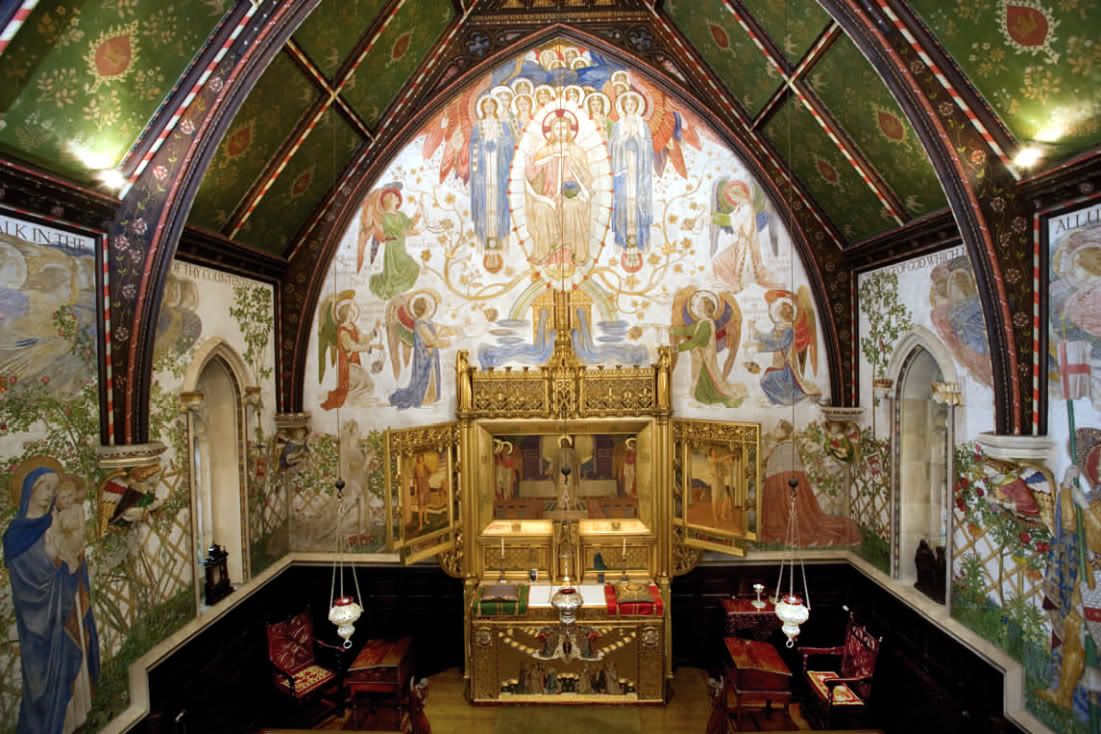

The house also has a magnificent Arts and Crafts library, full of books that the family actually read. Unfortunately, the family is rather private and so there are few good images of the interior online, and none of the library that I can find. Here is a tantalizing description:
Working later from their Cotswold base in Chipping Camden, the master carvers Alec Miller and Will Hart created scenes on four doors and two large bookcase ends which amount to Ashbee’s most successful scheme of interior decoration. The Tree of Knowledge and the Tree of Life form the centre of a series of images – the monkish scholar, the musician, the reaper, the doctor–which allude to the many different paths to learning and wisdom. Yet there is wit too: amidst the root of the Tree of Knowledge the hunched figure of the book thief rubs shoulders with the lowest forms of animal life, the toad, the rat and the weasel.
You can read more about the library and house in this pdf guide book. There is also a book on Madresfield containing more pictures and a history of the house and family, which goes back almost 1,00o years. Madresfield has another literary claim to fame: A past legal battle over inheritance in the family is said to be the inspiration for Charles Dickens’ Bleak House.
