…an ancient scholar read the inscription, which was in Latin; not in English; that would never do. It gave great satisfaction; especially every time there was a good long substantive in the third declension, ablative case, with an adjective to match; at which periods the assembly became very tender, and were much affected.
—Charles Dickens, Life and Adventures of Martin Chuzzlewit

Showing posts with label Latin. Show all posts
Showing posts with label Latin. Show all posts
4.10.2011
Chuzzlewit: The third declension always gets to me too

3.18.2009
Orbis Pictus: English–Latin Encyclopaedia for Children
Earlier this month Project Gutenberg added the Orbis Sensualium Pictus by Johann Amos Comenius to its catalogue. It is a bilingual English–Latin encyclopaedia for children, originally published in 1657 in Dutch and later translated into English. It is said to be the first children’s picture book in print. The volume reproduced at Project Gutenberg, with all the original woodcuts, is the 11th edition from 1727, which gives you an idea of how popular this text was. It progresses logically through the elements that make up the world, humankind, farming, trades, domestic life, navigation, books and learning, astronomy, virtue, society, entertainments, war, and religion. I don’t think children today get such a well-rounded view of how their world works as the children who studied this simple book must have had. Here is an excerpt from the preface explaining the pedagogical intent:
I. To entice witty children to it, that they may not conceit a torment to be in the school, but dainty fare. For it is apparent, that children (even from their infancy almost) are delighted with Pictures, and willingly please their eyes with these lights: And it will be very well worth the pains to have once brought it to pass, that scare-crows may be taken away out of Wisdom’s Gardens.
II. This same little Book will serve to stir up the Attention, which is to be fastened upon things, and even to be sharpened more and more: which is also a great matter. For the Senses (being the main guides of childhood, because therein the mind doth not as yet raise up itself to an abstracted contemplation of things) evermore seek their own objects, and if they be away, they grow dull, and wry themselves hither and thither out of a weariness of themselves: but when their objects are present, they grow merry, wax lively, and willingly suffer themselves to be fastened upon them, till the thing be sufficiently discerned. This Book then will do a good piece of service in taking (especially flickering) wits, and preparing them for deeper studies.
Speaking of deeper studies:

I’m not sure if Master Comenius has done a very good job of making study seem attractive to children, but I suppose staying up late to study is more fun than getting up early to milk the cow.
via LatinTeach
12.06.2008
Reason #72 to Learn Latin
To create obscure LOLcats. The great thing about this is that the more mistakes I make, the funnier the LOL. If you don't read Latin, this classically trained feline is asking for what all cats secretly crave, complete with incorrect grammar. I had to forgo the Z, though, as it was not a part of the ancient Roman alphabet.

11.15.2008
Grammatica Latina Antiqua Sum
Sylvia's Dewey Decimal Section:
475 Classical Latin grammar
Class:
400 Language
Contains:
Linguistics and language books.
What it says about you:
You value communication, even with people who are different from you. You like trying new things don't mind being exposed to unfamiliar territory. You get bored with routines that never change.
Very appropriate considering I've been hitting the Latin pretty hard lately!
via So Many Books
12.15.2007
Reminder: Greek and Latin Voices on BBC Radio 3
Don't miss your last chance to listen to Homer Week on BBC 3's new series, Greek and Latin Voices. The programs are only available online for a week, so make time this weekend to listen to the four 15-minute glimpses into the world of Homer. Monday's show looked at Homer's very human heros, and on Tuesday was presented a perspective on what Homer's work says about poets, perhaps including Homer himself. I particularly enjoyed Wednesday's episode, in which Oliver Taplin takes a literary view and looks at some of Homer's themes and devices. In the last program, poet Michael Longley brings Homer into the modern age through his own poetry. If you do listen to Monday's program, stay online to hear the great music that makes up the rest of the podcast.
Next week they turn to Latin literature and Horace. To see what else is coming up, see the Greek and Latin Voices schedule.
12.08.2007
Latin in the New World
A particularly intriguing chapter concerns the fate of [Latin] in Latin America. The Spanish had been the first for whom the penny had dropped that a modern language, not just Latin, might be given a grammatical rulebook. Elio Antonio de Nebrija (1441-1522) wrote his country's standard Latin textbook, but also a grammar of Spanish.

The idea that modern languages might be analysed and brought into grammatical line came in useful when the conquistadors were faced with a profusion of tongues in the New World. This was a two-way street: not only did missionaries learn Chibcha through Latin mnemonic rhymes, but Aztecs learned good Ciceronian Latin, astounding European visitors with their linguistic virtuosity. Startlingly, the writer sometimes called Guatemala's national poet, Rafael Landívar (1731-93), was responsible for a Latin poem in 15 books called the Rusticatio Mexicana (Mexican Pastoral); judging from the passage quoted by Ostler, it is an accomplished piece of writing.
—Charlotte Higgins, "Latin Lessons" (The Guardian)
Who knew? They really did speak Latin in Latin America. Some of Landívar's poem can be seen here, and there is also a recent book on the poem and its author.
UPDATE: There isn't much online about Rafael Landivar, but it seems he was a highly intelligent Jesuit priest (as if there is any other kind) who was banished and eventually settled in Bologna, where he wrote his epic poem about the land he loved. I'd like to know why he was banished—he wouldn't be the first Jesuit to run afoul of the authorities. I think I'm going to have to get that book.
UPDATE II: After more googling around I find that all the Jesuits were expelled from Spain and its territories in 1767, as part of a general European trend against the powerful order and against Church authority, with a side-order of internal church politics to help things along. The Pope was even pressured to suppress the order in 1773, but they were restored in 1814, after which they bounced back very nicely and continue to do good work in education and social justice.
via ARLT
11.25.2007
Crash Course in Classics on BBC Radio 3
BBC Radio 3 will soon be starting a new series of short programmes on the Greek and Roman classics:
Greek And Latin Voices, a new series within BBC Radio 3's The Essay, offers an accessible modern guide to some of the foundation texts of Western culture. Each week, the series focuses on the works of one of the major figures of Greek or Roman literature, philosophy, history and politics, including wide-ranging essays from contemporary novelists and poets, politicians and philosophers, as well as leading classical academics.
The 12-week series will be broadcast in six two-week sections. Each fortnight includes one week with a Greek focus and one week with a Latin focus; those featured over the series include Horace, Augustine, Tacitus, Thucydides, Euripides and Lucien.
The series is anchored by two classical authorities: Chris Pelling (Greek specialist and Regius Professor of Greek at Oxford) and Maria Wyke (Latin). Chris and Maria introduce the first essay in each sequence, offering listeners an opening insight into the life, times and work of the writer in focus. (more...)
The series starts with "Homer week" on December 10, and can be heard at The Essay.
via ARLT
1.20.2007
12.17.2006
Stumped for Gifts? How About Latin?
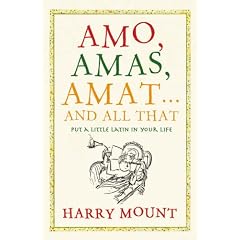 Latin is the new grammar. A recently released book on the subject has become one of the hottest gift books for this Christmas in the UK. Like Eats, Shoots and Leaves,Amo, Amas, Amat... and All That takes what is normally an intimidating subject and tries to make it fun (apparently with much success). At the moment it is ranked 27th on Amazon.co.uk. According to The Independent, publishers are expected to jump on this trend and produce a deluge [from the Latin, diluvium, diluvii, flood] of copycat books. Pretty good for a "dead" language.
via ARLT
3.22.2006
Verbum Bonum: Liber
One of the good words I've learned in Latin is liber, book (not to be confused with the adjective lîber, free). Here it is in some of the homework sentences (let me know if you can't see the accents):
Multî librî antîquî propter sapientiam cônsiliumque erant magnî.
Many ancient books were important because of their wisdom and counsel.
Glôria bonôrum librôrum semper manêbit.
The glory of good books will always endure.
Multî Rômânî magnôs librôs Graecôrum antîquôrum laudâbant.
Many Romans used to praise the great books of the ancient Greeks.
3.10.2006
Amo Sapientiam Antiquam Romanorum
It's been seven weeks since I started my Latin adventure and I thought I'd post an update. I just finished Chapter 4 of the venerable Wheelock's Latin, and am enjoying every minute of it. I begin each chapter thinking there is no way I will be able to assimilate all the new material, but after many (many) drills and exercises it magically becomes easy. I don't know about you but that is my idea of a good time.
The vocabulary is a snap since so many English words come from Latin, and I am getting the hang of the pronunciation rules. The grammar is another matter, but at least the exceptions and weirdnesses are mercifully few. Grote's guide has been invaluable in explaining why Latin is the way it is. Rote learning is all well and good but it's easier to remember the exceptions when you know how they got that way.
I'm already using the little bit of Latin I know. I can now take a stab at the Latin Proverb of the Day (see also the top left of this page), and the bits of Church Latin I'm exposed to are making more sense. In fact I get quite a thrill when I hear something like "gloria in excelsis deo" and can name the grammatical case of each noun in that phrase. I don't just know what it means, I know why it means what it means. It's all I can do not to exclaim, "Hey! That's the ablative!" in the middle of Mass.
 Looking ahead, I can now dream of reading Latin books from the Loeb Classical Library or it's early modern sister, the I Tatti Renaissance Library. The Loeb recently published its 500th volume—coincidentally in Latin rather than Greek—Lesser Declamations I by Quintilian. (And yes, I want to learn Greek too.) Susan at Pages Turned linked to a fascinating article in Harvard Magazine on I Tatti—Rereading the Renaissance by Adam Kirsch—which describes the irony of Renaissance writers who sought immortality by writing in Latin, a language that was made extinct in part by the humanistic values they embraced.
Of course Latin is not quite extinct. It's on life-support, for sure, but it is not dead, as some of my acquaintances seem to delight in proclaiming. There is a small but determined resurgence of Latin in numerous quarters, from public schools to the Vatican, which, one hopes, will resurrect the many defunct Classics departments in our universities. I am particularly hopeful that Pope Benedict XVI's enthusiasm for Latin will catch on in the Church. He is part of the reason I am learning Latin, so I guess you could say it is already working.
Now excuse me while I go find an unblemished calf to sacrifice. It seems we have done something to anger the gods. The last two days of freak snow squalls were just the lead up to what is now a spectacular winter thunderstorm that seems to be occurring directly over the house. The power was knocked out for half a minute, the dogs have been thoroughly spooked, and my car is once again covered in white stuff. Spring can't come soon enough for me.
1.31.2006
"I Know This Sounds Terrifying, But Try To Stay Calm"
This is Dale Grote's advice in chapter two of A Comprehensive Guide to Wheelock's Latin. The terrifying concept in question is the inflection of nouns and adjectives into six different grammatical cases. Simply put, nouns have different "inflected" endings depending on their grammatical function, and adjectives are inflected to match their noun.
What is really terrifying is that some of these inflected endings get recycled, so the same word could have more than one grammatical meaning. As an added bonus, the endings are recycled slightly differently in the singular and the plural. So puellae means of the girl (genitive/possessive) and to/for the girl (dative/indirect object) in the singular, but the corresponding forms in the plural are different (puellârum and puellîs, respectively). Puellîs is also recycled in the plural as by/with the girls (ablative/adverbial), and puellae makes a reappearance in the plural as girls (nominative/subject), or girls (direct address, as in "You go girls!"). No wonder inflection has gone out of fashion. I wonder if Latin represents a transition from greater or lesser inflection? Were primitive languages fully inflected or was Latin (among other inflected languages) an attempt to improve grammatical clarity through greater inflection?
Grote is right, though, it's really not that terrifying after a while if you practice. And practice. And practice some more. As Professor Wheelock says, repetîtiô mâter memoriae.
1.18.2006
Say Quid?
Salvete! I handed in my first Latin assignment today. Woohoo! As I mentioned in passing earlier, I've joined the Atrium Latin study group organized by David Meadows of rogueclassicism fame. There are no marks or credit involved, just answers, and more importantly, structure. The answers I can get online from the publisher of Wheelock's Latin, but structure was something I had failed to generate myself so I was glad for the opportunity to join this group and get on a schedule.
The first chapter in Wheelock's Latin is on verbs, specifically present indicative and imperative active verbs of the first and second conjugations (phew!). However, it was the Introduction that got me flustered, specifically the pronunciation of vowels. In Latin, vowels are either long or short, i.e. they are sounded for a shorter or longer amount of time. In normal written Latin, the length of a vowel is not indicated; you just have to know. In textbooks, long vowels are indicated with a caret or macron over the vowel … except for when they're not.
An unmarked vowel can be long if it is followed by two or more consonants, or x (short for ks), unless it is followed by a stop (p, b, t, d, c, g) and a liquid (l, r), or by qu, ch, ph, or th, because these combinations are pronounced more or less as a single consonant. And just to make things interesting, a long vowel is shortened if, in the process of conjugation (and presumably declension, although I haven't gotten there yet), it occurs before another vowel, or before m, r, or t at the end of a word, or before nt or nd anywhere in the word. I suppose it's better than English in that there are consistent rules, but do there have to be so many of them?
The rules for accent are much simpler, but trying to say a word with an accented short vowel and unaccented long vowels is quite the exercise. I can feel the neurons growing in my Broca's area. It's quite fun, really. To hear some examples, see (and listen to) the Wheelock's Latin pronunciation guide.
Wheelock's Introduction also includes a (very) brief history of English and Latin. Latin and Anglo-Saxon are cognates, which is to say that they were derived from a common Indo-European ancestor language. English, in turn, derived from Anglo-Saxon, but it also has many words that are derived from Latin, either borrowed directly or via French. So our language contains both cognates and derivatives of Latin words, the latter making up about 60 percent of our vocabulary. I don't know how this compares to other non-Romance (especially Germanic) languages but it seems like a lot to me. By contrast, only 10-15% of our vocabulary is derived from Greek. Interesting stuff.
1.14.2006
Latin, English, and Wheelock
…accurate translation from Latin provides a training in observation, analysis, judgment, evaluation, and a sense of linguistic form, clarity, and beauty which is excellent training in the shaping of one's own English expression.
—Frederic M. Wheelock [1902–1987]
If the preface to Wheelock's Latin is any indication, studying Latin does indeed produce crisp, smooth, beautiful English.
Latin class starts next week. Wish me fortuna!
9.12.2005
Carpe Diem
…sapias, vina liques, et spatio brevi
spem longam reseces. Dum loquimur, fugerit invida
aetas: carpe diem, quam minimum credula postero.Be wise, decant the wine, prune back
your long-term hopes. Life ebbs as I speak—
so sieze each day, and grant the next no credit.—Horace, Odes (Carmina), Book I Ode XI
No, I haven't started my study of Latin (see previous post) but I am almost finished my study of The Well-Educated Mind. The last chapter is on poetry, which until recently has been an inscrutible mystery to me, probably due to my former, Bush-like insulation from real life experience, a result (in my case) of youth, introversion, and a stable, cushy environment at home and at school. I'm starting to get it now (whether I like it or not) including the ever-popular "time's a-wastin'" theme. Apparently getting old(er) never gets old.
7.26.2005
Literary Latin
The foreword of The Most Beautiful Libraries in the World features these two latin inscriptions from the Library of Congress:
Liber dilectatio anime
Books, the delight of the soulLitera scripta manet
The written word endures.
I don't know what's more beautiful, these libraries or the spirit behind them.
6.04.2005
Does Latin Make You Liberal?
I think I am officially in love with The Latin Lover, Father Reginald Foster, the Vatican's senior Latinist. I have read several articles about him but this one (via) reveals his unorthodox side.
Perhaps [never seeing the Pope is] fortuitous for Foster, who says popes should ride buses instead of limousines, and who thinks the church needs be more open to women and more willing to address other contemporary issues.
"I think we need a revolution in the church, but no one seems to agree," he said.
It seems to me that an expert linguist needs to be logical (insofar as languages are logical), and that must carry over into other areas of life, in this case, religion. Could it be his training in Latin that helps him see where the Church has gone wrong? Perhaps not, but I think one of my goals in learning Latin will have to be writing a letter (in Latin, of course) to Father Foster telling him that I agree!
4.23.2005
Latin
I've been toying with the idea of learning Latin ever since Pope Benedict said his first papal Mass in Latin. It is the official language of my church, not to mention the language of the Gregorian chant I so love—and anyway, how hard can it be? It didn't take much googling to learn that the standard text for Latin is Wheelock's Latin, which is so standard it has generated a number of helpful spinoffs, namely tworeaders, a workbook, a companion, and flash cards. I did take some Latin in high school and was surprised by how much Latin I could read after a semester of loitering in the back of the class, whispering with my best friend and ogling the fair "Nathanius." Obviously I must have done a few declensions during that time but I remember little more than "agricola" and "puella," plus the little known fact that the plural of octopus is octopedes.
My idea is that learning Latin will, among other things, help me keep tabs on the shenanigans at the Vatican. Although Italian is the lingua franca of the Vatican, I suspect that Latin will be given more prominence with the election of Pope Benedictum XVI. I believe his first papal Mass was an indication of that, and I'm not the only one to think so. This interview (via) with Father Foster, the Vatican's Latin expert, shows that he among others hopes for a renaissance of Latin in the Church.
With new Pope Benedict XVI a strong proponent of Latin - as a cardinal he said the language should not have been completely eliminated from the Catholic Mass - Foster now may have a well-connected fellow Latin evangelist ensconced at the Holy See.
…"Without Latin you are missing out on the whole of Western culture! Without Latin you should just stay in bed!" he exclaims. "The schools don't teach it! The church doesn't use it anymore! Latin is being lost, and because of that we are losing our history!"
…The future of the language, he admits, does not look bright. That is one reason for his evangelism for the language. People who know Foster say the colorful, offbeat persona he has adopted makes him more approachable than he might be if he were viewed as a stuffy and famous academic.
…… "I'm trying to help people who want to learn Latin," he says with a shrug. "But there is only so much one man can do."
Unless that man is the pope. Foster notes that the newly installed Pope Benedict XVI, the former Cardinal Joseph Ratzinger of Germany, speaks excellent Latin. "The problem comes with those under him, the bishops, the priests, the seminarians," Foster says. "They don't have a clue!"
Though he recognizes it is unlikely, Foster says the language would get a great boost if Benedict XVI used Latin more than previous popes. "Latin is a beautiful and poetic language, and people would pay attention to it if the pope spoke the language, spoke it from his heart," Foster says.
…While I'm a big fan of hearing the Mass in my own language (thank you Vatican II), the geek in me likes that idea of learning and using a such an arcane (but important) language. It has been suggested to me that I learn Koine Greek so I can read the New Testament in the original idiom, but Latin seems like a less strenuous introduction to ancient languages considering how many Latin roots I know (including botanical Latin, plus some French and Spanish) and the convenient fact that the Latin alphabet is our alphabet.
Apparently Benedict's inauguration Mass (a few hours from now) will be in Latin, so I will get another chance to hear this language and decide if I want to take all the mystery out of papal Masses and Gregorian chant by learning the language. Votum mihi fortuna!
And get all your Latin news at rogueclassicism, including regular updates on Father Foster's activities.
Subscribe to:
Posts (Atom)