Showing posts with label Libraries. Show all posts

2.11.2012

British Library seeks to acquire Europe’s oldest book

The British Library is trying to raise £9M to acquire what is thought to be Europe’s oldest intact book, the Anglo-Saxon St. Cuthbert Gospel. The late 7th century book still has its original red leather cover, and contains the Gospel of John. The binding is beautifully decorated and the calligraphy is as clear and beautiful as it was when it was written 1300 years ago. You can get a look at it in the video below, and contribute to the acquisition fund at the British Library website.

via @Melwyk

2.10.2012

Duolingo knows me

Spooky.

1.29.2012

Library Video Mashup

11.08.2011

Bulgarian Book Bus

Here’s another one to add to the eclectic assortment of bookmobiles on this planet. This is the Otets Paisiy Public Library located in Plovdiv, Bulgaria. It is named after an 18th century monk who wrote the first history of Bulgaria. See more photos and read more about it at inhabitat.

via Booklover

11.06.2011

Byron’s Books

Newstead Abbey library.

Photo by Norma Bellini. Via Booklover.

8.11.2011

Street Books

Because we all need to read.

1.29.2011

British Libraries in Peril

It is an unfortunate fact of political life that public libraries are easy targets for politicians looking to cut their budgets. Where I live we lost Sunday openings for a year and all buying of new materials has stopped, despite being an affluent area with high library usage. Two years earlier the entire library system was shut down for weeks because the library board did not want to honour a pay equity agreement from 1996. But all that is nothing compared to what is happening in the UK, where over 400 libraries are in danger of being closed. Not only is it monstrous to close libraries on such a scale, it is idiotic to do so during difficult economic times, when the full gamut of library services are the most needed.

Here is an excerpt from a speech given by writer David Crystal in a village library in Wales:

Once a library is gone, it is gone. It cannot suddenly be resuscitated. As the British politician Augustine Birrell (1850-1933) once said: 'Libraries are not made; they grow.' That takes time. Behind each library, no matter how small, is a history of growth, watered by the professionalism of the library's caretakers and the enthusiasm of its readers. It is not an enterprise that can be measured by numbers. It is quality that counts, not quantity. No political body should fall into the trap of judging the success of a library solely in terms of the number of its visitors. That lone reader in the corner: who knows what personal potential will be realized in the future because of today's library experience? As American poet Archibald MacLeish (1892-1982) said: 'What is more important in a library than anything else - than everything else - is the fact that it exists.' If it exists, it will be used. And French writer Victor Hugo (1802-85) sums it up: 'A library implies an act of faith'.

It’s worth reading the whole speech for the plethora of wonderful quotes from all quarters about the value of libraries. Public Library News is tracking the library closings and cuts in the UK, and the national librarians’ organization is organizing a day of action on February 5th. Another way you can help is by sharing what libraries mean to you at Voices for the Library, a collection of personal stories about public libraries. Americans who are concerned about the state of their own library systems can visits Losing Libraries, which maps all US libraries suffering cuts or possible closure, with tips on what to do about it. Perhaps the best thing we can do is follow the same advice our doctors give us as we get older: use it or lose it!

1.12.2011

Library Girl

I spotted this lovely song by Reina del Cid (great name, eh?) at Your Move, Dickens. As a former library girl I can relate!

6.03.2010

Librarians Going Gaga

Prepare to be entertained by the students and faculty of the Information School at the University of Washington:

via Lisa Gold: Research Maven

9.15.2009

Cushing Academy e-Library Update

I found an online transcript of a live chat with the headmaster of Cushing Academy, Dr. James Tracy, talking about their transition to a bookless library. Here are some highlights:

We at Cushing LOVE books - so much that we want our students to have access to millions of them anywhere on campus, not just twenty thousand in the library.   We also are not eliminating books altogether.   Teachers can still assign printed books in their courses and students are encouraged to read printed books for pleasure.

Cushing is a laptop school.   Every student has a laptop for use in the classroom; those on financial aid are provided laptops free of charge.   Every classroom also has a Smart Board, with direct access to the Internet.
All of the books, journals, and data that our library will have available electronically will now be immediately available via wi fi to every student instantaneously in every classroom - and, in fact, anywhere on campus.
We also are providing Kindles and Sony Readers for students who want to read in a more eye-friendly format.   Currently, we are providing 18 of those, because we think students will do most of their research on their laptops.   We will purchase as many as we think the community needs as we get a sense this year of the demand for Kindles and Sony Readers circulating from the library.

One of the biggest challenges ahead is to work out the copyright issues that are holding up some of the access and standardization, especially for new material.   Cushing hopes to work with Amazon and other companies to build models that are profitable for them and feasible for schools.

We are providing all of this free of charge to each student.   Cushing is admittedly an affluent private school with extensive resources, so we are in something of a privileged position in this regard.
We do believe, though, that pioneers like Cushing will build the paradigm that, as costs come down with technological progress, will make this available to even the poorest schools in the developing world at accessible cost.

All of Cushing's administrators spent the summer testing Kindles and Sony Readers.   We fell in love with them and read all of our novels on them now.   It is great to be on a plane with hundreds of books in your hand!

We believe that the costs will actually come down dramatically in the coming years and that the models which Cushing and others are now fine-tuning will make it easier for public school students to have cheap -even free - access to all of the great literature and cultural achievements of human civilization on a scale many orders of magnitude greater than what they can garner from a tiny school library today.

I give the headmaster points for acknowledging that they can do this because they are richer than God, as the saying goes. I do wonder whether encouraging students to read books for pleasure carries much water when you’re getting rid of your book collection. Teens are notoriously adept at spotting when grownups are not walking the walk.

I recently read about another laptop school in much more humble circumstances. Actually it’s a whole laptop school system. As of this month, every student in Uruguay will have an XO laptop of their own and wifi at their school. Under Plan Ceibal [English link on this page], Uruguay’s government has bought a laptop for every student and is connecting every school to their educational network to provide them with internet access and educational materials, including books. Compare this with Chile’s Maletín Literario, in which cases of books are sent to needy families. It will be interesting to see how all of these experiments turn out.

9.12.2009

Is a Library Without Books Still a Library?

I think by now most bibliophiles have seen this:

This year, after having amassed a collection of more than 20,000 books, officials at the pristine [Cushing Academy] campus about 90 minutes west of Boston have decided the 144-year-old school no longer needs a traditional library. The academy’s administrators have decided to discard all their books and have given away half of what stocked their sprawling stacks - the classics, novels, poetry, biographies, tomes on every subject from the humanities to the sciences. The future, they believe, is digital.

“When I look at books, I see an outdated technology, like scrolls before books,’’ said James Tracy, headmaster of Cushing and chief promoter of the bookless campus. “This isn’t ‘Fahrenheit 451’ [the 1953 Ray Bradbury novel in which books are banned]. We’re not discouraging students from reading. We see this as a natural way to shape emerging trends and optimize technology.’’

You heard it here first, folks. After a mere 2,300 years the book has now become obsolete. It would be laughable if it wasn’t part of a well-established general trend to push books further and further down the library totem pole that I’m sure you’ve all see in your local libraries. As Stefanie recently blogged, libraries, or at least some of them, are giddily embracing new technologies. Some of these seem appropriate—I can access newspapers, databases, and all sorts of reference works through my library’s website, an experience that greatly improves on the analog equivalent. I can’t tell you how much I hated spending days on end sifting through scientific journal indexes in university and I’m glad students don’t have to go through that any more. But there’s a difference between gathering information and reading.

I don’t know if advocates of the digital library have really considered the economics and ergonomics of reading. As Stefanie points out in her post, the costs of digital technologies seem to get overlooked. There is this idea that once you digitize a book it will be free and useful forever. Who pays for the data servers, computers, reading devices, database subscriptions, software upgrades, hardware upgrades, IT support, electricity, and disposal of toxic e-waste is a question that is never asked let alone answered. When you consider all of the costs of maintaining constantly changing technology, buying a book once and sticking it on a shelf for a few decades seems like an incredible bargain.

I also wonder how people are supposed to read the books in a digital library. I can’t imagine reading a whole book on screen. It’s simply not that comfortable. With a book you can curl up in an armchair or stretch out on a sofa, read it over breakfast or sitting on the bus. You can change position as often as you like, cuddle with the mammal of your choice, or (as is usually mentioned in these discussions) read it in the bathtub. Of course you can do all that with an e-reader (provided the batteries are charged), but do we expect every man, woman, and child to shell out hundreds of dollars for an e-reader every 3-5 years? Obviously that is not going to be possible for a great many library patrons, and if libraries can’t even buy books now they are certainly not going to be buying thousands of e-readers to loan to their patrons.

There’s also the question of quiet. Reading and thinking require quiet. The human brain has not changed with our changing lifestyles, and the science is clear: more distraction equals poorer reading, thinking, and learning. As libraries add coffee bars, video games, big screens, and other interactive amenities, where are we supposed to read? You would think that in this noisy, infinitely distracted world we would value quiet places even more than before, but the opposite seems to be the case. Just about every news article about libraries that I read makes fun of the “shushing librarian,” as though quiet is old-fashioned and we’ve evolved beyond it. Quiet reflection is out, and manic distraction is in. Unless something changes, there will soon be no place in public life for quiet thoughtfulness at a time when it has become the rarest of commodities. All things considered, if the goal of libraries was to discourage reading, going entirely digital seems like a very good way to go about it.

I think libraries feel that they have to do something. The days of “build it and they will read” are clearly waning. Funding is weakening dangerously and circulation (of books, at least) continues on its downward slide. Libraries have responded by going multimedia, but is this what libraries are for? The one thing libraries traditionally had that you couldn’t get anywhere else was a wide selection of books that are free to read, and a peaceful, quiet place to read them. That is still a combination you can’t get anywhere else. The first rule of marketing is to state what makes your product or service unique. Why aren’t libraries promoting themselves as a way to get away from the rat race and media frenzy, a place to relax, recharge, and just be you for a while?Instead, librarians seem embarrassed by their books and quiet and are eager to assure patrons that they can be as noisy and distracted in a library as they are every place else.

Who knows, turning libraries into public rec rooms might keep overall circulation up, but it will rob society of something it needs, whether it knows it or not. I think society actually does know it, or else it wouldn’t be stampeding in search of quiet and wisdom from yoga, tai chi, meditation, and retreat centres from every branchlet of every tradition you can think of. Aren’t quiet and wisdom what libraries do best? Maybe that’s something they should be making noise about.

12.10.2008

More Modern Library Architecture

The WebUrbanist has just put together a collection of fifteen "dazzling" modern libraries from all over the world. It's a diverse assortment, from the Anchorage "washtub" to Prague's purple and pea green amoeba. Seattle is there, of course, as is Jay Walker's library. Two interesting libraries missing from the list are Salt Lake City's main library and the Vancouver Public Library. I haven't featured the latter before, so here it is:

Vancouver Public Library

Vancouver Public Library

12.01.2008

Bookworms Crash Online Heritage Library

When Stefanie at So Many Books first posted about Europeana, the European Union's new online heritage library, I virtually ran rather than walked over to the website. Unfortunately, so did every other bookworm, history buff, art lover and cultural aficionado in the Western hemisphere, and we crashed the servers. I mean hard. They were getting up to 15 million hits per hour. Who says people aren't interested in culture and heritage any more? The site is still down but they plan to be back in a couple of weeks. You can get a full update at the New York Times.

via So Many Books

10.25.2008

Libraries that Walk

Librarians everywhere are heroes, but there are some librarians in Colombia who literally go the extra mile to bring books to people who don't have them, and they have the cutest bookmobiles you'll ever see:


Get the full story at the New York Times, and check out this other biblioburro in northern Colombia and this bibliomula in neighbouring Venezuela.

via Iconic Books

9.27.2008

The Disneyland of Libraries

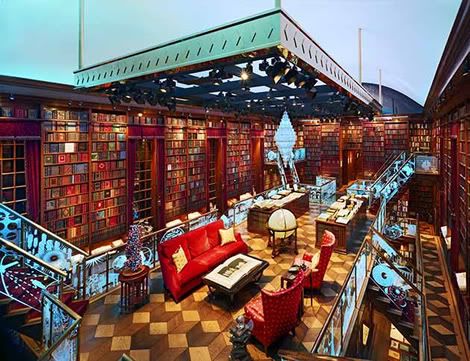
Jay Walker's Library

This is the extraordinary private library of Jay Walker, founder of Walker Digital. Wired Magazine was invited for an exclusive look at this 3,600 square foot, three-level, bibliograpic assault on the senses. The collection features books and objects that call to mind the great scientific and technical discoveries in human history. Globes, telescopes, dinosaur skeletons, even a Sputnik satellite, sit beside groundbreaking books, both old and new, on anatomy, astronomy, geography, and other scientific and technical fields

The library's stated purpose is to stir the imagination and stimulate technological innovation in its owner and his associates. Indeed it does seem like a library built for effect rather than for use. The upper shelves are stocked with modern decorative leather-bound books, with a great many turned sideways to show their covers. Great attention has been paid to lighting, and the library even has its own soundtrack. The glass panels enclosing the central platform and stairways are all etched with scientific and historical icons like the double-helix or the Parthenon (or possibly the NYSE). It is mesmerizing, whimsical, a playground of human discovery, and yet something seems to be missing. It's not entirely real. It's also a shame that only a select few get to enjoy it. Imagine if Mr. Walker put his millions (billions?) into building public libraries with the same kind of verve and life in them? How many young people might be inspired to follow in the footsteps of great scientists and inventors if they could spend time in this sort of environment on a regular basis? Perhaps he needs to add a biography of Andrew Carnegie to his collection.

Jay Walker's Library

via Book Patrol

9.03.2008

Grand Old Censorship

I just had to copy this over from Pages Turned because it's so horrifying:

Stein says that as mayor, Palin continued to inject religious beliefs into her policy at times. "She asked the library how she could go about banning books," he says, because some voters thought they had inappropriate language in them. "The librarian was aghast." That woman, Mary Ellen Baker, couldn't be reached for comment, but news reports from the time show that Palin had threatened to fire Baker for not giving "full support" to the mayor.

—Nathan Thornburgh, Time

The librarian was lucky because in her very short time in public offices Palin has fired numerous officials for disagreeing with her extreme right-wing views. A few rigged voting machines and a heart attack and this woman could be the President of the United States. Think about it. And then get out and stop her.

Update: There's a bit more on Palin's attempt to ban books in the New York Times (via blog.rightreading.com) and the Anchorage Daily News (via Pages Turned).

Update II:Here is the original news story from the Mat-Su Valley Frontiersman (via Pages Turned). I think this is my favourite part:

But on Monday, Oct. 28, Emmons said Palin asked her outright if she
could live with censorship of library books. This was during a weak (sic)
when Palin was requesting resignations from all  the city's department
heads as a way of expressing loyalty.

What is this, the middle ages? Did Palin think she was running a feudal duchy? Someone needs to explain democracy to her. Soon.

8.12.2008

Salt Lake City Public Library: "Where Democracy Happens"

Slcpl
Photo Timothy Hursley

“A dynamic civic resource that promotes free and open access to information, materials and services to all members of the community to advance knowledge, foster creativity, encourage the exchange of ideas, build community and enhance quality of life.”

I discovered this gorgeous new library at QuizzyLizzy's Web 2.0 Experience (perhaps this is Library 2.0?). What makes this one special is the huge public square (really more of a curvy triangle) where people can gather, hold festivals, and listen to lectures at the outdoor amphitheatre. You can also walk along the top of the curved wall at the right of the picture to reach the rooftop garden and enjoy the 360° view. The indoor spaces sound wonderful too, with lots of natural light and views of the Wasach mountains. The library runs programs to bring together diverse groups and to create links with other cultural institutions in the city. They aimed high with this library, and it looks like they hit the bull's-eye.

You can read more about it at the Salt Lake City Public Library website, and take a tour of the architecture at a weekly dose of architecture. If you're really lucky you'll get to go there yourself!

8.05.2008

The Library at Traquair

This is a delightful place in which to read in peace, secure from interruption. The walls are lined from floor to ceiling with old books. The cove which runs around the room is painted with heads of classical writers and philosophers. In addition to being very decorative, these serve as a reference system. 'Cicero 2 XII', for instance, give the book stack, shelf number, and position of the book on the shelf. The books were all catalogued on this system in a great leather-bound volume when the library was installed. The system still works today for the books are all in their original positions.

—Mark Girouard, Historic Houses of Britain

Want...

Traquair House

Click image for full size
Traquair Library

6.17.2008

Iowa River 0 - Bibliophiles 100,000

A flood of volunteers have managed to save some 100,000-plus books from the rising Iowa River at the University of Iowa's main library. Fitness enthusiasts: take special note of the new U of I Book-Rescue Workout!

Unfortunately some other Iowa libraries were not so lucky (or didn't think to call for volunteers) and are now under water. How sad.

video via Iconic Books

UPDATE: The damage to the Cedar Rapids main library has been estimated at two-thirds of the collection, at least. What the floodwaters didn't get, the mold will. The building and the collection will have to be restored from the bottom up, and any help is welcome. Tax-deductible donations can be made online through the Cedar Rapids Public Library website, or mailed to:

Cedar Rapids Public Library Foundation
500 1st St. SE, Cedar Rapids, IA 52401

Cedar Rapids Library
More sad photos here...

via Book Patrol

5.02.2008

Buckhead Library Update

In February I posted about the Buckhead Public Library, a modern architectural gem in the city of Atlanta, which was in danger of being replaced by a parking garage as part of a massive new development. Thanks to all the public opposition, the library board voted to reject the offer to purchase the property, and the County did not include the purchase in their new library plan, effectively quashing the deal. Moreover, they plan to spend $150 million to renew and expand their library system, including the building of eight new libraries. Way to go Atlanta!

Buckhead Public Library