Showing posts with label Science and Math. Show all posts

10.18.2011

Catching Fire: The double-edged chef’s knife

In Victorian England, the aesthetic writer John Ruskin argued that household labor was divided harmoniously and that women were superior to men. He credited women with greater organizational skills than men and explained that women were therefore better at managing households. But to philosopher John Stuart Mill, it was obvious that women were treated unfairly. Ruskin’s gallantry, he said, was “an empty compliment … since there is no other situation in life in which it is the established order, and considered quite natural and suitable, that the better should obey the worse. If this piece of talk is good for anything, it is only as an admission by men, of the corrupting influence of power.”

Mill’s accusation that Victorian British men used power to their own advantage might be applied equally well to all nonindustrial societies. The women living on Vanatinai had as much control over their lives as in any society. They were not regarded as inferior to men, and in the public realm they were not subject to male authority. But even when they were tired and men were relaxing, they still had to cook. [Anthropologist] Maria Lepowsky does not report what would have happened if a woman had refused to cook, but among hunter-gatherers who are similarly egalitarian, husbands are liable to beat wives if the evening meal is merely late or poorly cooked. When there is a conflict, most women have no choice: they have to cook, because cultural rules, ultimately enforced by men for their own benefit, demand it

The idea that cooking led to our pair-bonds suggests a worldwide irony. Cooking brought huge nutritional benefits. But for women, the adoptions of cooking has also led to a major increase in their vulnerability to male authority. Men were the greater beneficiaries. Cooking freed women’s time and fed their children, but it also trapped women into a newly subservient role enforced by male-dominated culture. Cooking created and perpetuated a novel system of male cultural superiority. It is not a pretty picture.

—Richard Wrangham, Catching Fire: How Cooking Made Us Human

This is one of the most depressing chapters I’ve read in a while. Up until this point I was enjoying the idea that cooking made us human, that it shaped our bodies and brains to be what they are today. But the idea that cooking also made us patriarchal is decidedly uncomfortable, especially since I am on the receiving end of that patriarchy. I am fortunate to live in a time and place where I don’t need a husband to guard my food (or books!) from marauders, but men still do make most of the decisions in the world, and let’s just say that there is some room for improvement there. I can only hope that we will continue to evolve in the direction of equality so that we can all enjoy being human.

10.16.2011

Catching Fire: Men, Women, and Cooking

This may explain why I’m not keen on either marriage or cooking:

Relying on cooked food creates opportunities for cooperation, but just as important, it exposes cooks to being exploited. Cooking takes time, so lone cooks cannot easily guard their wares from determined thieves such as hungry males without their own food. Pair-bonds solve the problem. Having a husband ensures that a woman’s gathered foods will not be taken by others; having a wife ensures the man will have an evening meal. According to this idea, cooking created a simple marriage system; or perhaps it solidified a preexisting version of married life that could have been prompted by hunting or sexual competition. Either way, the result was a primitive protection racket in which husbands used their bonds with other men in the community to protect their wives from being robbed, and women returned the favour by preparing their husbands’ meals. The many beneficial aspects of the household, such as provisioning by males, increases in labor efficiency, and creating of a social network for child-rearing, were additions consequent to solving the more basic problem: females needed male protection, specifically because of cooking. A male used his social power both to ensure that a female did not lose her food, and to guarantee his own meal by assigning to work of cooking to the female.

—Richard Wrangham, Catching Fire: How Cooking Made Us Human

A while back I read a book that argued that our bodies our designed to run. This book argues that our bodies are designed to eat cooked food. Both theories seem to be correct, but it’s the cooking that would have made the running possible. Cooking dramatically increases the energy we can get from food, and this allowed our early ancestors to downsize their jaws and intestines in favour of growing bigger brains. It also cuts down on chewing time (our primate cousins spend much of the day just chewing raw food) which frees up time for chasing animals across the veldt. Of course one must cook on the ground, and it may be fire that encouraged us to leave the trees in the first place by making it safe to live on the ground full-time. From there it was just an evolutionary hop, skip, and jump to standing, walking, and running.

The trade-off for the technological miracle of cooking seems to be the subjugation of half of the species. Women are responsible for daily household cooking in nearly every culture ever studied, past and present, even though there is no biological reason for it. The division of labour in this case seems to be, as Wrangham so aptly puts it, a protection racket. “Cook for me and there won’t be any trouble.” Apparently it was an offer our foremothers could not refuse, and to this day women in every society are burdened with the vast majority of the cooking and other household work. What is amazing is that after nearly 2 million years of evolution, in every culture from the Kalahari to downtown Tokyo, women still know it’s a raw deal. Perhaps it’s time to renegotiate?

12.04.2010

Biodiversity of Mexico 2010

It’s down to the wire with my 2010 reading challenges and I must confess that I haven’t done very well on either of them. I blame Twitter and soccer! But there is still time to salvage something before the new year, and I started with the Species of the Mexican Bicentennial (which conveniently combines both challenges!). It is a web companion to a special 2010 wall calendar that features plants and animals that have some connection to Romerolagus diazi - Volcano rabbitMexico’s centennial and bicentennial, mainly by virtue of being named after important historical figures. Many of them are endangered, such as the adorable volcano rabbit (Romerolagus diazi). This tiny rabbit lives only on the volcanoes near Mexico City, and has been decimated by habitat destruction and attempts by farmers to eradicate them. There are two national parks in their range but even there they are not entirely safe because of lack of enforcement. Killing them anywhere is now illegal and so their numbers are rebounding slowly, but their habitat continues to shrink.

One doesn’t often think of desert plants as being endangered, but there are two endangered cacti on the calendar, including the pretty artichoke cactus (Obregonia dengrii). This plant has been over-harvested for the horticultural trade (it is a popular garden plant in arid zones) and also as a remedy for rheumatism. Obregonia dengrii - artichoke cactusIt is now protected by law both nationally and internationally, and there is hope that a proposed nature reserve will help reverse its rapid decline.

The Species of the Mexican Bicentennial is only a tiny sampling of Mexico’s biodiversity. Mexico is one of 12 “megadiverse” countries and is home to more than 10% of the world’s species, including 45% of cacti and 75% of agaves. The IUCN lists nearly 1000 vulnerable or endangered species in Mexico, and those are only the ones we know about. You don’t need to go to the Amazon to see amazing biodiversity, there is still much to discover right in our own back yard.


Species of the Mexican Bicentennial

Viva Natura – Biodiversity of Mexico

IUCN Red List

UNAM: Año Internacional de la Biodiversidad (UNAM, the Universidad Nacional Autónoma de México, is also celebrating its centennial this year.)

CONABIO: Biodiversidad Mexicana

Species of the Mexican Bicentennial

1.01.2010

International Year of Biodiversity Reading Challenge

International Year of Biodiversity 2010

Welcome to the International Year of Biodiversity! This year is dedicated to celebrating the world’s biodiversity and making progress on the UN Convention on Biological Diversity, which was established at the 1992 Rio “Earth Summit.” The Convention on Biological Diversity, which has been signed by almost every country in the world (*cough* USA *cough*), has three main goals:

  1. To conserve biological diversity
  2. The use biological diversity in a sustainable fashion
  3. To share the benefits of biological diversity fairly and equitably

The parties to the Convention decided to make 2010 their deadline for achieving a “significant reduction of the current rate of biodiversity loss,” and so this year was declared the International Year of Biodiversity.

As a biologist, I naturally couldn’t let this international year go by without putting together a reading challenge for it! By learning more about biodiversity we can better appreciate its value and do more to ensure its protection at home and around the world. To that end I’ve put together a selection of reading challenges for this year:

Basic: 3 books on any biodiversity topic.

Biomes: 3 books about major world ecosystems: open ocean; coral reefs; lakes and rivers; arctic tundra; boreal forests; temperate forests; tropical forests; savannah; grassland/steppe/ deserts.

Branches: 3 books on different life forms: plants; fungi; invertebrates (including insects); reptiles and amphibians; birds; mammals.

Bye-bye: 2 books about endangered or extinct species or about extinction or conservation.

Back yard: Buy 2 or more field guides to your local flora & fauna and get to know your neighbours.

Biodiversity Bonanza: One of each of the above!

I’ve also devised some “field trips” to get you closer to your subject:

Level 1—Indoorsy: Visit a natural history museum or watch a documentary series on biodiversity (e.g. Planet Earth)

Level 2—Outdoorsy: Take a guided walk or hike in a local park. Check park system websites for schedules.

Level 3—Full Granola: Design your own field trip to go birding, botanizing, field-journaling, or whatever you like. Alternatively, join a local natural history club, or take a course in natural history online or at a college or community centre.

To make all this easier I’ve gathered together some helpful resources here, and will be adding to them throughout the year as I make more discoveries. Just below are a number of web resources on the International Year of Biodiversity and biodiversity in general. Further down I’ve posted a collection of suggested books for the reading challenges. I haven’t read them all myself but I tried to pick out titles that come highly recommended. Suggestions are welcome!

If you’d like to participate in this challenge, I have created a badge for your blog, available in various sizes at the bottom of this post. Leave a comment if you intend to participate so I can follow your bio-adventures. I do hope you’ll join me on this very special and important challenge!


Resources

Global Initiatives:

International Year of Biodiversity

Convention on Biological Diversity

Countdown 2010

International Day for Biological Diversity —May 22

Biodiversity Indicators Partnership

International Union for the Conservation of Nature (IUCN)

United Nations Environment Program: Biodiversity

Convention on the International Trade in Endangered Species of Wild Fauna and Flora (CITES)

Biodiversity Information:

Tree of Life web project

NatureServe (US & Canada)

Canadian Biodiversity Information Network

Viva Natura (Mexico)

InfoNatura (Latin America & Caribbean)

European Nature Information System

European Centre for Nature Conservation

ASEAN Centre for Biodiversity

African Biodiversity Network

For Young People:

Biodiversity 911

Natural History

Kamana Naturalist Training Program


Biodiversity Reading Challenge 2010 Biodiversity Reading Challenge 2010

Biodiversity Reading Challenge 2010 Biodiversity Reading Challenge 2010


Participants

Stefanie at So Many Books

Grilsgood

Kristen at BookNAround

Eva at A Striped Armchair

Lynda at Lynda’s Book Blog

Heather at The Library Ladder

Ceebie

Christy at A Good Stopping Point

Gavin at Page247

Andi at Andi lit

Kristine at Wild Oak Academy

chicory cottage

Caroline at Uh, Yeah, I Have A Blog (love that blog title!)

Jenn at Once Upon A Time...

You?

12.30.2009

What comes after IYA? IYB, of course!

As exciting as the International Year of Astronomy was, I am even more excited about 2010 because it will celebrate the subject I am most familiar with: Biodiversity. And yes, there will be a reading challenge! I’ll be posting the details in the New Year. Stay tuned!

International Year of Astronomy Wrap-up

International Year of Astronomy 2009 For us poor creatures stuck in Newtonian reality, time marches steadfastly in one direction only, and that means the International Year of Astronomy must end. For me this global event has been an unqualified success and a complete delight. I’ve learned a tremendous amount about our Universe in the past year and had a great time doing it. The worldwide community of astronomers really rose to the occasion and developed a wide variety of innovative public programs. One of my favourites was Around the World in 80 Telescopes, a 24-hour live webcast from observatories all around the world during which astronomers showed what they’re working on right now. If you missed it you can click on the link and watch the segments on demand.

Another project of the IYA was to develop an inexpensive, quality telescope to make astronomy accessible to all. The Galileoscope was modelled after Galileo’s own invention, but has improved optics and is light and portable. Through their give-one-get-one program people could donate a discounted Galileoscope to an underprivileged school somewhere in the world while ordering one for themselves. The program has been so successful that they have had trouble keeping up with orders, but they plan to continue the program through 2010 and beyond so it’s not too late to get or give a Galileoscope.

The grass roots nature of the IYA really came out in the 365 Days of Astronomy podcast. A call was put out for astronomers to put together podcasts for the series and the result has been outstanding and incredibly diverse. Professional astronomers, amateur enthusiasts, students, writers, and artists of all ages presented informative and entertaining podcasts on every imaginable astronomical topic. I listen to the podcast almost every day and it has been great for reinforcing things I have learned elsewhere, and it rarely fails to make me laugh. Astronomers have a great sense of humour, which is evident from the podcast’s theme song (click on one of the podcasts to hear it). I was thrilled to find out that they plan to continue the podcast in 2010, so I can look forward to many more fascinating voyages through the Universe.

My other daily dose of astronomy came from the Astronomical Picture of the Day (APOD) website, which has been around for years but obviously has special significance this year. The night sky has no shortage of beautiful sights and that is the focus of The World at Night project. I could (and have) spent many happy hours browsing their spectacular photography of our shared sky. Alas, many of those sights are invisible in areas where there is a lot of wasteful outdoor lighting. That was the focus of the Dark Skies Awareness project, which ran education programs on proper outdoor lighting design to minimize light pollution and preserve night vision. Ironically, by destroying our night vision and obliterating the stars, outdoor lighting actually makes the night seem darker rather than lighter.

Astronomy isn’t just about sights, though, there are sounds too. There is a historical connection between astronomy in music, thanks to the ancient Greek theory that celestial bodies are arranged in much the same way that notes are arranged in a scale. Since then musicians, including Galileo himself, have been inspired by the heavens. This year in various countries concerts were presented on astronomical themes, with telescopes made available for stargazing during intermission. Canada’s own Tafelmusik put together a program of music and imagery called The Galileo Project: Music of the Spheres, which can be heard on the CBC Concerts on Demand website. For a more scientific astronomical soundscape, check out the sound of the Big Bang. Yes, we know what the Big Bang sounded like, and it wasn’t a bang.

My own humble contribution to the IYA was the International Year of Astronomy Reading Challenge. How did everyone do? I read three densely-packed “Very Short Introductions,” The History of Astronomy, Galaxies, and Cosmology, as well as Benford & Brin’s Heart of the Comet for my dose of sci-fi. For my EVAs I went to an open-house at my local astronomical observatory, and spent some evenings trying out my Galileoscope with the help of Stellarium, an excellent, free planetarium program for navigating the night sky.

The International Year of Astronomy may be coming to an end, but that certainly won’t be the end of my astronomical adventures. I’ve just started listening to the audio version of 2001: A Space Odyssey, in advance of watching 2010: The Year We Make Contact on New Year’s Day. I also want to read more about Galileo, and have just received the very daunting The Road to Reality: A Complete Guide to the Laws of the Universe, which should take me at least all of 2010 to finish! There seems to be a mathematical equation on nearly every one of its 1100 pages, but it’s supposedly a book for the general public so I will give it a try. There are so many other great astronomy books I’d like to read too, so it looks like the astronomy year is going to turn into an astronomy decade! Well done, IYA!

Fox Fur, a Unicorn, and a Christmas Tree (NGC 2264)

Fox Fur, a Unicorn, and a Christmas Tree (NGC 2264). Source: APOD.

12.27.2009

Galileo’s Instruments

“It was the summer of 1609 when on one of my trips to Venice, some startling news reached my ears. A spectacle maker in Holland had presented to Count Maurice of Nassau a glass, manufactured in such a way as to make distant objects appear very near, so that a man at the distance of two miles could be clearly seen. This seemed to me so marvellous an invention that I began to think about it. What if I could make such a device—only more powerful? It appeared to me to have a foundation in the science of perspective. Once again I turned to my lute for inspiration as I contemplated such an instrument.”

—Galileo Galilei, Sidereus Nuncius (via Galileo and His Lute)

Here is some lute music composed by Galileo's brother, Michelangelo Galilei:

12.26.2009

“Cosmology: A Very Short Introduction” by Peter Coles

Cosmology by Peter Coles Cosmology: A Very Short Introduction
Peter Coles
Oxford University Press
2001
9780192854162

This was the third and best of the astronomy-related Very Short Introductions I have read for my International Year of Astronomy Reading Challenge. Cosmology: A Very Short Introduction is well written and organized, and treats extremely difficult subjects in a very down to earth and sometimes humorous way. Relativity, particle physics, quantum mechanics, and the Big Bang are all presented in a way anyone can understand and see how they relate to cosmology, without getting into all the nasty mathematics.  But Peter Coles does more than explain the science of cosmology—the search to understand the nature, origins, and fate of the universe—he also shares some of the journeys science has taken towards understanding the universe. He shows how discoveries are built, one upon the other, how work in disparate fields can be brought together to find answers, and how the work of some scientists can be lost and forgotten, or recovered and brought forward. When he reaches the limits of knowledge, he doesn’t stop but describes some of the theories competing to make the next step forward.  That makes this an excellent book not just for teaching some basics of cosmology, but also teaching how science works.

There is just one little problem with this otherwise excellent book: it is out of date. In the mere 8 years since it was published, cosmologists have made phenomenal progress in substantiating some of the theories that Coles presents as mere possible alternatives. For instance we now know what the Universe is made of: 4% “baryonic” matter, of which we are made; 23% cold dark matter, which doesn’t do much other than gravitate; and 73% dark energy, which seems to gravitate in reverse. This adds up to a Universe that is geometrically “flat,” a concept that is difficult to explain but absolutely fundamental to cosmology. Most people have also heard by now that the Universe is expanding, and at an ever-increasing rate—thanks to dark energy. That answers another major question in cosmology, and has reduced the age of the Universe from an estimate of 15 billion years when this book was written to about 13.7 billion years.

The reason I know all this is because I had already read Galaxies: A Very Short Introduction, which describes these great discoveries at some length. At the time I criticized the book for straying off topic, but now I am glad of it because I might not have known about them otherwise. I don’t think I can overstate the importance of these discoveries—it is a privilege to be alive at a time when a picture of the whole universe, from beginning to end, is starting to come together. There is still the problem of the initial state of the Big Bang—as far as our theories can tell, it was a time (if time even existed then) of infinite density and infinite temperature, which is impossible—not to mention trying to figure out what the heck cold dark matter and dark energy are. But knowing the fundamental properties of the Universe—the “ΛCDM” or “standard” model—is, as the author of Galaxies puts it, “one of the great triumphs of science.” Hurrah for humans!

I would still recommend reading this book, but I would read it with, and before, Galaxies. The two books complement each other well, and by reading Cosmology first you set up a delicious mystery that gets solved, at least partially, in Galaxies. The two books together are a wild ride through all that is. I can only hope that both of them will soon be obsolete as we discover more about this amazing Universe of ours.

Galaxy M101 from the Hubble Space Telescope

The “Pinwheel Galaxy” (M101/NGC 5457) as seen by the Hubble Space Telescope.

11.29.2009

“Galaxies: A Very Short Introduction” by John Gribbin

“Galaxies: A Very Short Introduction” by John Gribbin Galaxies: A Very Short Introduction
John Gribbin
Oxford University Press
978-0199234349

Galaxies was my second Very Short Introduction on astronomy, and I found it to be more of a challenge than the first. In fact I had to read it twice in order to get my head around some of the concepts. The book was rather inconsistent when it came to explaining astronomical terms and concepts—some are explained in the text, some are defined in the glossary, but others are not explained at all—and this made it hard to follow some of the discussion. I’ve filled some of the gaps serendipitously in the course of listening to the very entertaining 365 Days of Astronomy podcast daily, but it shouldn’t have to come to that with a book that purports to be an introduction for the average reader.

I did learn quite a lot from the book in spite of the occasional difficulties. The first section covers the history of the study of galaxies which is very recent, since it takes a powerful telescope to distinguish the individual stars in a galaxy. It was not until the 1920s that Edwin Hubble, working with the largest telescope yet built, established that previously observed nebulae are not clouds of gas but clouds of stars, and that our galaxy is not the only one in the Universe. Indeed astronomers now estimate that there are hundreds of billions of galaxies in the Universe, each of which can contain hundreds of billions of stars.

I’ll just let that sink in for a moment…

OK. Although the book does cover the development, structure, distribution, and dynamics of galaxies, most of it is really about what we have learned about the Universe from studying galaxies. I won’t go into detail here (and I’m not sure I could explain it anyway), but the study of galaxies has led to profound discoveries about the nature of the Universe. It’s a perfect example of how studying one thing in detail can contribute greatly to a better understanding of something much greater. However, I think the book dwelt on the subject too long, at the expense of describing galaxies themselves in more detail, and perhaps straying into the territory of Cosmology: A Very Short Introduction, my next astronomy book. I look forward to that book filling in more of the gaps in my understanding of what we know about this astounding Universe of ours.

Hubble Ultra Deep Field

Hubble Ultra Deep Field: This is what they saw when they pointed the Hubble Space Telescope at an “empty” patch of sky: over 10,000 galaxies never seen before.

International Year of Astronomy Reading Challenge

10.15.2009

Blog Action Day 2009: Climate Change

Blog Action Day 2009 This is my first time participating in Blog Action Day, a global campaign that harnesses the power of blogs to raise awareness about important issues. The topic this year is climate change, something most people are already aware of, but about which much still needs to be done.

Today I heard about the United States’ first “climate refugees,” an entire village that must move because the sea ice that protected their shoreline has melted and storm surges have eroded the shore right to their doorsteps. To make matters worse, the permafrost is also melting, so their homes are gradually sinking into the ground. In fact there are several villages in Alaska that are now in the same situation, and hundreds more that are threatened. Rather ironic for a state dominated by “drill, baby, drill” climate change deniers.

I think that most of us who live in the real world know what climate change is all about. Burning millions of years worth of stored carbon, in the form of fossil fuels, over a couple of centuries has increased the concentration of CO2 in the atmosphere far beyond its natural levels. Carbon dioxide holds in heat from Earth that would otherwise radiate into space, and so the climate is warming, which is causing massive changes, mostly negative ones, in the Earth’s ecosystems.

It is the rate of change that is so devastating to natural systems. Most species can adapt to slow gradual changes, which happen naturally all the time due to the wobble in our planet’s rotation and changes in the intensity of the Sun. It is sudden changes that exceed nature’s capacity to adapt. The dinosaurs, who had survived 160 million years of natural climate variation, were likely wiped out by sudden climate change after a space rock hit the earth. The impact would have filled the sky with dust, shading the sun and slowing plant growth enough for the large herbivores, and their predators, to starve out.

Obviously what is happening now is warming rather than cooling, but the consequences may be no less serious. Tropical rainforests, which contain about 80% of all species, are at risk of drying out and being replaced by species-poor savannahs. This would comparable to the greatest mass extinctions in our planet’s history, with the unique distinction of being wholly caused by a single species.

So what can we do about it? This is a painful question because almost every aspect of our lives is now dependent on fossil fuels. Science and technology make our modern lives possible, but fossil fuels make them happen. If we want to cut back on fossil fuels we either have to cut back our consumption, or how many new consumers we produce, or both. Certainly much can be done by promoting efficiency, but as long as we keep producing more goods, and more kids, any efficiency gains will be swamped by growth just as surely as Arctic coastal villages will be swamped by the sea.

The touchiest subject here is population, but there are ways of dealing with it humanely. Decades of humanitarian work in the developing world has revealed a very simple equation: educating girls and women results in smaller families. It’s already happening, but more can be done by supporting NGOs that work specifically with girls and women in the developing world. I like the Global Fund for Women, but most development agencies have programs aimed at educating girls that you can earmark your donations for.

Westerners already have a low birth rate, but we consume so much more than the world’s poor that having one child here is the same as an Indian woman (theoretically) having over 30 children! Since we are all competing in the same globalized food market, and there are already a billion people malnourished or starving in the world, having children in the West has very real consequences for children elsewhere. Luckily we have the freedom to choose whether or not to have a family, and have many other options for finding fulfillment in our lives.

For us, reducing consumption is critical. The easiest way to do this is to simply buy less stuff. Everything we buy takes fossil fuels to make, transport, and sell, so the less we buy, the less fossil fuels we burn. Putting off purchases, making do, borrowing, or buying used are all ways to reduce our consumption. If you’re worried about the economy, spend your money on human-powered things like live theatre or a weekly massage. Reducing our direct use of fossil fuels is also good, and I think we all know how to do that by now: drive less, fly less, turn off the lights, turn down the heat, etc.

But if you really want to make a difference, and save even more money, become a vegetarian. It may be the single most impactful thing one can do to stop climate change. The production of meat in industrialized countries is not only cruel, it is extremely energy-intensive, consumes large amounts of grains that could be used to feed people, and used and pollutes vast quantities of water. Eating meat is also very unhealthy, and only necessary in places where there is no access to a variety of plant foods (e.g. the far North). So you can stop animal cruelty, save the environment, feed the hungry, stop global warming, live longer, and save money on groceries and health care all in one fell swoop. If you don’t believe me, just Google “vegetarianism and the environment.”

Speaking of Google, did you know that Google has committed to going carbon neutral? I was quite happy to discover that since this blog lives on their servers. Not long ago I asked my previous host, Typepad, if they were doing anything about their climate impact, and I was told that have no plans whatsoever to do anything about it. Meanwhile, Google has enacted a detailed program of increasing server efficiency, using more renewable energy, and buying carbon offsets. Yet another reason to be glad I moved my blog!

Just in case there is anyone still reading, I’d like to plug one organization that is geared specifically at offsetting the carbon footprint of our beloved books. The US alone uses about 30 million trees each year to make books, so it’s not a small issue. While trees are a renewable resource and are theoretically carbon neutral since they fix carbon, that is only true if they harvested sustainably and replanted. I know from working on forestry issues that this doesn’t always happen, even where it is required by law. Climate related drought, fire, and insect infestations make it even more doubtful that all the trees felled to make books will be replaced.

Enter EcoLibris, an American organization that works with partners in the developing world to plant trees that not only take CO2 out of the atmosphere but provide wildlife habitat, restore water flows, and do all the other wonderful things that trees do. The price is quite reasonable, just a dollar to plant a tree to offset one book, with volume discounts if you want to do your whole library at once. Planting trees is one of the best things that can be done for both people and the environment, so it’s hard to go wrong. Ideally, all of our books will be some day be printed on recycled or tree-free paper, but until then it’s nice to have a way to lessen the impact of our favourite pastime.

If you still haven’t had enough climate change talk, check out the Blog Action Day website to see some of the other 10,000 13,000 blogs from 153 155 countries that are blogging about climate change today. If you’ve blogged about it too, do leave me a link!

8.25.2009

Aaaaand we’re back.

So, how was everyone’s summer? I know there are still a couple of weeks left but the deepening angle of the sun tells me that the end is near. I trust that a good time was had by all. I spent a good part of my summer making some improvements to Rancho Bookworm (i.e. my apartment) and enjoying the company of a certain new member of the pack. I have been reading all the while but nothing especially blog-worthy (with the exception of Lying Awake, which is so profoundly blog-worthy that I don’t know how to approach it). Most enjoyably, I have been wending my way through the Anne of Green Gables books, primarily in audio format. (Right now Anne is busily arranging marriages for all her spinster friends.) Anne’s dreaminess is well-suited to summer, but now that summer is ending it’s time to get a little more serious. I’m sure that Anne the scholar and schoolteacher would agree.

Autumn is probably my favourite time of year. The cool, damp weather is so refreshing after the heat-induced torpor of summer that, paradoxically for a time when nature is winding down, it renews my energy. Add to that the anticipation of back-to-school time and I’m ready to hit the books. I think 17 years of schooling has deeply ingrained in me the connection between September and starting new learning adventures with fresh enthusiasm. Yes, summer has been fun and frolicsome, but now it’s time to get back to learning and studying and doing things that don’t require a trip to the hardware store.

Of course, back-to-school time would not be complete without a trip to the stationery store, and I found something there recently that might be of interest to other bookworms. Staples is selling a handy metal bookstand for a mere three bucks. Despite the low price I’ve found that it does an excellent job. It’s quite sturdy and has rubber tips that keep slippery pages in place. It handles large heavy books and pocket paperbacks equally well. Alas they only seem to be available in Canada, but they are Staples brand so perhaps your local store can get them in.

Staples wire study stand — click image for more info.

Another nice thing about this time of year is that it gets darker sooner, which means I don’t have to stay up past my bedtime to look at the stars. I just found something that will make stargazing even easier. As you may recall, the Astronomy Reading Challenge calls for some stargazing with a guide (EVA1). It turns out the guide doesn’t have to be a book, it could be a laptop with Stellarium installed on it. Stellarium is a free, open source, multi-platform, real-time sky charting program that is easy to use by absolute beginners. There are other free sky chart applications out there, but they tend to be rather technical and geared towards experienced astronomers. With Stellarium you can be stargazing in a matter of minutes. I found it easy to figure out the options and get it set up for my location. What makes Stellarium especially useful as a field guide is that you can switch it to night mode, which turns the display red to save your night vision.

Stellarium has a number of interesting features, such as showing constellations from various cultures. You can also do fun things like zoom in on celestial objects. I zoomed in on Jupiter, which was up last night, and was shown the planet and its moons at their present locations, orbiting in real time. Pretty cool. Even cooler is that you have the option of using a panoramic image of your own back yard as the background scenery for Stellarium. It doesn’t get much more personalized than that! If you’ve ever wanted to learn your way around the night sky, I can’t think of an easier way than Stellarium. Give it a try!

Stellarium

My back yard view according to Stellarium. See more screenshots here.

6.26.2009

“Decoding the Heavens” by Jo Marchant

Decoding the Heavens by Jo MarchantDecoding the Heavens: A 2,000-Year-Old Computer—And the Century-Long Search to Discover its Secrets (phew! long title!) is a very well-written and well-researched account of the discovery and study of the Antikythera Mechanism. The Antikythera Mechanism (which I’ve posted about before) is a complex geared device made in Greece in the second century B.C. and recovered from an ancient shipwreck off the Greek island of Antikythera in 1901. Put simply, it displays the positions of heavenly bodies over time. By turning a knob on the side, pointers on three dials mark the passage of time on various scales—solar months, lunar months, Olympiads, etc.—and predicts the positions of the sun, moon (with its phases), important zodiacal stars and possibly the known planets as well. It represents not only the state of the art of astronomy at the time, but also the most advanced mechanical engineering known from the ancient world. However it was probably not a scientific instrument. Why turn a knob around and around when you can easily look things up in a table or do a quick calculation? It is thought that this was actually a luxury item, a personal planetarium for some rich and powerful individual who wanted to have the universe at his fingertips.

We know all this now, but it took a long time and a tremendous amount of painstaking work to get to this point. The mechanism itself is in pieces and badly corroded by sea water. Early archaeologists paid little attention to it. Attempts were made to study it visually, but it was not until it was x-rayed that it started to reveal its true functions. Jo Marchant tells the story of the individuals who caught the Antikythera bug and studied it obsessively for years, sometimes at great personal risk and cost, sometimes without giving due credit to their predecessors and colleagues. They all wanted to be known as the one who discovered what the Antikythera Mechanism did.

This made me think about how science works. The macro view is that knowledge is built up, brick by brick, on the foundation of those that came before—a sort of grand collaboration over time. But the micro view is individuals striving to make major discoveries all by themselves and not being too particular about how they cut out the competition. Would cooperation achieve greater results, or does the lure of glory accelerate scientific progress?

In any case, the lure of glory has led us to understand the Antikythera Mechanism, though some details remain murky. It is likely that it showed the position of the 5 planets then known to the Greeks but those parts of the mechanism are missing except for one gear. Some of the inscriptions on the faces of the device—instructions for its use—have also been lost to corrosion. We still don’t know for sure who made it, where it was made, or who it was made for. But I think what we do know about it is more important that what we don’t. It tells us that the ancient Greeks were far more sophisticated engineers than we though, and more importantly, it tells us to be more careful about making assumptions about the past. So many artefacts have been lost to time and accident, and genius can be so fleeting, that we shouldn’t assume we’ve already seen it all. Though it is possible to trace some legacy of this technology through time to modern clock-builders, the Antikythera Mechanism really represents a geographically-isolated tradition that was snuffed out by the Roman conquest of Greece. There are contemporary accounts of similar geared instruments but, in the absence of hard evidence, scholars dismissed them as fables. If it were not for the accidental discovery of the shipwreck of the island of Antikythera, we would, in our hubris, have continued to underestimate ancient Greek technology. Two thousand years later and the Greeks still have much to teach us.

5.22.2009

Derek Price, King of the Autodidacts

[Derek de Solla Price] was born in 1922 to Philip Price, a tailor, and Fanny de Solla, a singer. The couple didn’t have many material possessions, but they had enough money to indulge their young son in his love of Meccano, which was all the rage at the time. With enough ingenuity, the red and green painted girders, pulleys and cogs could be built into pretty much anything a boy could imagine—a bridge, a crane, a car, a spaceship—and Price wasn’t short of either ingenuity or imagination. The toy instilled in him a passion for mechanics and for how things work, which stayed with him for life….

Despite his talent, Price didn’t have the money or the background to go to university, so he followed a less conventional route to pursuing the subjects that he loved. He got a job as a lab assistant at the newly opened South West Essex Technical College, which enabled him to study part-time for a degree at the University of London. The physics equipment there was one glorious step up from Meccano. Square and black with clunky dials and flickering green screens, the oscilloscopes, voltmeters and spectrometers were as heavy as stones, and packed full to bursting with valves and wiring. With such instruments you could make sense of things; you could measure the whole world! Price spend hours taking these devices apart, tinkering with them and putting them back together, until his fingers and his heart were intimately familiar with their workings.

He got his degree in physics and maths in 1942 and the college—seriously short-staffed because of the war—instantly promoted him to lecturer. He worked in one classroom often for eight hours straight, learning the curriculum as he taught it. He also carried out research for the military on the optics of molten metals, and the University of London awarded him a PhD for it in 1946. Once the war ended, however, there was no job for him in London… He accepted a teaching position at the young Raffles College in Singapore….

Singapore was wonderful and exotic and it inspired in Price a new love for oriental culture and its history. It also introduced him to the history of science. Raffles College acquired a full set of the Philosophical Transactions of the Royal Society—the journal of Britain’s foremost scientific body, with such worthy members over the centuries as Humphry Davy, Isaac Newton and Robert Hooke. The college library was still being built, so Price seized his chance and took the beautiful calf-bound volumes home with him—into ‘protective custody’, he joked. Accustomed by now to teaching himself everything, he used them as bedtime reading, starting with the first volume from 1665 and working his way through.

—Jo Marchant, Decoding the Heavens: A 2,000-Year-Old Computer—and the Century-Long Search to Discover its Secrets

Price’s reading of the Royal Society papers aroused an interest in the history of science, particularly the history of scientific instruments, especially clockwork and astronomical instruments. When he found out about the Antikythera Mechanism there was only one thing to do: go to Athens!

4.05.2009

"The History of Astronomy"—A Very Short Review

The History of Astronomy: A Very Short IntroductionI recently finished the first book on my list for the Astronomy Reading Challenge. The History of Astronomy: A Very Short Introduction by Michael Hoskin is part of a series of “very short introductions” covering a dazzling variety of topics, published by Oxford. This very slender but dense volume covers the history of astronomy from prehistory to the mid-19th century, just before the birth of modern astrophysics. It tells the story of how humans gradually grew to understand the true nature of the solar system and started exploring the cosmos with the help of telescopes.

Astronomy began as astrology, an attempt to understand and predict events by the movement of the stars and planets. The Babylonians were particularly eager astrologers, and their meticulous records were very valuable to later researchers trying to create accurate calendars and navigational aids, and ultimately for those trying to study the physical nature of the planets and stars.

While I was reading the book I was also perusing my new Peterson Field Guide to Stars and Planets and was struck by the fact that though we know so much more about the universe than the ancients, we still talk about what we see in the sky in much the same way. Stars are still mapped on the “celestial sphere,” very much like the sphere studded with stars that early astronomers conceived, complete with north and south poles. Star charts are bisected by the “ecliptic,” the path the sun takes across the sky, even though we know it is the Earth that is moving. Astronomers talk about stars and planets rising and setting, and we still locate everything in the cosmos as we always have, relative to our position on the Earth. As much as we can turn the solar system, galaxy and universe around in our minds and view them from any angle, we only ever actually view them from the same place the ancient Greeks did, right here on our wobbly little planet, or just above it in the case of space telescopes. If a medieval astronomer used to using an astrolabe was brought here in a time machine, he would probably have a much easier time finding his way around the sky than I do, no matter how much I might know about galaxies and black holes. I actually find it quite confusing to consider the stars and planets from an Earth-centered perspective, but since I’m on Earth I had probably better get used to it!

I have two other very short introductions waiting to be tackled next, on Galaxies and Cosmology. I look forward to more enjoyable astronomical confusion!

4.01.2009

Get Ready for 100 Hours of Astronomy!

100 Hours of Astronomy

Starting Thursday astronomers all over the world will be sharing their work with the public for 100 hours straight. Over 1500 events in 130 countries have been planned for the 100 Hours of Astronomy, a cornerstone project of the International Year of Astronomy. It’s a good opportunity to complete one of your EVAs for the Astronomy Reading Challenge. If you can’t make it to an event in your area, you can also participate in Around the World in 80 Telescopes, a global live webcast from 80 different observatories. This is not likely to be repeated, so don’t miss it! The websites have all the information you need, and you can also get updates on Twitter @100Hours and @telescopecast. Get ready to be amazed!

Around the World in 80 Telescopes

UPDATE: It seems that so many netizens are interested in astronomy that we crashed the servers! Oops. It seems to be working now, so if you tried earlier and didn’t get anything, try it again now. Right now I’m watching real time observation of black hole. Wow. You can also watch recorded webcasts from all the previously visited telescopes so you won’t miss a thing. Enjoy!

UPDATE II: They are still having the occasional outage, but one can amuse oneself by reading the associated live chat at ustream.tv. Disappointed starwatchers are sharing theories about the outages—aliens, coronal mass ejections, Conficker, black holes, DRM, Earth Hour, Linux…

3.07.2009

One Small Step

Inspiring.

via ReTweet

Give a 'Scope, Get a 'Scope

Galileoscope One of the major initiatives of the International Year of Astronomy is to bring astronomy to underprivileged children around the world. For this they needed affordable telescopes that children could put together and operate in any environment. A group of astronomers and engineers got together to design such a telescope and the result is the Galileoscope.

It is a new and improved version of the telescope Galileo used to discover the moons of Jupiter and the rings of Saturn. The optics have been much improved, with various options for configuring the lenses depending on what you want to observe. The body is made sturdy ABS plastic and is easy to assemble, with no tools required. You can mount the Galileoscope on a tripod, and it accepts standard optical accessories so you can shoot photos or video through it. A great deal of thought has been put into this telescope and the result is a truly useful apparatus at a very affordable price.

The Galileoscope

Inspired by the One Laptop Per Child initiative, the creators of the Galileoscope are giving people the opportunity to donate one or more of the the telescopes, at a discount, when they buy one. You can buy a Galileoscope for a mere $15, but donating one is only $12.50. That’s less than most people spend on coffee in a week! It seems like a small price to pay to give a child the universe.

Find out more at the Galileoscope website.

2.12.2009

Happy Darwin Day!

Today is the 200th anniversary of the birth of Charles Darwin, father of evolutionary biology. This year is also the 150th anniversary of the publication of one of the most influential books ever written, On the Origin of Species.

Now, let’s be clear. Evolution is not a theory. What Darwin theorized was the main mechanism that causes it, natural selection. It’s not “the theory of evolution” but “the theory of evolution by natural selection.” Evolution itself is a fact that is literally written in stone and written in every living thing on the planet. It was described long before Darwin, and even the ancient Greeks had an idea of it. What Darwin did was painstakingly put together his minute observations of natural history into a scientific explanation of how species change and diversify over time.

As a biologist I am particularly indebted to Darwin and his contemporaries for elucidating the mechanisms behind evolution. Modern biology is founded on evolution; biology just doesn’t make sense without it. Natural selection is without question one of the most powerful scientific discoveries of all time, and Darwin deserves a place next to the likes of Newton and Einstein in the pantheon of science.

Darwin at Cambridge If you saw any television news today you know that there were special celebrations of Charles Darwin, including the unveiling of a statue of him as a student at Cambridge (take that, Oxford!). In fact the celebrations began last summer, commemorating the day Darwin first presented his findings to the Linnean Society, and will continue until the 24th of November this year, the exact date on which On the Origin of Species was published. The Natural History Museum in London has a special website dedicated to Charles Darwin and his discoveries: Darwin200.org. Attenborough fans might enjoy the video on (animal) evolution at the Wellcome Trust’s Tree of Life site. A more thorough treatment of the history of life on Earth is the Tree of Life Web Project, which today is featuring party balloons and an animated gif showing Darwin blowing out a candle on a birthday cupcake! Silly biologists.

1.30.2009

In case you didn't already love Neil deGrasse Tyson...

Check out Amers favourite astrophysicist on The Daily Show this week. The interview is fun; the follow-up is hilarious. Thanks to the stupidities of television, I have to post separate links for American and Canadian viewers. If you're not in either of those countries you'll have to fend for yourselves!

Note: Links are time-limited.

Canada: InterviewFollow-up

USA: InterviewFollow-up

1.27.2009

Archimedes Does It Again

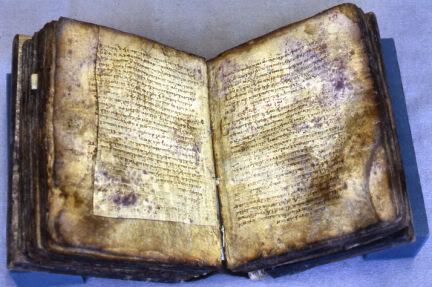
Not content with inventing the world's first computer, it seems that Archimedes (c. 287 BC – c. 212 BC) also invented calculus nearly two millennia before Newton and Liebniz worked out the mathematical details. This fact was only recently discovered after a Byzantine liturgical book was examined with modern techniques including x-ray photography. Underneath the thirteenth century Greek prayers were the partially erased traces of ancient Greek treatises by Archimedes on geometry and physics, three of which are the only known surviving copies today, and one of which is the earliest known text on calculus. The Method deals with the problem of measuring the area under a curve by slicing it into an infinite number of sections. What makes this treatise remarkable is that he chose to employ the concept of actual infinity, which was not thought to exist, instead of the more commonly used potential infinity. Newton and Leibniz followed this method as well, Leibniz with particular pride:

I am so in favour of the actual infinite that instead of admitting that Nature abhors it, as is commonly said, I hold that Nature makes frequent use of it everywhere, in order to show more effectively the perfections of its Author.

Science News has a great illustrated article on the subject, and you can find out more at the Archimedes Palimpsest Project website. There is also a book on the subject, newly out in paperback: The Archimedes Codex: How a Medieval Prayer Book Is Revealing the True Genius of Antiquity's Greatest Scientist. And stay tuned for news that Archimedes built an airplane, decoded DNA, and had a supercollider in his back yard...

Archimedes Palimpsest

via Dark Roasted Blend