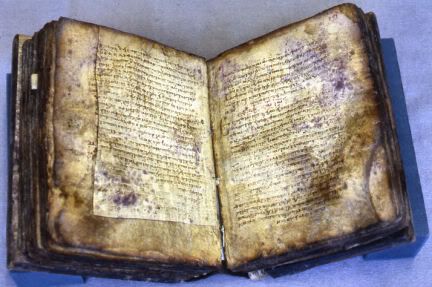
Not content with inventing the world's first computer, it seems that Archimedes (c. 287 BC – c. 212 BC) also invented calculus nearly two millennia before Newton and Liebniz worked out the mathematical details. This fact was only recently discovered after a Byzantine liturgical book was examined with modern techniques including x-ray photography. Underneath the thirteenth century Greek prayers were the partially erased traces of ancient Greek treatises by Archimedes on geometry and physics, three of which are the only known surviving copies today, and one of which is the earliest known text on calculus. The Method deals with the problem of measuring the area under a curve by slicing it into an infinite number of sections. What makes this treatise remarkable is that he chose to employ the concept of actual infinity, which was not thought to exist, instead of the more commonly used potential infinity. Newton and Leibniz followed this method as well, Leibniz with particular pride:
I am so in favour of the actual infinite that instead of admitting that Nature abhors it, as is commonly said, I hold that Nature makes frequent use of it everywhere, in order to show more effectively the perfections of its Author.
Science News has a great illustrated article on the subject, and you can find out more at the Archimedes Palimpsest Project website. There is also a book on the subject, newly out in paperback: The Archimedes Codex: How a Medieval Prayer Book Is Revealing the True Genius of Antiquity's Greatest Scientist. And stay tuned for news that Archimedes built an airplane, decoded DNA, and had a supercollider in his back yard...