Showing posts with label Reference. Show all posts

12.09.2010

Saving and Searching Words at OUP

Oxford University Press has recently updated its OED Online website and added the contents of the monumental Historical Thesaurus of the Oxford English Dictionary (which I blogged about before). It’s quite amazing that a reference work that took over 40 years to create can be put online in one year. Many public and school libraries have Oxford Online subscriptions, and you may be able to access it through your library’s website. Otherwise it costs about as much for a one-year subscription as to buy the gigantic two-volume set. It doesn’t seem to be available to buy in digital format, but perhaps that is coming later. I must confess that the books are very large and heavy, and the (necessary) semantic organization makes finding words a bit slow, so frequent users would probably find an electronic version much more convenient.

For something a little lighter, try Save the Words, a quirky web page from Oxford Dictionaries. It presents a cornucopia of worthy words in danger of extinction who are (audibly) begging to be adopted and saved. It’s great fun for all the linguistic inveteratists out there.

via Lisa Gold: Research Maven and So Many Books

10.09.2010

Dictionnaire culturel en langue française: étang

ÉTANG [etā] n.m. <av. 1150 estanc, étang v. 1460, Villon; dér. de estanchier «arrêter l’écoulement d’un liquide» (→ étancher), correspondant à l’anc. occitan estanh (v. 1280), béarnais et landai estagn, issu de lat. stagnum>

Étendue d’eau reposant dans une cuvette à fond imperméable et généralement moins vaste, moins profonde que le lac. →bassin, mare, réservoir. Étang naturels et étangs artificiels (creusés de main d’homme). «Le soir je m’embarquais sur létang, conduisant seul mon batea au milieu des joncs et des large feuilles flottantes du nénuphar» (Chateaubriand, Mémoires d’outre-tombe). Assécher, curer un étang plein de vase. Les rives, les chaussées, la poêle, le déversoir, la décharge d’un étang. Étang poissonneux.

Écho, parlant quand bruit on mène
Dessus rivière ou sus étang […] 
     Villon, Testament, «Ballade des dame du temp jadis».

L’étang reflète
Profond miroir,
La silhouette
Du saule noir.
     Verlane, la Bonne Chanson, VI

Dictionnaire culturel en langue française

How do you like a dictionary that recites poetry to you? This is the entry for “pond,” and as you can see it has a detailed etymology, with precise dates, as well as various examples of the word in prose use (italics). But it’s the two poetic quotations that give life to this entry. I’m just beginning my journey through this dictionary but already it’s obvious to me that it is alive with beauty. I thought I loved dictionaries before, but that was before I met le Dictionnaire culturel! Poor steady, stalwart OED, supplanted by a suave Gallic rival whispering poetry into my ear…

9.26.2010

From Petit Larousse to Petit Robert

A while back I blogged about the wonderful world of Larousse encyclopedic dictionaries. As I continued to delve into the world of French dictionaries I discovered, or rather rediscovered, Larousse’s main competitor, the house of Robert. I now recall seeing the Petit Robert dictionary on the desks of some of my French Immersion teachers, with it’s plain white covers and dense text—not too appealing to a young person. Larousse has traditionally geared itself towards children and families, with lots of colourful illustrations, and both common and proper nouns in the same volume, though in separate sections. Robert, on the other hand, is a more technical dictionary in two volumes (common and proper nouns separated), with more etymology and more extensive definitions, suited to the older student, professional, or translator.

Though Larousse is certainly progressive, Robert has traditionally been thought of as the more modern and up-to-date of the two publishers, and their most recent dictionaries live up to that reputation. First is the Dixel, their new annual illustrated encyclopedic dictionary (see sample pages here). It might seem to be in direct competition with the Petit Larousse but it does have some significant differences. Dixel: Le dictionnaire illustréFirst of all, common and proper nouns are listed together, with differently coloured headwords to distinguish them. This enables the reader to get a more complete appreciation of how a word is used without having to look it up twice. The publishers also tried to make the illustrations and sidebars relevant to today’s world. For example, instead of a generic spread on the world’s mammals, they have one on endangered species. The Dixel also uses photographs of famous people doing what they were famous for, instead of just a head shot. It’s a subtle difference but it reflects a philosophy of making knowledge active and connected to reality.

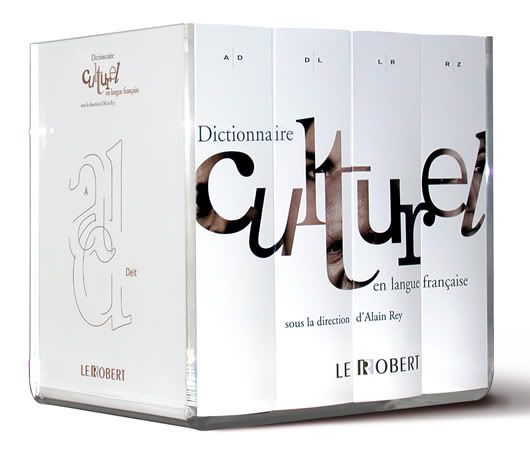
A far more significant publication is the Dictionnaire culturel en langue française (see sample pages here). This unique and monumental work is the brainchild of Alain Rey, who also edited the Dixel. It is not merely a dictionary, but a cultural dictionary, which means that in addition to giving you the technical meanings of words, it also strives to give a sense of their cultural connotations and symbolism. It’s an embodiment of the interconnection of language and culture—what words mean, to a particular people, is connected to their ideas and cultural expressions. Consequently, the Dictionnaire culturel includes quotations showing the use of words in a beautiful, literary way, not just a catalogue of historical uses in any form as in the Oxford English Dictionary. Furthermore, it does not explain the cultural significance of words in French or European culture only, but in other cultures as well, and throughout human history. As a final touch, the 9,600-page, 4-volume set is enclosed by a Plexiglas box, which is meant to signify clarity of understanding and letting the reader make of their language what they will. Fabulous, non?

Dictionnaire culturel en langue française

Alain Rey’s philosophy is that a proper knowledge of language is fundamental to any kind of work. This connection between language and what people do is what makes his dictionaries different. Dictionaries have a tendency to handle language as though in a historical vacuum, which is understandable for reference books that are intended for years, if not decades of use. But with annual dictionaries like the Petit Larousse and Dixel, and even the Dictionnaire culturel, there is more liberty to connect language with its cultural context, and thereby to bring language closer to the real life of today. I for one am very excited by this, and hope this passion for correct, creative, living, and working language catches on in the English-speaking world. Bravo, M. Rey.


Links:

Dictionnaires le Robert

Dixel: Le dictionnaire illustré

Le dictionnaire culturel en langue française

Rencontre avec Alain Rey (YouTube)

Les dicos plus à la page que jamais.

Larousse vs Robert, quel dico choisir?

7.25.2010

Últimas Adquisiciónes — Latest Acquisitions

Inspired by Spain’s World Cup victory I’ve been working on my Spanish lately. Thanks to the wonders of modern libraries I was able to download a set of audio lessons to my mp3 player and now have an idea of how to ask when the train leaves for Madrid (or better yet, Camp Nou). I’ve also been bravely slogging through websites in Spanish with the aid of the handy aFCA translation add-on.

Larousse Quod and Gran Diccionario Oxford

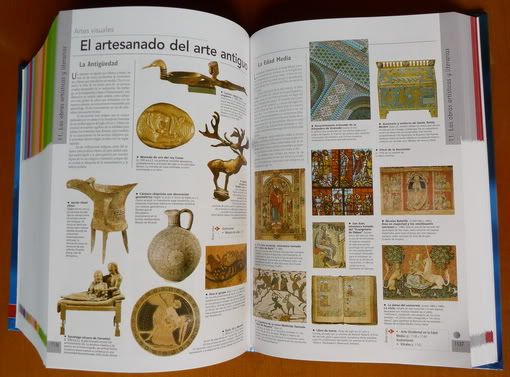
However, no learning enterprise is complete without a trip to the (virtual) bookstore. My old Spanish-English dictionary was getting dreadfully out of date, particularly with respect to information technology, so enter the Oxford Spanish Dictionary, or rather the Gran Diccionario Oxford. The books are identical except for the covers, but by some mystery of marketing the edition with the Spanish title is $9 cheaper in Canada, so that’s what I got. It is quite an improvement over my last dictionary, with large headwords in blue that are easy to scan, various bubbles and boxes with subheadings to break up large entries, lots of examples of words in use, and sidebars with helpful cultural information.

Gran Diccionario Oxford: Libro

My other new acquisition is the Larousse Quod 2009 which I mentioned at the end of a prior post. At a mere $3.08, thanks to another mystery of marketing, I couldn’t pass up the opportunity to check it out. As the cover suggests, it is a pretty slick publication. Published annually and geared towards students, it is a heavily illustrated encyclopedia arranged by topic in 11 major sections:

The Universe and the Earth
Science and Technology
The Living World
Human Health
Religions
World History
Economic Life
Human Society
Sports, Games, and Entertainment
Geopolitics
Arts and Literature

 Larousse Quod

The introduction states that the purpose of the book is help everyone participate intellectually in the development of the world and the debates of the day, as well as access the wealth of human knowledge in an enjoyable way. It is indeed very up-to-date and enjoyable to flip through (see pages from an older edition here). The only caveat is that the typeface is extremely small. Clearly this is meant for young eyes, and really there’s no other way to cram this much information into a single volume. This edition also has a slight flaw in that some of the index pages are printed in grey rather than black; it is perfectly legible but may explain the bargain price of the book. I also noticed that they included an ad for El Pequeño Larousse Ilustrado, their encyclopedic dictionary, in the section on marketing—sneaky!

British readers may chuckle at the name “Quod,” which is mean to signify who, what, when, where and why, but in Britain is slang for prison. Perhaps for this reason Larousse has renamed the book Larousse Pequeña Enciclopedia for 2010, though the book isn’t available yet. Their companion website is also unavailable, which makes me wonder if they are struggling just as other encyclopedia publishers are. Perhaps the days of randomly flipping through an encyclopedia are coming to an end. Searching online may be more efficient, but it lacks something as a relaxing pastime—it’s hunting, rather than fishing. Sometimes you just want an excuse to sit and muse for a while, and a little encyclopedia like this is just perfect for that.

7.05.2010

Petit Larousse, Grand Larousse, and Larousses In Between

Ever since I was a little kid I’ve had a thing for reference books. I remember flipping through my mom’s books of accounting tables and my dad’s “Rubber Bible” (Handbook of Chemistry and Physics) before I had any idea of what they contained. Later I spent many happy times flipping through our Columbia Encyclopedia and National Geographic World Atlas. Even now that the web has become the ultimate reference, my hankering for giant tomes of knowledge has not abated. Pound for pound and dollar for dollar, most of the books I buy are reference books.

So, while shopping for an updated Spanish-English dictionary (my old one doesn’t even have an entry for “Internet”), I stumbled across some delightful reference works from Larousse. I already have two Larousse French-English dictionaries, including the “advanced” dictionary, their largest. It is the thickest book I own, with a sturdy convex spine that seems well able to take the weight of all 2,300+ pages. Inside it has large, easy to scan headwords, extra organization for long entries, boxes with additional information on important topics (mostly historical and geographic), and a bilingual “cultural supplement,” an illustrated guide to French and English literature, art, and architecture, with additional pages on transportation, sports, technology, nature, and geography. This latter section follows in the tradition of illustrated Larousse dictionaries and encyclopedias, which I have only just come to appreciate.

petit Larousse en couleurs and Larousse Advanced French-English Dictionary
(with soccer ball for scale)

I do have an old 1980 petit Larousse en couleurs (yes, it’s capitalized, or rather, not capitalized that way), an illustrated encyclopedic dictionary only marginally thinner than my big Larousse dictionary. Perhaps I should call it a dictionary-encyclopedia because it has two sections, one for vocabulary, the other for people, places, and works of art (the first entry in the encylopedia section is Proust’s À la recherche du temps perdu). It is illustrated throughout, which makes for enjoyable flipping even if I don’t understand every word of the definitions.

Opening of petit Larousse en couleurs showing illustrations for "Impressionisme" and "imprimerie".

I found it amusing that such a large book (it weighs over 6 pounds) was called “petit,” but have since learned that this is in comparison to the Grand Dictionnaire Encyclopédique Larousse, a ten-volume encyclopedic dictionary last published in the 1980’s, and the earlier 17-volume Grand Dictionnaire Universel du XIX Siècle compiled by Pierre Larousse himself. These are not the Petit Larousse’s only big brothers, however.

Intermediate in size is the Grand Usuel Larousse, a five-volume “every day” slipcased paperback encyclopedic dictionary and atlas. Based on the 1987 Grand Larousse en 5 volumes, this set was published in 1997 and is now out of print. Smaller still is the Grand Larousse Illustré, a three-volume set published in 2005. This work really fascinates me because it had the option (only available in Europe, it seems) of automatically linking articles in the paper volumes to multimedia resources in the companion CD-ROM. It did this by way of small graphical codes printed with the text that could be read with a wireless USB scanner. Scanning one of these “chips” launched the CD-ROM on your computer and brought up the relevant material.

This seems like a remarkable innovation, especially for 2005. Stefanie recently blogged about QR codes in books, which can be scanned with a cell phone to view relevant mobile web pages, but so far only one book has been published with this technology. Larousse, which has always been a progressive publisher, was once again ahead of its time. Could this breathe new life into the paper encyclopedia? Alas, even the high-tech Grand Larousse Illustré is out of print, and Larousse has moved its reference material online. Only the Petit Larousse is alive and well after 105 years in print, with new editions every year in French and Spanish. Larousse Mexico also publishes the Larousse Enciclopedia Quod, an illustrated encyclopedia in Spanish arranged by subject, more like a textbook about everything than an A–Z encyclopedia. For some reason, Amazon is selling the 2009 Quod (list price $43.50) for a mere $3.08. Is it a typo or are the gods of reference books smiling on me (and not for the first time)? Who cares, I’ll take it!


More on Le Grand Larousse Illustré (in French):

Le Grand Larousse Illustré avec stylo multimédia

la Rousse Absolue

4.01.2010

Newest Addition to the Family

Stay tuned for more…

3.06.2010

Want.

The Oxford Companion to the Book. Two volumes, 1408 pages, a million words, 6 glorious kilograms on our favourite subject. See more details here. Let the drooling begin.

The Oxford Companion to the Book

11.17.2009

An Help Meet for the OED

And the Lord God said, It is not good that the man should be alone; I will make him an help meet for him. (Gen 2:18 KJV)

Just as it was not good for Adam to be alone in the world, so it was not good for the OED to be the solitary representative of the English language on Earth. After nearly 45 years of taking the ribs out of the OED and sorting them by kind, a group of dedicated philologists have created the perfect mate for the OED, the Historical Thesaurus of the Oxford English Dictionary (available at Amazon). Naturally it is the largest thesaurus ever produced, and the only historical thesaurus in any language. It contains all of the OED entries up to the second edition additions (they had to stop somewhere!) and is arranged semantically by a structure created specifically for this project.

I’m sure half the pleasure of the HTOED is browsing through the categories of words, but if you are looking for something in particular, there is an alphabetical index volume to go with the thesaurus. Together they form a two-volume boxed set that is about the same size as the Shorter Oxford English Dictionary. I think they would look quite handsome on the shelf together. I think it is a good sign, in these days of e-books and online references, that Oxford has published this monumental thesaurus in book form. I will most definitely be saving up my pennies to get my own copy!

Find out more about the HTOED and see a sample page here.

Historical Thesaurus of the Oxford English Dictionary

7.03.2009

“Reading the OED” by Ammon Shea

Reading the OED by Ammon SheaI’ve always considered myself something of a dictionary-lover. I have half a dozen English dictionaries, ranging in size from pocketbook to tombstone, all strategically located for specific applications. The smallest ones, both from the 50’s to capture older literary words, are next to my bed for novel-reading. A chunky little Concise Oxford from 1964 does duty in my lectory, and a Merriam-Webster’s Collegiate stands by my study desk. Finally, by my computer desk I have a Canadian Oxford and my big guns, the two-volume Shorter Oxford English Dictionary (all words used since 1700 plus Shakespeare, Milton, Spenser, and the KJV).

As it turns out, my regard for and collection of dictionaries is minuscule compared to those of Ammon Shea. He has about a thousand dictionaries (and related books) stuffed in his New York apartment, and has actually read a number of his dictionaries, cover to cover. Dictionaries are simply the love of his life. Obviously, an obsession like that could only lead to one place: the Oxford English Dictionary. Sure enough, he spent a year reading the entire 20-volume OED, and has recounted his journey in Reading the OED: One Man, One Year, 21,730 Pages.

The book consists of one chapter for each letter of the English alphabet, with a short section of prose and a selection of his favourite words from that letter. Shea writes about the OED, his love of dictionaries, and the trials of reading the OED. It takes until G to find a quiet-enough place to read (basement of a college library), and he gets such regular headaches that he comes to regard them as pleasantly familiar reading companions. The headaches abate somewhat after he breaks down and gets glasses, but his task is no less gruelling thereafter. Fuelled by gallons of coffee, he reads for something like 10 hours a day. I don’t think I could read the most engaging novels for that length of time, let alone a dictionary. The best I’ve done is read the Bible for three hours a day one Lent. Pretty paltry compared to Shea’s year-long odyssey.

I must admit I was rather disappointed with the lexicon he collected for this book. For one thing, the only information you get about each word is a short definition. There is no etymology, unless he mentions it in his annotations, and apparently copyright concerns prevented him from including any text from the actual OED, including the literary references that are its hallmark. It seems pretty short-sighted of Oxford not to allow quotations from the OED in what is more or less a book-length advertisement for it. Have you ever heard of a book about another book without any quotations? That is what we have here, and it means that the reader doesn’t really get any of the OED experience. It’s an opportunity lost, I think.

My other disappointment with the word lists is that like A.J. Jacobs, who read the Encyclopaedia Britannica, Shea devotes altogether too much attention to the things that make teenage boys giggle. He has already co-authored a book on obscure naughty words, but apparently that wasn’t enough. Not a letter went by without references to various bodily functions, and drunkenness and raunch were much in evidence also. I could have done without it.

Overall the book is light and breezy (if New York misanthropy can be light and breezy) and a very quick read. In a way it is not really for the established dictionary enthusiast. There is almost no discussion of the kind of technical work that goes into a dictionary, or indeed on the specific content of the OED. He touches on the subject when he discusses “set,” the word with the longest entry in the OED, but that’s about it. This is not a book that will tell you much about dictionaries or the OED, though Shea does provide a short bibliography with books that will.

For Shea it seems the journey is the destination. He simply enjoys reading dictionaries. No sooner had he finished reading the OED than he decided to read it again, this time without a deadline, allowing himself to look up intriguing cross-references or literary quotations. I think he might have produced a more substantial book if he had done that the first time around, but that is probably not what publishers are looking for. Feats of strength sell better than thoughtful sauntering. I guess it is up to us to do our own thoughtful sauntering.

6.28.2009

Ammon Shea: The Making of a Bibliophile

I’ve always suspected that my parents’ reasons for steering us away from TV had mainly to do with the fact that there were four of us living in a small tenement apartment, and if one person was watching TV the rest of the family had no real choice but to be exposed to it as well. Books, on the other hand, could be read without disturbing anyone else. Most evenings from my childhood that I remember consisted of each of the four of us sitting in the living room, either reading our own book, or having a book read out loud.

My parents also had the habit of reading us bedtime stories that were completely incommensurate with our age, and when my brother and I were seven and nine we were being lulled to sleep by Richmond Lattimore’s translations of the Iliad and the Odyssey, Robert Fitzgerald’s Aeneid, and Malory’s Le Morte d’Arthur. I don’t think they had the intent of educating us young, or believed that we were unduly precocious—they just read what they wanted to read, and we happened to be the ones who were listening.

I bought my first book for myself when I was ten. Stuck at a beach somewhere near the end of Cape Cod one summer, and eventually bored by the normal pursuits of summer, I happened into the clapboard shack by the parking lot that served as a combination of hot dog stand and purveyor of cheap souvenirs. In the back of the store was a shaky wire carousel full of aged paperbacks….

…I grabbed the first book that caught my eye—Three Tickets to Adventure by Gerald Durrell. It was a memoir of sorts, recounting the trials and travails of being an animal collector for zoos in the 1950s.

It was instantly the most transporting experience I could imagine. I had been an avid reader, prone to spending more time while at school in the library than in the classroom, but this was somehow different. Here, fully realized, was the idea that one could just go and find a book that one wanted to read, buy it, and get joyfully and irretrievably lost in its pages.

I suppose it helped that the book I happened upon was humorous and well written (its author to this day remains one of my favorite writers), but more important that that was the idea of escaping into a book. Suddenly it was unclear to me why people bothered to do anything besides read, unless it was of necessity.

I became obsessive about reading, and was not terribly discriminating in my tastes. Gone With the Wind interested me every bit as much as Bullfinch’s Mythology. I would find an author or a genre that seemed acceptable and proceed to shovel everything I could find into my head….

At some point my parents became concerned with the amount of time I spent reading. When I was twelve my father began kicking me out of the house on weekends so that I wouldn’t lie on the couch all day with my nose in a book. All this accomplished was to give me the impetus to go out and find new volumes to read. I would walk several miles downtown, to Fifty-firth Street and Fifth Avenue, where Doubleday had its flagship store. I was more than content to perch on an uncomfortable stool reading all day and then walk home, pretending that I’d been out and about and performing energetic childhood activities for hours.

I’ve never been prone to buying fancy clothes, or meals in nice restaurants. But I’ve always allowed myself to buy books, no matter how meager a budget I was living on at the time. Anytime I come across a book that holds the slightest potential that someday I may want to read some part of it I pick it up and bring it home. It isn’t a mania for collecting—it’s a defense against boredom. The fact that my shelves are filled with things I haven’t yet read and want to, and things that I’ve read before and want to revisit, means I will never be at a loss for entertainment at home.

—Ammon Shea, Reading the OED: One Man, One Year, 21,730 Pages

Thanks to this book I have learned some very useful and pertinent words. My favourites among these are:

Petrichor: The pleasant loamy smell of rain on the ground, especially after a long dry spell.
I love this smell and never had a word to describe it. Now I do.

Psithurism: The whispering of leaves moved by the wind.
Nice example of onomatopoeia.

Lectory: A place for reading.
See also cozy reading corner.

Onomatomania: Vexation at having difficulty in finding the right word.
Reading the OED may be the cure for this, if one can tolerate the side-effects (headaches, aphasia due to the logjam of words in one’s head, being thought strange by librarians).

3.18.2009

Orbis Pictus: English–Latin Encyclopaedia for Children

Earlier this month Project Gutenberg added the Orbis Sensualium Pictus by Johann Amos Comenius to its catalogue. It is a bilingual English–Latin encyclopaedia for children, originally published in 1657 in Dutch and later translated into English. It is said to be the first children’s picture book in print. The volume reproduced at Project Gutenberg, with all the original woodcuts, is the 11th edition from 1727, which gives you an idea of how popular this text was. It progresses logically through the elements that make up the world, humankind, farming, trades, domestic life, navigation, books and learning, astronomy, virtue, society, entertainments, war, and religion. I don’t think children today get such a well-rounded view of how their world works as the children who studied this simple book must have had. Here is an excerpt from the preface explaining the pedagogical intent:

I. To entice witty children to it, that they may not conceit a torment to be in the school, but dainty fare. For it is apparent, that children (even from their infancy almost) are delighted with Pictures, and willingly please their eyes with these lights: And it will be very well worth the pains to have once brought it to pass, that scare-crows may be taken away out of Wisdom’s Gardens.

II. This same little Book will serve to stir up the Attention, which is to be fastened upon things, and even to be sharpened more and more: which is also a great matter. For the Senses (being the main guides of childhood, because therein the mind doth not as yet raise up itself to an abstracted contemplation of things) evermore seek their own objects, and if they be away, they grow dull, and wry themselves hither and thither out of a weariness of themselves: but when their objects are present, they grow merry, wax lively, and willingly suffer themselves to be fastened upon them, till the thing be sufficiently discerned. This Book then will do a good piece of service in taking (especially flickering) wits, and preparing them for deeper studies.

Speaking of deeper studies:

Orbis Pictus

I’m not sure if Master Comenius has done a very good job of making study seem attractive to children, but I suppose staying up late to study is more fun than getting up early to milk the cow.

via LatinTeach

5.21.2008

EB and OED: To Print or Not To Print?

The New York Times Magazine recently reported that there are no plans to print a new edition of the Oxford English Dictionary.

The future is here, and the immortal O.E.D., the one that lives in bound pages last published micrographically in 1991, is obsolete — at least according to the folks who publish it. As of now, Oxford University Press has no official plans to publish a new print edition of the Oxford English Dictionary.

However, AskOxford.com presents this statement:

The Third Edition of the OED is already currently available in the form of quarterly updates of new and revised material to the OED Online (www.oed.com). This revision project is unlikely to finish before 2018.

In the future it is likely that OED Online will be the version that most people consult. However, since the present hardback edition has many fans, a new OED in traditional book form is not out of the question. It will depend on demand and printing costs when it is finished.

That doesn't sound like a categorical denial to me, but the fact that it's not assumed that Oxford will print the third edition is a little unnerving. Although I'm unlikely to ever have the space or wherewithal to get the full OED in print (I'm quite happy with the Shorter OED), it's nice to know that it's there, waiting to be consulted, in a nearby public or university library. In this age of ephemeral electronic communication, it seems even more important that our remarkable language be safely recorded in a solid and enduring form.

Naturally encyclopedias are affected by the same online phenomenon. This New York Times article gives a snapshot of the situation, with some encyclopedias going online, new encyclopedias never going into print at all, and print encyclopedias like Britannica possibly being marketed as prestige items.

At the time I got my Encyclopedia Britannica, it was looking as though the whole enterprise could go under and there might never be another printing. I'm glad I jumped on the opportunity to get one because I find it helpful when I am interested in a depth of information that is either greater or lesser than what a website like Wikipedia presents. The great innovation of the 15th edition was the Macropaedia, 17 volumes of comprehensive, sometimes book-length articles on broad topics. This is great when I want in-depth knowledge of a subject but don't want to spend hours reading online. At the other end of the scale, I often consult the Micropaedia when I want a quick and reliable overview without the detail and uneven treatment one finds in Wikipedia.

I should add that there are ways to access these venerable references online for free. My library, and perhaps yours, provides access to the complete OED online through its website. As for the Encyclopaedia Britannica, bloggers can request a free one-year subscriptions through the WebShare program. Not only will you be able to access the encyclopedia, but you will be able to link to it and your readers will also be able to access the full text of the article you linked to. Let's try it, shall we? Since I'm reading War & Peace, how about an article on Russia? I should warn you, though, that the site is littered with ads and very heavy on the Flash. Let me know if it works!

And now, for your amusement...

Lazy

11.01.2007

Neruda: Ode to the Dictionary

I happened into a book store today and the spirit of Chilean literature led me to a copy of The Poetry of Pablo Neruda. When I got the book home, it opened to this (apologies in advance for any typos):

Odo al Diccionario

Lomo de buey, pesado
cargador, sistemático
libro espeso:
de joven
te ignoré, me visitió
la suficiencia
y me creí repleto,
y orondo como un
melancólico sapo
dictaminé: "Recibo
las palabras
directamente
del Sinaí bramante.
Reduciré
las formas a la alquimia.
Soy mago."

El gran mago callaba.

Ode to the Dictionary

Back like an ox, beast of
burden, orderly
thick book:
as a youth
I ignored you,
wrapped in my smugness,
I though I knew it all,
and as puffed up as a
melancholy toad
I proclaimed: "I receive
my words
in a loud, clear voice
directly from Mt. Sinai.
I shall convert
forms to alchemy.
I am the Magus"

The Great Magus said nothing. 

El Diccionario,
viejo y pesado, con su chaquetón
de pellejo gastado,
se quedó silencioso
sin mostrar sus probetas.

Per un día,
después de haberlo usado
y desusado,
después
de declararlo
inútil y anacrónico camello,
cuando por largos meses, sin protesta,
me sirvió de sillón
y de almohada,
se rebeló y plantándose
en mi puerta
creció, movió sus hojas
y sus nidos,
movió la elevación de su follaje:
árbol
era,
natural,
generoso
manzano, manzanar or manzanero,
y las palabras
brillaban en su copa inagotable,
opacas o sonoras,
fecundas en la fronda del lenguaje,
cargadas de verdad y de sonido.

Aparto una
sola de
sus
páginas:
Caporal
Capuchón
qué maravilla
pronunciar estas sílabas
con aire,
y más abajo
Cápsula
hueca, esperando aceite o ambrosía,
y junto a ellas
Captura Capucete Capuchina
Caprario Captatorio
palabras
que se deslizan como suaves uvas
o que a la luz estallan
como gérmentes ciegos que esperaron
en las bodegas del vocabulario
y viven otra vez y dan la vida:
una vez más el corazón las quema.

Diccionario, no eres
tumba, sepulcro, féretro,
túmulo, mausoleo,
sino preservación,
fuego escondido,
plantación de rubíes,
perpetuidad viviente
de la esencia,
granero del idioma.
Y es hermoso
recoger en tus filas
la palabra
de estirpe,
la severa
y olvidada
sentencia,
hija de España,
endurecida
como reja de arado,
fija en su límite
de anticuada herramienta,
preservada
con su hermosura exacta
y su dureza de medalla.
O la otra
palabra
que allí vimos perdida
entre renglones
y que de pronto
se hizo sabroso y lisa en nuestra boca
como una almendra
o tierna como un higo.

Diccionario, una mano
de tus mil manos, una
de tus mil esmeraldas,
una
sola
gota
de tus vertientes virginales,
un grano
de
tus
magnánimos graneros
en el momento
justo
a mis labios conduce,
al hilo de mi pluma,
a mi tintero.
De tu espesa y sonora
profundidad de selva,
dame,
cuando lo necesite,
un solo trino, el lujo
de una abeja,
un fragmento caído
de tu antigua madera perfumada
por una eternidad de jazmineros,
una
sílaba,
un temblor, un sonido,
una semilla:
de tierra soy y con palabras canto.

The Dictionary,
old and heavy in its scruffy
leather jacket
sat in silence,
its resources unrevealed

But one day,
after I'd used it
and abused it,
after
I'd called it
useless, an anachronistic camel,
when for months, without protest
it had served me as a chair
and a pillow,
it rebelled and planting its feet
firmly in my doorway,
expanded, shook its leaves
and nests,
and spread its foliage:
it was
a tree,
a natural,
bountiful
apple blossom, apple orchard, apple tree,
and words
glittered in its infinite branches,
opaque or sonorous,
fertile in the fronds of language,
charged with truth and sound.

I
turn
its
pages
caporal,
capote,
what a marvel
to pronounce these plosive
syllables,
and further on,
capsule
unfilled, awaiting ambrosia or oil
and others,
capsicum, caption, capture,
comparison, capricorn,
words
as slippery as smooth grapes,
words exploding in the light
like dormant seeds waiting
in the vaults of vocabulary,
alive again, and giving life:
once again the heart distills them.

Dictionary, you are not a
tomb, sepulcher, grave,
tumulus, mausoleum,
but guard and keeper,
hidden fire,
groves of rubies,
living eternity
of essence,
depository of language.
How wonderful
to read in your columns
ancestral
words,
the severe and
long-forgotten
maxim,
daughter of Spain,
petrified
as a plow blade,
as limited in use
as an antiquated tool,
but preserved
in the precise beauty and
immutability of a medallion.
Or another
word
we find hiding
between the lines
that suddenly seems
as delicious and smooth on the tongue
as an almond
or tender as a fig.

Dictionary, let one hand
of your thousand hands, one
of your thousand emeralds,
a
single
drop
of your virginal springs,
one grain
from
your
magnanimous granaries,
fall
at the perfect moment
upon my lips,
onto the tip of my pen,
into my inkwell.
From the depths of your
dense and reverberating jungle
grant me,
at the moment it is needed,
a single birdsong, the luxury
of one bee,
one splinter
of your ancient wood perfumed
by an eternity of jasmine,
one
syllable,
one tremor, one sound,
one seed:
I am of the earth and with words I sing.

9.20.2006

Learn About Your Tongue

The Guardian has posted a list of top-ten books on the English language from linguist David Crystal. The "Quirk Grammar" and the Cambridge History of the English Language sound very tempting.

via Light Reading

8.20.2006

Sr. Miriam Joseph: Allusions

One of the rewards of literary study is the possession of a heritage of poetry and story which causes many names and phrases to echo with rich reverberations down the centuries.

—Sister Miriam Joseph, The Trivium: The Liberal Arts of Logic, Grammar, and Rhetoric

This is partly why I am endeavouring to read all the classics, though, as Sister Miriam Joseph points out, three sources in particular dominate our "heritage of poetry and story": the Bible, classical literature, and Shakespeare. She recommends that the novice make use of a concordance of the Bible, a dictionary of classical literature, and a concordance of Shakespeare. I have a couple of NRSV Bible concordances but, now that I think about it, most literary allusions in English literature would be from the King James Version, so perhaps I should invest in something like this. I believe I have classical Greece and Rome covered with my new OCD, but a concordance of Shakespeare? I had no idea such a thing existed. How delightful! A quick search turns up only one edition in print, Bartlett's Complete Concordance to Shakespeare. It's a hefty volume (7 lbs!) with a hefty price tag. I'm a fool for reference books but $20 a pound is a bit much for me. Perhaps an out-of-print concordance will do the job just as well, and they have much more interesting titles, such as:

  • A Concordance to Shakespeare: Suited to All the Editions, in Which the Distinguished and Parallel Passages in the Plays of That Justly Admired Writer Are Methodically Arranged. to Which Are Added Three Hundred Notes and Illustrations, Entirely New. (1787)
  • AN INDEX TO THE REMARKABLE PASSAGES AND WORDS; Made Use of By SHAKSPEARE; Calculated to Point Out the Different Meanings to Which the Words are Applied. (1791)
  • Complete Works of Shakespeare With Notes By Malone, Steevens, and Others Together With a Biography, Concordance of Familiar Passages, Index to Characters, and Glossary of Obsolete Terms.
    or
    Complete Works of Shakespeare - Includes Poems and Sonnets With Notes By Malone, Steevens and Others Together with a Biography, Glossary of Obsolete Terms and Concordance of Familiar Passages In Eight Volumes. (1887)
  • A Compendium and Concordance of the Complete Works of Shakespeare: Also, an Index of Every Character in the Dramas and Where They Appear. (1889)
  • A Complete Concordance Or Verbal Index to Words, Phrases and Passages in the Dramatic Works of Shakespeare: With a Supplement Concordance to the Poems. (1896)

Those dates make me wonder if there is a Shakespeare craze every hundred years or so. Perhaps the Oxford Shakespeare and it's spinoffs, the Norton Shakespeare, and the Oxford Companion to Shakespeare, are just the latest manifestations of this publishing cycle. Long live Shakespeare!

8.18.2006

A Good Dictionary

Few books are so readable as a good dictionary.

—Author unknown, from a review of Hensleigh Wedgwood's A Dictionary of English Etymology in The Living Age (No.76 (1863) 542-543), quoted at OUP Blog.

7.25.2006

Ah yes, the Hyperboreans are lovely at this time of year

I read this the other day:

When Zeus was born, Rhea entrusted the guardianship of her son to the Dactyls of Ida, who are the same as those called Curetes. They came from Cretan Ida—Heracles, Paeonaeus, Epimedes, Iasius, and Idas... Olen the Lycian, in his hymn to Achaeia, was the first to say that from these Hyperboreans Achaeia came to Delos. Then Melanopus of Cyme composed an ode to Opis and Hecaërge, declaring that these, even before Achaeia, came to Delos from the Hyperboreans. And Aristeas of Proconnesus—for he too made mention of the Hyperboreans—may perhaps have learnt even more about them from the Issedones, to whom he says in his poem that he came.

[Pausanias, Description of Greece, from A Loeb Classical Library Reader]

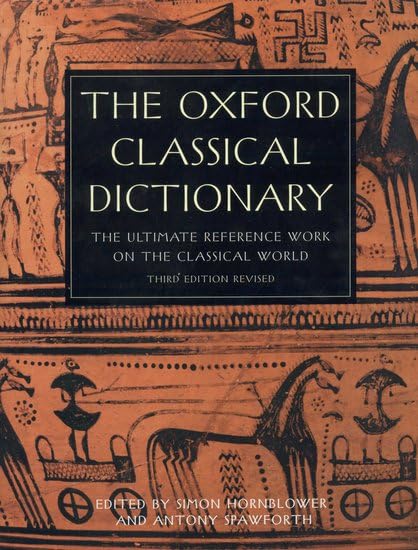
I might as well have tried to read the Greek on the facing page for all the sense this made. Zeus I know, the rest is a blur. Actually, I didn't even know Zeus had a mother, so I'm pretty much 0 for 23 on the proper nouns in this passage. What to do? Oxford Classical DictionaryBuy a book, of course! And not just any book, but a weighty tome. Behold the Oxford Classical Dictionary. This is the reference for classical studies, with 1700 pages of obscure, tongue-twisting names and scholarly articles on all aspects of ancient Greek and Roman life and culture. Perhaps it's overkill, but who cares?! I'll admit it, I have a reference book fetish, and there are few more worthy objects of desire than the OCD. Come to mama!