
If there's one thing I learned in 2007 it's that a book that starts badly will continue badly and end badly. Never again will I labour through a book that should be good but just doesn't fulfil its promise. Life is just too short and there are too many truly good books to read to waste time on a dud.
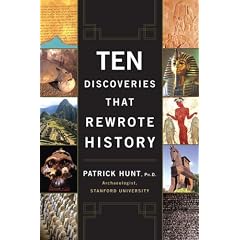
I've just had an opportunity to exercise my new discernment muscles by deciding to jettison Ten Discoveries The Rewrote History, by Patrick Hunt, after just one chapter. It was supposed to be a fascinating look at such touchstones of ancient history as the Rosetta Stone, the library of Nineveh, Pompeii, and Troy. Sadly, it proves once again that being a good scientist and being a good writer are two entirely different things.
The alarm bells started going off when I saw that the cover proclaimed that not only was the author a Ph.D., but an archaeologist, from Stanford. This seemed a bit much. I've looked at a bunch of my other nonfiction books and not one has so much as a "Dr." on the cover, even when the author is a physician!
Ten Discoveries then opens to a full page of text describing Dr. Hunt's great achievements. I skipped this, but it was the second clue that the book wasn't going to get by on its own merits. My doubts solidified after I read the stilted and awkward Acknowledgements and Introduction. Could things get better in the text itself? No, I'm afraid not. I read the chapter on the Rosetta Stone and it was dreadful. Hunt writes about the story instead of telling the story. The writing is repetitive, disorganized, vaguely hyperbolic, and generally unimaginative. Technical terms are thrown in and not explained until pages later, and things mentioned earlier are presented again as though they were a surprise.
Then there are the odd leaps of logic. He states (twice) that the content of the Rosetta Stone is "mundane," and then reveals that it declares the establishment of a royal religious cult in the name of Ptolemy V, meaning that he had the official support of the priestly class. This is mundane?! I'm no expert but this sounds to me like the height of power politics in ancient Egypt! He also goes on and on about the rivalry between the French and English cryptographers who were trying to decipher the hieroglyphs, and illustrates this by quoting from a letter from a French scientist warning an English researcher not to share too much information with the letter-writer's former protégé (who eventually succeeded in deciphering the stone). How is this French-English rivalry? It looks more like the master had a grudge against his student.
Judging by the bibliography, the research for this book was all secondary, and it shows. There is more detail (not to mention more story) about this discovery in my Encyclopaedia Britannica than in Ten Discoveries. It's such a shame because these are obviously great stories that probably can't be retold enough. Maybe a good editor could have made something of this book, but really the publisher would have been better off with a skilled no-name writer who was willing to do proper research and craft a compelling story that would take the reader back in time. Shame on them for putting Dr. Hunt in a position to embarrass himself like this, and for possibly turning people off archaeology as a result.
