
 It was not long ago that I discovered the Myers-Briggs Type Indicator (MBTI), a description of human personality based on Jung's theory of psychological types. When I first saw a description of my type, INTJ, it was as though someone had spent a week in my head and taken notes on everything that went on there. It was both liberating and embarrassing to be so well pegged. I am not so much of a mystery to myself now, but neither am I much of a mystery to anyone else!
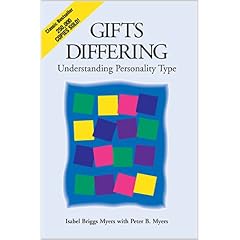
There was still some mystery for me, though, because I didn't really understand the MBTI system. I just knew it had me figured out. Now after readingGifts Differing: Understanding Personality Type by Isabel Briggs Myers (with Peter B. Myers), I wish I hadn't waited so long to find out more. It lays out with exceptional clarity the theories and research conducted by Isabel Briggs Myers and her mother Katharine C. Briggs over the course of 60 years. This is MBTI from the horse's mouth.
I will attempt to give a brief description of the system, but if it seems confusing it is entirely my fault because in the book it is crystal clear (at least to an INTJ!). The system is based on the observation (by Carl Jung) that people prefer to use their mental faculties in four specific and dichotomous ways. The first preference is between extraversion (E) and introversion (I), which I think everyone is familiar with—social butterfly versus wallflower.
The second preference is between two modes of perception, sensing (S, using the physical senses to observe actual reality) and intuition (N, using the conscious and unconscious mind to interpret symbols and perceive possibilities). The third preference is between two modes of "judging" or decision-making: thinking, T, which is based on logic and cause-and-effect relationships, and feeling, F, which is based on values of personal and interpersonal harmony.
The final preference is whether the perceiving or judging function is used when dealing with the outside world. For extraverts, this is their overall preferred function, and for introverts, it is their second-most preferred function because they reserve their overall preferred function for their interior life. In my case, the letters INTJ indicate that I am an introvert (I) who uses the thinking function (T) to deal with the outside world (indicated by the "J") but am most comfortable with using my intuitive faculty (N) inside my own head.
The book posits that these preferences are inborn and are developed as we grow so that we eventually become highly skilled at using our preferred functions. The auxiliary functions are still there and can be very useful (e.g. using feeling when dealing with people, something I'm terrible at), but they are necessarily less developed. It is especially important for introverts to develop their second-most preferred function so they can communicate to some extent with the outside world.
What the book does so well is to help the reader appreciate their non-preferred functions and see how they are necessary and valuable in certain situations. It also raised in my mind questions about intelligence. After reading this book it seems pretty clear that intelligence tests are geared towards finding how skilled a person is at intuition and thinking. As a result, NT types do consistently better on IQ tests than sensing and feeling types. The same goes for school, where the ability to perceive physical reality and concern for other people's feelings don't show up on your report card. This obviously causes feelings of low worth which can cause all sorts of problems, particularly for the SF types.
I think our democratic ideals get in the way of addressing these issues openly. We don't want to admit that some people will never do well on IQ tests (as they are now constructed), and maybe they will be happiest if they are not forced to take academic classes and instead streamed towards the trades or other occupations where their preferred functions will be useful and appreciated.
This may also bear on the recent library discussion. Some say that it's good to provide bestsellers because at least people are reading something, but perhaps reading pulp is not the best use of their human potential. Maybe these people would really be happier and contribute more to the common good by playing hockey or gardening or talking on the phone with their relatives.
The book goes a long way to restoring dignity to functions that are not particularly valued or rewarded in our society. A mechanic may be no less skilled than a neurosurgeon, but we all know how they rate on the socioeconomic ladder.
I should also add that only one of the preferences shows sexual differentiation. About 75% of men are of the thinking type, and 75% of women are of the feeling type. I'm sure I don't have to tell you all that this is a major source of friction in romantic relationships, but again, the book gives suggestions on how each type can learn to appreciate, communicate with, and benefit from the opposing type.
There is so much more in the book I could talk about—early childhood development, education, careers—and it definitely deserves to be re-read carefully. There are no doubt other books out there with all the latest research and insights into the MBTI system but this was certainly a good, clear, simple, and respectful introduction and I highly recommend it to anyone who wants to understand our crazy species a little better.
